
Automatically apply for jobs with Zippia
Upload your resume to get started.
Pediatric clinical dietician skills for your resume and career

14 pediatric clinical dietician skills for your resume and career
1. Patients
- Administered Medication, conducted assessments, assisted with activities of daily living, comforted patients
- Delivered care to patients of various ages and development stages on the Pediatric unit, PICU, and NICU.
2. Occupational Therapy
- Assisted in providing pediatric occupational therapy services Organized and lead occupational therapy pediatric group sessions
- Documented occupational therapy services to ensure accountability of service provision and to meet standards of reimbursements of services as appropriate.
3. Early Intervention
- Provided services for early intervention program.
- Worked in five programs: early intervention, assessment, integrated preschool, community resource and clinic.
4. Physical Assessments
- Conducted focused physical assessment including neurological, cardiovascular, respiratory, sensory motor and nutritional status, vaccination screening and administration.
- Practiced conducting patient interviews and performed complete physical assessments including objective and subjective data for patients with various chronic conditions.
5. Patient Care
Patient care entails the diagnosis, recovery, and control of sickness as well as the maintenance of physical and emotional well-being through the use of healthcare providers' services. Patient care is described as services provided to patients by health practitioners or non-professionals under guidance.
- Collaborated with other professional disciplines to ensure effective and efficient patient care delivery and the achievement of desired patient outcomes.
- Provided family members with emotional support and education in areas such as patient care and adaptation to disability and/or illness.
6. EMR
- Utilized EMR to both gather information and document patient assessments and medication.
- Operated the EMR system with proficiency to assist in the proper care of patients.
Choose from 10+ customizable pediatric clinical dietician resume templates
Build a professional pediatric clinical dietician resume in minutes. Our AI resume writing assistant will guide you through every step of the process, and you can choose from 10+ resume templates to create your pediatric clinical dietician resume.7. Vital Signs
Vital signs are a set of values indicating different body systems' performance. They are measurements of the body's most basic functions. The four major vital signs used in medicine to assess a patient are body temperature, pulse rate, respiration rate, and blood pressure.
- Provided basic care, including vital signs, hygienic and nutritional care to children experiencing a variety of medical-surgical health alterations.
- Obtained vital signs, complete assessments, administered medication, immunizations, injections as directed by Attending physicians and/or Pediatric Residents.
8. Medication Administration
- Implemented nursing care of children, and adolescents in assessments, wound care, tracheostomy care and suctioning and medication administration
- Care encompassed medication administration, tracheostomy care, nebulizer treatments, chest physiotherapy, and basic activities of daily living.
9. Tracheostomy
- Performed tracheostomy care and suctioning for ventilator dependent patients.
- Gained experience in tracheostomy suctioning.
10. IV
- Prepared patients for procedures, initiated and maintained medication and IV therapy, prepared equipment and assisted physicians.
- Monitored IV medications, telemetry monitors, and ventilators while maintaining strict adherence to isolation and infection-protection protocol.
11. Patient Education
- Provided patient education, monitored physical condition, planned and implemented care based on needs and initiated emergency procedures when indicated.
- Serve as Charge Nurse/Patient Care Coordinator facilitating admissions, discharges, patient education and perform medical rounds with multidisciplinary teams.
12. Surgery
- Conducted full assessments on children recovering from orthopedic surgery.
- Operate heart-lung to regulate blood circulation, composition, administered drugs and anesthetic agents, and controlled body temperature during surgery.
13. IM
IM or intramuscular literally means, ‘situated or taking place within, or administered into, a muscle.' Medical professionals use IM as an abbreviation when referring to intramuscular injections. In the field of medicine, injecting a substance into a muscle is one of several methods for the administration of medications.
- Provide parents/family teaching Administer medication ( orally, IM ) Performed pediatric assessment Collaborated Registered nurses in Intravenous catheter insertions
14. Catheter
- Gained experience in procedures such as urinary catheter insertion on a female and fetal heart rate monitoring and interpretation.
- Provide catheter care and a variety of injections for patients with autoimmune metabolic illnesses and urinary dysfunction.

What skills help Pediatric Clinical Dieticians find jobs?
Tell us what job you are looking for, we’ll show you what skills employers want.
List of pediatric clinical dietician skills to add to your resume
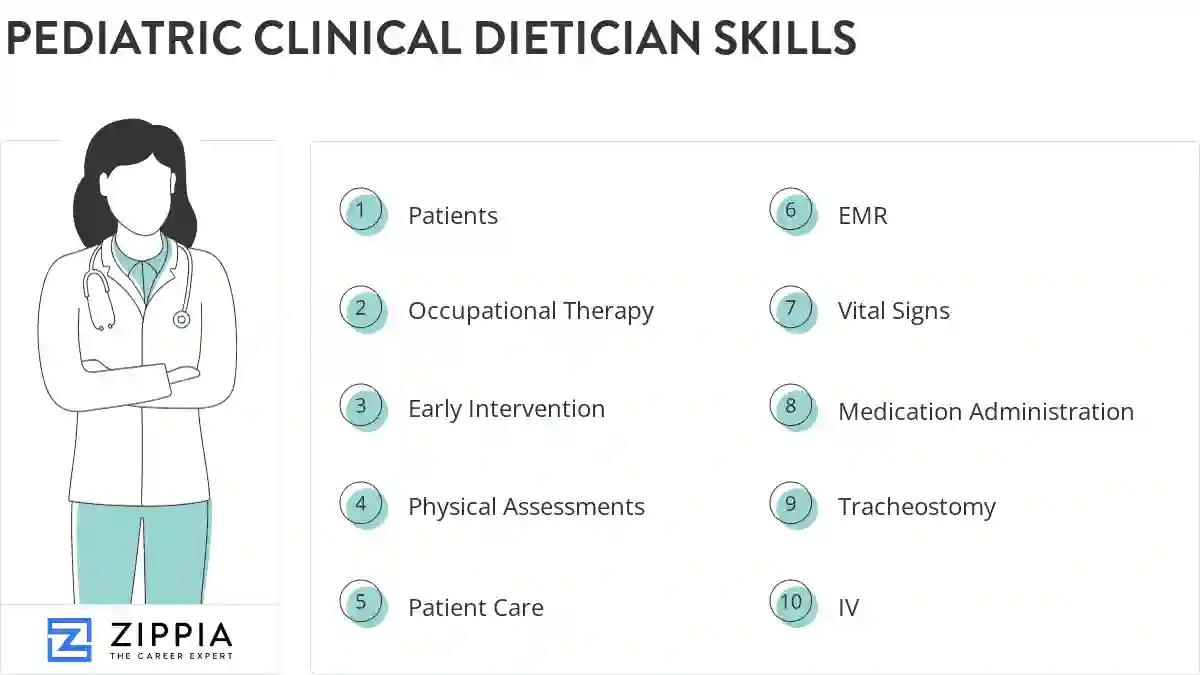
The most important skills for a pediatric clinical dietician resume and required skills for a pediatric clinical dietician to have include:
- Patients
- Occupational Therapy
- Early Intervention
- Physical Assessments
- Patient Care
- EMR
- Vital Signs
- Medication Administration
- Tracheostomy
- IV
- Patient Education
- Surgery
- IM
- Catheter
Updated January 8, 2025
