
Automatically apply for jobs with Zippia
Upload your resume to get started.
Performance engineer skills for your resume and career

15 performance engineer skills for your resume and career
1. Java
Java is a widely-known programming language that was invented in 1995 and is owned by Oracle. It is a server-side language that was created to let app developers "write once, run anywhere". It is easy and simple to learn and use and is powerful, fast, and secure. This object-oriented programming language lets the code be reused that automatically lowers the development cost. Java is specially used for android apps, web and application servers, games, database connections, etc. This programming language is closely related to C++ making it easier for the users to switch between the two.
- Prepared and executed functional test through SilkTest and Mercury QuickTest on Java application.
- Developed enhancements to a Java based performance automation framework.
2. Linux
Linux is a Unix-like operating system. Just like Windows, Mac OS, and IOS, Linux is an operating system used by millions across the globe. Android itself is powered by the Linux operating system. Linux manages all the hardware resources that are associated with your computer. The software is famous because of the protection it grants from viruses, malware, and crashes. The Linux operating system is entirely free and is an open-source software meaning it can be altered by those equipped with the knowledge to code.
- Developed system RAM usage profiling utility for an embedded Linux platform.
- Aided in developing custom Linux distributions.
3. Performance Issues
The failure to meet the basic requirements of a job is called a performance issue. These issues are measured based on policies company culture and job objectives. Performance issues can broadly fall into either one or more categories quantity of work, quality of work, inappropriate behavior, and resistance to change.
- Developed and coordinated implementation of client-approved action plans to address network performance issues and capacity concerns.
- Provided valuable and timely feedback early in development cycle to identify potential performance issues.
4. Performance Analysis
Performance analysis is a discipline that involves methodical observations to boost performance and enhance decision making, largely delivered through objective statistical and data analysis.
- Produced production and development batch job activity and turnaround for daily and monthly reporting, performance analysis and service level agreements.
- Create process documents for the production issue root-cause analysis from the Business monitoring dashboards to Production support dashboards and performance analysis
5. Profiling
- Developed application and system profiling strategies.
- Install and configure diagnostic tools (HP Diagnostics and DynaTrace Diagnostics) and send profiling information to development teams for tuning.
6. JMeter
- Involved in setting up the JMETER tool on various environments.
- Based on business/functional specification execution of automated tools using Jmeter.
Choose from 10+ customizable performance engineer resume templates
Build a professional performance engineer resume in minutes. Our AI resume writing assistant will guide you through every step of the process, and you can choose from 10+ resume templates to create your performance engineer resume.7. CPU
- Identified and analyzed system bottlenecks like CPU utilization and Memory utilization with the help of DynaTrace.
- Identified and analyzed system bottlenecks like CPU utilization and Memory utilization.
8. Splunk
- Used Splunk to look at errors in server logs and communicated those errors to technical team and developers.
- Used Splunk for searching different events, exceptions from web logs and created dashboard for monitoring.
9. Test Results
- Define limits for performance related system tests and review system development/qualification test results to validate the design analysis.
- Created comprehensive performance test results report, and participated in meeting to certify application for production readiness.
10. Dynatrace
- Monitored and analyzed system performance during load tests using SiteScope and DynaTrace.
- Performed front-end testing using Firebug and DynaTrace browser agents.
11. Unix
UNIX is a computer operating system that was first created in the 1960s and has been constantly updated since then. The operating system refers to the set of programs that enable a machine to function. It is a multi-user, multi-tasking device that works on computers, laptops, and servers. UNIX systems also have a graphical user interface (GUI), similar to Microsoft Windows, that makes it simple to use.
- Provide statistical and impact analysis for new and existing business in Stratus VOS and Sun and IBM Unix Systems.
- Maintained unattended performance test automation and reporting systems using Python, TCL, Perl and various Unix Shells scripts.
12. Debugging
- Involved in Performance testing, debugging, executing, analyzing complex applications using HP LoadRunner and HP ALM Performance Center.
- Read and understand the Log files to verify the processes for debugging and/or test data verification purposes.
13. Test Data
- Test data preparations and developing utilities to automate the data conditioning process.
- Executed drive testing and perform optimization activities by analyzing drive test data.
14. Capacity Planning
Capacity planning is the process or method that balances the available hours of team members against the project or program that they need to accomplish. It comprises the resources to do the work or project and the necessities to complete a particular task. Capacity planning assesses the resources and the skill of the team to decide whether to hire or purchase additional resources, defer or delay the project, push through with it or cancel the project.
- Supported project management office in Technical Design decision making by providing application and environment performance and analysis and capacity planning.
- Make recommendations related to capacity planning for network systems and customer connectivity* Act as point-of-escalation and contact for leadership as needed
15. Web Services
A web service is software that is available on the internet and uses a specific messaging system. A web service is a kind of service that is not bound to any specific programming language or operating system. Web services help every device to communicate over the world wide web.
- Designed and developed Web Services for integrating with Common Origination and Disbursement system.
- Performed functional testing of web service using the SOAPUI in a single test environment and directly used WSDL from the developers.
5 Performance Engineer resume examples
Build a professional performance engineer resume in minutes. Browse through our resume examples to identify the best way to word your resume. Then choose from 5+ resume templates to create your performance engineer resume.

What skills help Performance Engineers find jobs?
Tell us what job you are looking for, we’ll show you what skills employers want.
What performance engineer skills would you recommend for someone trying to advance their career?
Junping Sun Ph.D.
Professor, Nova Southeastern University
List of performance engineer skills to add to your resume
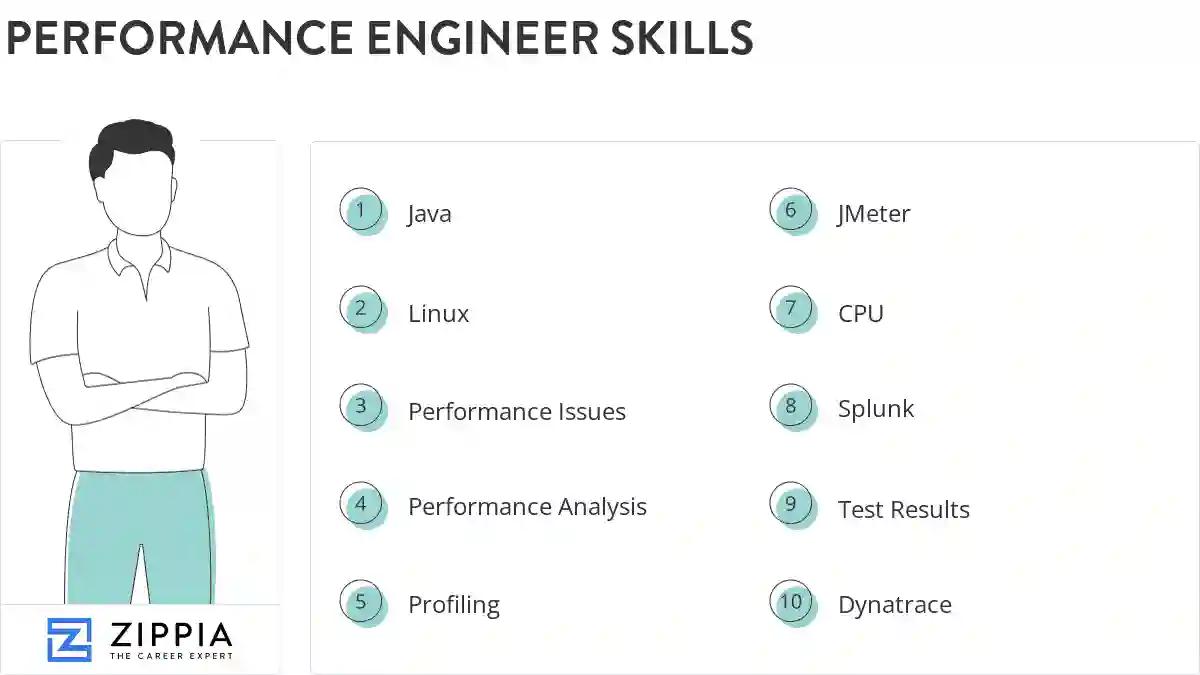
The most important skills for a performance engineer resume and required skills for a performance engineer to have include:
- Java
- Linux
- Performance Issues
- Performance Analysis
- Profiling
- JMeter
- CPU
- Splunk
- Test Results
- Dynatrace
- Unix
- Debugging
- Test Data
- Capacity Planning
- Web Services
- QA
- Visualization
- Test Scripts
- Performance Bottlenecks
- SQL Server
- Test Scenarios
- Jenkins
- Azure
- Test Cases
- Ruby
- Macro
- Load Test
- DB
- JVM
- UI
- Jira
- Web Application
- XML
- Test Execution
- I/O
- J2EE
- Test Strategy
- Stress Tests
- End User Experience
- Endurance
- SLA
- Regression
- Virtualization
- IIS
- Citrix
- Http
- HTML
Updated January 8, 2025
