
Automatically apply for jobs with Zippia
Upload your resume to get started.
Phlebotomy program coordinator skills for your resume and career
15 phlebotomy program coordinator skills for your resume and career
1. Patient Care
Patient care entails the diagnosis, recovery, and control of sickness as well as the maintenance of physical and emotional well-being through the use of healthcare providers' services. Patient care is described as services provided to patients by health practitioners or non-professionals under guidance.
- Applied knowledge of regulations applicable to patient care and other department functions to achieve quality improvement and patient satisfaction
- Orchestrate daily operations, strategically planning and coordinating workflow to simultaneously enhance profitability, patient care, and customer satisfaction.
2. Laboratory Services
Laboratory services provide an advisory service and a full range of diagnostic tests and clinical services that perform tests on clinical specimens to obtain information about a patient's health to aid in the diagnosis, treatment, and prevention of disease.
- Developed relationships with physician offices increasing awareness of services provided.Coordinator for laboratory services for home bound geriatric and special needs patients.
3. Patients
- Monitored nightly staff to ensure that patients had blood drawn in a timely and efficient manner.
- Draw blood from inpatient, outpatient and patients admitted to the emergency room.
4. Quality Improvement
Quality improvement (QA) is a systematic approach to eliminate or reduce rework, wastes, and losses in the production process. It is part of quality management, which aims to increase the ability to meet quality requirements. It manages change and uses data for making decisions to improve policies, programs, and results.
- Assist management in the implementation of new QC/QA policies and continuous quality improvement programs.
5. OSHA
- Train and coach current and new staff on Service Operation Procedures (SOP), safety regulations and OSHA regulations.
- Assured area is in compliance with CAP, JCAHO and OSHA regulations.
6. Phlebotomy Training
- Provide phlebotomy training to enhance workplace performance at all levels of staffing.
- Completed phlebotomy training, finishing all coursework and lab training receiving grades at the top of the class.
Choose from 10+ customizable phlebotomy program coordinator resume templates
Build a professional phlebotomy program coordinator resume in minutes. Our AI resume writing assistant will guide you through every step of the process, and you can choose from 10+ resume templates to create your phlebotomy program coordinator resume.7. Syringes
- Experience using needles, syringes, and other equipment.
- Prepared patient rooms, syringes and correct pallet dosage for surgical procedures.
8. QC
Quality control is a set of instructions or procedures to ensure a manufactured product or a service is up to the highest quality standards. This set of quality control criteria are either defined by the clients or the company itself.
- Implemented use, maintenance, and QC of I-stat instrument.
9. Customer Service
Customer service is the process of offering assistance to all the current and potential customers -- answering questions, fixing problems, and providing excellent service. The main goal of customer service is to build a strong relationship with the customers so that they keep coming back for more business.
- Established a strong working relationship with both internal and external customers by delivering excellent customer service.
- Maintain a strong customer service orientation, providing empathetic customer support.
10. Computer System
- Developed and oversaw retirement plan program, including training, compliance and coordination with other financial institutions in shared computer system.
- Plan and produce informational and promotional materials; update website and computer system with inventory and schedules to keep community informed.
11. EKG
- Performed procedures and uses equipment as delegated by a licensed professional, including blood draws, and EKG's.
- Experience with EKG, including correct placement of electrodes, patient ease and procedure guidance.
12. Blood Samples
A blood sample is a specimen of blood extracted from the body of an organism to run laboratory tests on it. Lab tests are conducted to determine if a person has optimum mineral content and has no illness. Blood is extracted from the vein with the help of a hypodermic needle. The blood is then analyzed to perform multiple tests such as; glucose tests, cholesterol tests, hemoglobin tests, blood count tests.
- Collect blood samples ,process, package, and ship all specimens.
- Process and separates blood samples for Chemistry and Hematology Examinations.
13. Drawing Blood
- Worked in the Oncology, upstairs, and main lab drawing blood.
- Obtained and verified patient information prior to drawing blood.
14. Test Results
- Verify and enter test results.
- Scan test results into SRS.
15. Disciplinary Actions
Disciplinary actions refer to a corrective measure taken against an employee for unsatisfactory behavior. Many work environments have a tiered system for disciplinary action, where the first warning is verbal and the second is written. Disciplinary action may be given after a weak performance review, a violation of company rules and policies, or a poor customer review.
- Scheduled phlebotomist and clerical staff to assure adequate staffing, trained new employees, ordered supplies, written performance and disciplinary actions
5 Phlebotomy Program Coordinator resume examples
Build a professional phlebotomy program coordinator resume in minutes. Browse through our resume examples to identify the best way to word your resume. Then choose from 5+ resume templates to create your phlebotomy program coordinator resume.

What skills help Phlebotomy Program Coordinators find jobs?
Tell us what job you are looking for, we’ll show you what skills employers want.
What type of skills will young phlebotomy program coordinators need?
John Marston
Associate Professor and Director, Archaeology Program, Boston University
List of phlebotomy program coordinator skills to add to your resume
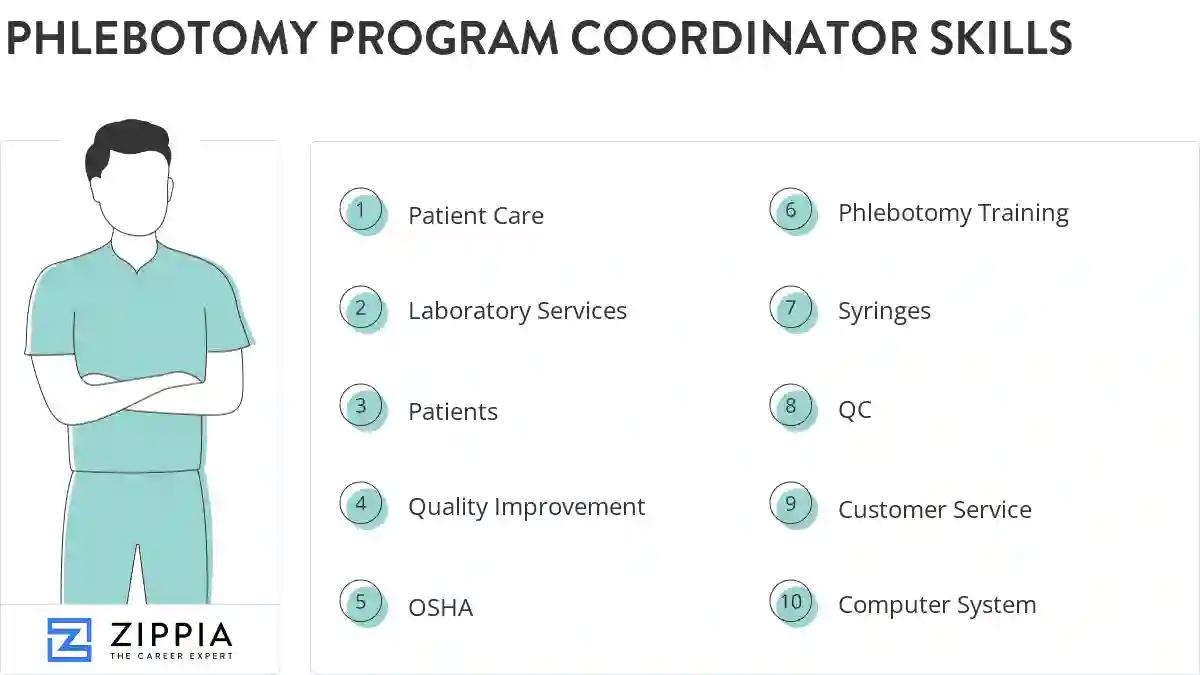
The most important skills for a phlebotomy program coordinator resume and required skills for a phlebotomy program coordinator to have include:
- Patient Care
- Laboratory Services
- Patients
- Quality Improvement
- OSHA
- Phlebotomy Training
- Syringes
- QC
- Customer Service
- Computer System
- EKG
- Blood Samples
- Drawing Blood
- Test Results
- Disciplinary Actions
- Blood Cultures
- Computer Operations
- Hippa
- Blood Collection
- Client Satisfaction
- Lab Draws
- I-Stat
Updated January 8, 2025
