
Automatically apply for jobs with Zippia
Upload your resume to get started.
Photo technologist skills for your resume and career
15 photo technologist skills for your resume and career
1. Customer Service
Customer service is the process of offering assistance to all the current and potential customers -- answering questions, fixing problems, and providing excellent service. The main goal of customer service is to build a strong relationship with the customers so that they keep coming back for more business.
- Cashier Receive and register payment for merchandise sold Reconcile cash/credit care receipt transactions Re-stock shelves when needed Provided customer services
- Provided customer service, assisted customers in specific photo needs, and operated high quality photo developing instruments.
2. Customer Orders
- Sorted, organized, and filed customer orders and photos while maintaining customer confidentiality.
- Organized and fulfilled customer orders* Organized editing for customers* Maintained strong customer relationships
3. Sales Floor
The sales floor is the area in a company or a business that is specified for retail activities or is designated as the selling area of the shop. A car showroom can be considered a sales floor, as it has cars in its display which are to be sold. A sales floor is generally crowded with sales assistants who are there to help you out while you can search and check out the products. Generally a sales floor has free access to the public and they can observe, view and get information about the product that is being sold.
- Expected to train new employees in the photo lab, on the register, and in all other sales floor requirements.
- Coordinate other employees' duties on the sales floor and mentor new employees in customer service and technical training
4. Troubleshoot
Troubleshooting is the process of analyzing and fixing any kind of problem in a system or a machine. Troubleshooting is the detailed yet quick search in the system for the main source of an issue and solving it.
- Trained to use and troubleshoot all types of photo processing equipment.
- Learned to use and troubleshoot photo-printing machine.
5. Stock Shelves
To "stock shelves" is referred as the process of putting the supplies on the shelves in the store. It is important to stock the shelves timely as empty shelves can cost a business too much.
- Process photos, make posters, canvas, cashier, stock shelves, tag merchandise, check for markdowns, inventory
- Stock Shelves, cashier, process photos, stock freezer, inventory and order photo supplies, clean photo area
6. POS
POS is an abbreviation of "Point of Sale" which is the time and place where a customer completes a transaction. It can either be a physical shop that consists of POS terminals or a virtual shop. A POS system helps simplify the retail functions and track important sales data.
- Processed orders Maintained equipment POS Worked daily to keep inventory correct
- Worked collaboratively in a team of 40 to drive sales and minimize error at POS.
Choose from 10+ customizable photo technologist resume templates
Build a professional photo technologist resume in minutes. Our AI resume writing assistant will guide you through every step of the process, and you can choose from 10+ resume templates to create your photo technologist resume.7. Equipment Maintenance
Equipment maintenance is any process that includes the use of maintenance methods and procedures to keep the organization's equipment in good and reliable working condition. This may include routine maintenance as well as corrective repairs. The practice takes place in a variety of settings, including catering establishments, industrial factories, manufacturing facilities, hotels, etc.
- Performed regular equipment maintenance and/or any troubleshooting malfunctions.
- Worked in Photography warehouse doing equipment maintenance/repair.
8. Detect Malfunctions
Detect Malfunctions commonly known as Fault Detection, Isolation, and Recovery (FDIR) is a control theory that evaluates the timing and type of faults happening within a system. Faults are detected either when sensor readings show some unique patterns or when there is a variance going beyond the expected value's threshold.
- Clean and maintain photo processing equipment, using cleaning and rinsing solutions Monitor equipment operation to detect malfunctions.
- Loaded digital images onto computers directly from cameras and/or similar devices Monitored equipment operation to detect malfunctions
9. Quality Standards
Quality standards are a specific level of standards of products that are set by the companies for the customers that have to be met and maintained throughout the process until the time of delivery. Quality standards are information that includes the customer's requirements, guidelines, and characteristics for the needed final product or service.
- Removed completed work from equipment and examined circuit boards, plates, film, and prints for conformance to quality standards.
- Work with project managers in maintaining budgets, safety, & quality standards.
10. Customer Complaints
- Handled customer complaints, and resolved the issues in a quick and beneficial matter.
- Maintained low rate of mixes and damages, resulting in lowering customer complaints.
11. Circuit Boards
A circuit board refers to an electronic device used to offer mechanical support and connect components electrically using signal traces and conductive pathways.
- Printed and developed film of circuit designs for use in fabricating printed circuit boards, using photographic equipment and proper chemicals.
- Loaded circuit boards, racks and rolls of film, negatives and printing paper into processing and printing machines.
12. Digital Images
- Provide customer satisfaction* Help customers critique digital images* Process customers' creative photo orders
- Increased quality and efficiency of digital images by revising scanning procedures.
13. Routine Maintenance
- Performed routine maintenance on all laboratory photo machines.
- Perform routine maintenance on photo processing equipment.
14. Fuji
- Performed maintenance, calibration & chemical balance of Fuji Digital Photo Processing Equipment
- Maintained department monitor color calibration and FUJI F922AL film processors
15. Processing Machines
- Maintained processing machines for cleanliness and efficacy, troubleshot mechanical and technological malfunctions.
- Developed and produced special photo restorations and use of photo processing machines.
5 Photo Technologist resume examples
Build a professional photo technologist resume in minutes. Browse through our resume examples to identify the best way to word your resume. Then choose from 5+ resume templates to create your photo technologist resume.

What skills help Photo Technologists find jobs?
Tell us what job you are looking for, we’ll show you what skills employers want.
List of photo technologist skills to add to your resume
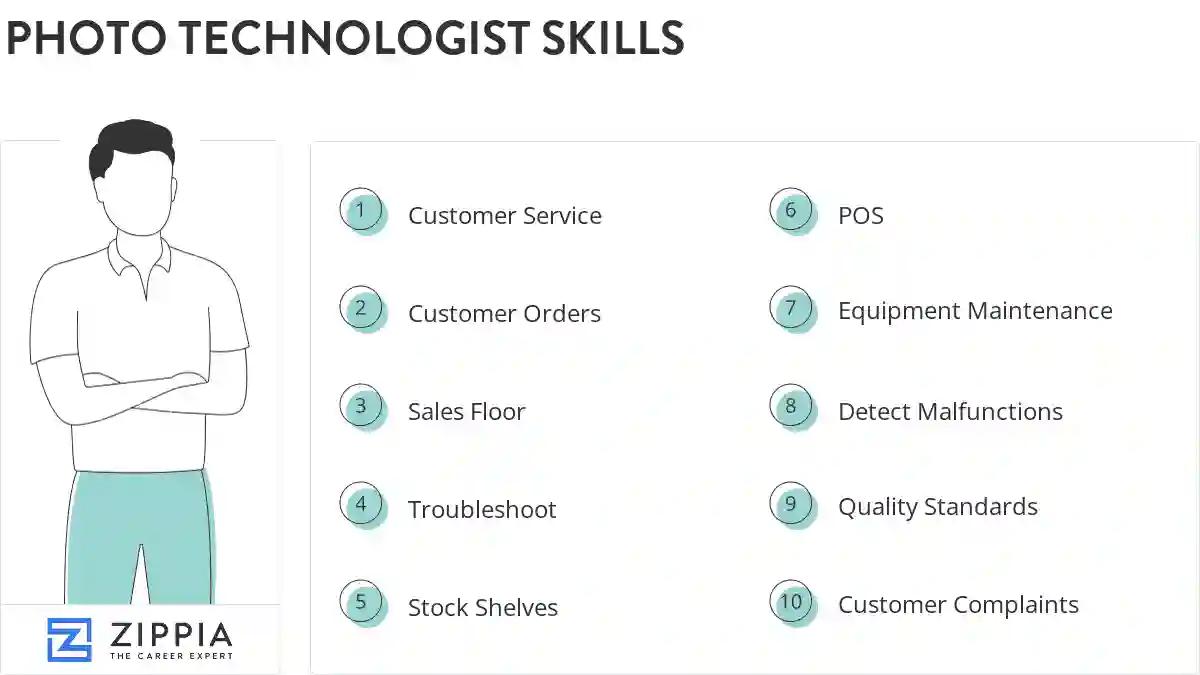
The most important skills for a photo technologist resume and required skills for a photo technologist to have include:
- Customer Service
- Customer Orders
- Sales Floor
- Troubleshoot
- Stock Shelves
- POS
- Equipment Maintenance
- Detect Malfunctions
- Quality Standards
- Customer Complaints
- Circuit Boards
- Digital Images
- Routine Maintenance
- Fuji
- Processing Machines
- Customer Specifications
- Computer Software
- Inventory Control
- Customer Inquiries
- Stock Room
- Equipment Operation
- Cash Drawers
- Photographic Equipment
- USB
- Digital Cameras
- Quality Customer Service
- Film Processing
- Photo Booth
- Kodak
- Photographic Techniques
- Digital Photos
- Photo Books
- Solution Integrity
- Greeting Cards
- Credit Card Transactions
- Cash Registers
- Photographic Prints
- Print Photos
- Store Inventory
- Digital Print
- Passport Photos
Updated January 8, 2025
