Explore jobs
Find specific jobs
Explore careers
Explore professions
Best companies
Explore companies
What is a piping engineer and how to become one
Do you spend a lot of time thinking about what's beneath the sidewalks you walk on? Because piping engineers do. Piping engineers build and maintain the vast network of pipes beneath our streets that bring oil, gas, and water to our homes and transport waste away from them.
Piping Engineers are responsible for every step of the process when it comes to installing or maintaining pipes, from surveying prospective sites to developing blueprints to assisting with cost management so that the project remains within budget. Piping engineers can work for private companies such as Exxon or local governments looking to expand their services.
One does not become a piping engineer overnight. Making a mistake during this process could cause big problems, especially for people living near the pipes, so a piping engineer needs to be well educated and trained. Most (but not all) piping engineers have bachelor's degrees and several years of experience in engineering before they break out the blueprints.
What general advice would you give to a piping engineer?
Dr. Harvey Hoffman
Associate Dean of Engineering, Fairfield University
A professional in any field must continue to learn. Your engineering degree gave you the necessary tools. You must engage in lifelong learning to increase your knowledge and improve your skills and competencies to set yourself apart.
Avg. Salary $107,432
Avg. Salary $59,228
Growth rate 2%
Growth rate 0.3%
American Indian and Alaska Native 0.11%
Asian 16.66%
Black or African American 3.06%
Hispanic or Latino 7.80%
Unknown 4.51%
White 67.87%
Genderfemale 9.82%
male 90.18%
Age - 39American Indian and Alaska Native 3.00%
Asian 7.00%
Black or African American 14.00%
Hispanic or Latino 19.00%
White 57.00%
Genderfemale 47.00%
male 53.00%
Age - 39Stress level is high
7.1 - high
Complexity level is advanced
7 - challenging
Work life balance is fair
6.4 - fair
Piping engineer career paths
Key steps to become a piping engineer
Explore piping engineer education requirements
Start to develop specific piping engineer skills
Skills Percentages CAD 8.23% Engineering Design 7.58% API 7.06% Pipe Stress Analysis 5.98% Caesar II 5.79% Complete relevant piping engineer training and internships
Accountants spend an average of 1-2 years on post-employment, on-the-job training. New piping engineers learn the skills and techniques required for their job and employer during this time. The chart below shows how long it takes to gain competency as a piping engineer based on U.S. Bureau of Labor Statistics data and data from real piping engineer resumes.Research piping engineer duties and responsibilities
- Manage and maintain CADWorx databases, verify data accuracy, and create reports and queries.
- Manage Jenkins security by providing specific access to authorize developers/testers using project base matrix authorization strategy.
- Oversee both utility and process piping and supports using AutoCAD, CadWorx, CloudWorx and AutoPLANT.
- Attend meetings conducting 3D model reviews utilizing Navisworks 2014 for both clients.
Get piping engineer experience
Generally, it takes 4-6 years to become a piping engineer. The most common roles before becoming a piping engineer include mechanical engineer, piping designer team lead and stress engineer.Prepare your piping engineer resume
When your background is strong enough, you can start writing your piping engineer resume.
You can use Zippia's AI resume builder to make the resume writing process easier while also making sure that you include key information that hiring managers expect to see on a piping engineer resume. You'll find resume tips and examples of skills, responsibilities, and summaries, all provided by Zippi, your career sidekick.
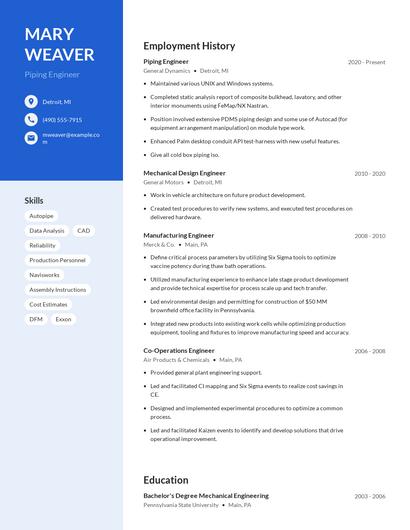
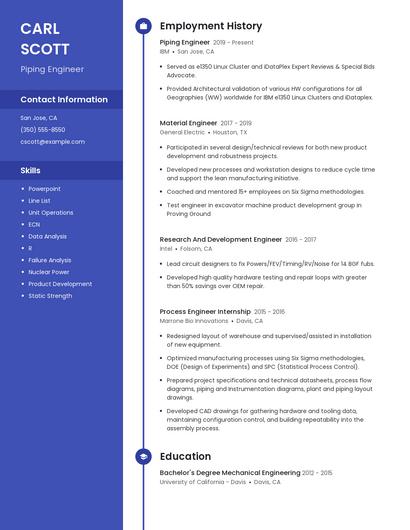
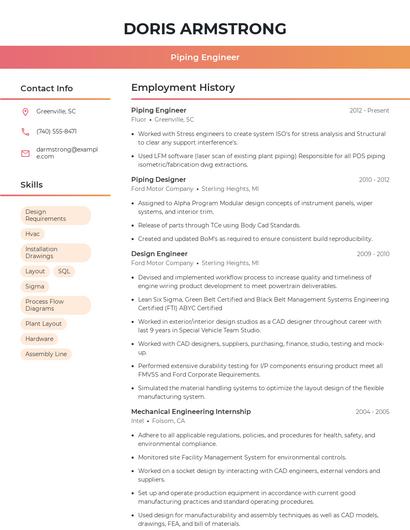
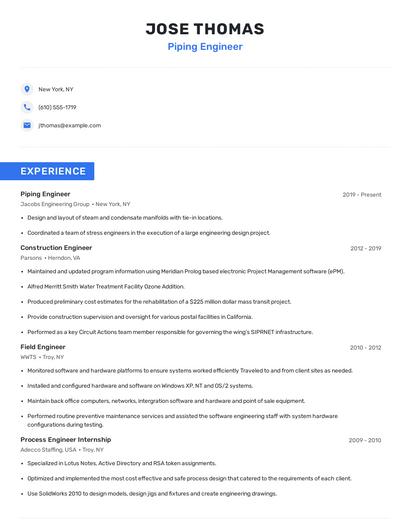
Choose from 10+ customizable piping engineer resume templates
Build a professional piping engineer resume in minutes. Browse through our resume examples to identify the best way to word your resume. Then choose from 10+ resume templates to create your piping engineer resume.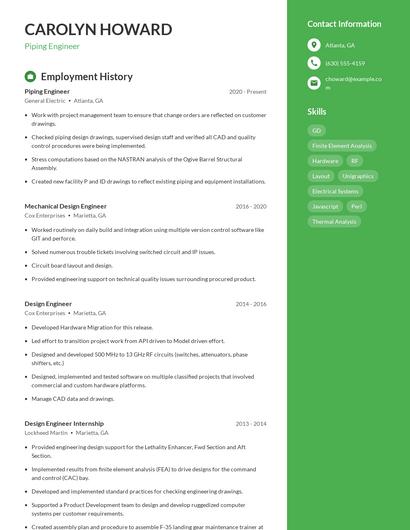
Apply for piping engineer jobs
Now it's time to start searching for a piping engineer job. Consider the tips below for a successful job search:
- Browse job boards for relevant postings
- Consult your professional network
- Reach out to companies you're interested in working for directly
- Watch out for job scams
How did you land your first piping engineer job

Are you a piping engineer?
Share your story for a free salary report.
Average piping engineer salary
The average piping engineer salary in the United States is $107,432 per year or $52 per hour. Piping engineer salaries range between $75,000 and $153,000 per year.
What am I worth?

How do piping engineers rate their job?
Piping engineer reviews

very little
I liked working in oil and gas at Chevron in Pascagoula, MS. I worked there right after finishing college. I drew flow sheets in isometric inserting valves. I'm wanting another pipe draftsman/designer job.
Updated January 8, 2025
