
Automatically apply for jobs with Zippia
Upload your resume to get started.
Police clerk skills for your resume and career
15 police clerk skills for your resume and career
1. Police Reports
Police reports, also known as "incident reports," are recorded by members of the police department and detail a (potentially) illegal incident or confrontation. The following information is usually found on a police report: the date and time of the incident, which officers were involved, the address of the incident, what kind of incident (theft, assault, etc.), and how the officers were alerted to the incident.
- Code and data entry of police reports *Received incoming calls/filing
- Processed Police reports, data entry, filing, answered telephone and customer service.
2. Customer Service
Customer service is the process of offering assistance to all the current and potential customers -- answering questions, fixing problems, and providing excellent service. The main goal of customer service is to build a strong relationship with the customers so that they keep coming back for more business.
- Awarded the Civilian of The Month Award for exemplary Customer Service dealing with customer complaints to the benefit of their satisfaction.
- Perform a wide variety of general administrative, clerical, and customer service duties to support department and unit operations.
3. Data Entry
Data entry means entering data into a company's system with the help of a keyboard. A person responsible for entering data may also be asked to verify the authenticity of the data being entered. A person doing data entry must pay great attention to tiny details.
- Entered/edited citations and warrants; data entry and queried various city, statewide, and national databases.
- Answered multi-line telephone Copied documents Data Entry Faxed Filed reports Duplicated cassette tapes & Cd's to be transcribed
4. Law Enforcement Agencies
- Reviewed documents submitted by other Law Enforcement agencies in regard to equitable distribution of seized property.
- Collaborated with human services and law enforcement agencies to ensure efficiency and accuracy.
5. Background Checks
- Review, input, and process police-related documents, data and incident reports; execute criminal histories and background checks.
- Transcribed crime and accident reports * Conducted criminal background checks * Processed cash transactions for various reports
6. Incident Reports
An Incident Report, in a medical facility such as hospitals and nursing homes, is a type of paperwork filled out immediately after and in the case of an incident of some sort, with the goal of describing the incident and its consequences, as well as the measurements taken after or during the incident, as well as any other information relevant to said incident. Such an incident might be a patient acting out or a patient being injured.
- answer phones, dispatch, enter arrest reports, incident reports, domestic violence reports and tickets in computer.
- Maintained and managed incident reports.
Choose from 10+ customizable police clerk resume templates
Build a professional police clerk resume in minutes. Our AI resume writing assistant will guide you through every step of the process, and you can choose from 10+ resume templates to create your police clerk resume.7. Office Machines
An office machine is a mechanical and electronic device that is used to get work done in an organization or establishment, to finish multiple works in a short time, and to enhance productivity. Office machines are essential in running a modern office and range from calculators to printers to computers.
- Balanced basic bookkeeping and filing duties Deliver and/or pick up packages Operate office machines Compile financial records
- Responsibilities-Operated office machines handled incoming and outgoing messages and maintained and update filing.
8. Criminal Cases
A criminal case is a court proceeding in which a person is charged with committing a crime against the state or the community. Such individuals are brought for trials, to decide they are guilty or not. There are two kinds of criminal cases misdemeanors and felonies. A misdemeanor is a crime on a lower level like traffic offenses or minor assaults. While felonies are offenses on a higher level.
- Established, and maintained permanent criminal history records, updated documents for criminal cases.
- Maintain and update police records for use in criminal cases.
9. Computer System
- Enter Domestic Violence Protection Orders into the national computer system.
- Entered/Updated Voters Registration Applications into Computer System; Verified Sensitive Detailed Information on Petitions/Absentee Ballots; Worked overtime to meet deadline.
10. Non-Emergency Calls
Non-emergency calls are calls that do not require immediate attention or intervention. They are simply a request for police, fire or rescue service that does not present a life or death situation. In this case, the local non-emergency number should be used if immediate dispatch of the police is not required.
- Monitor direct emergency alarms, answer non-emergency calls for assistance.
- Weekend Civilian Police Clerk, answering non-emergency calls and transferring them to the S.S.R.E.C.C.
11. Office Equipment
- FAX's, copy machines and standard office equipment.
- Operated standard office equipment, adhered to safety practices, efficiently used pertinent software applications and prepared and maintained accurate records.
12. Subpoenas
Subpoenas are formal and legal documents issued mostly by a court or some other government agency that demands the presence of the person the document is addressed to, to show up at court. Subpoenas are issued to individuals whom the court wants to appear either as a witness in a particular case in order to testify or to provide any evidence such as an object or a document.
- Maintain jail docket, review all traffic citations and arrest reports for accuracy, processed warrants, affidavits, and subpoenas.
- Prepared subpoenas and other legal correspondence in support of Administrative Judge.
13. NCIC
- Operated computer terminals to perform record checks using NCIC, METERS, and MILES.
- Created reports, statistics and other information from Regional Justice Information System, MULES and(NCIC.
14. Direct Calls
Direct calls are connections established with a previous customer or client, most likely a subscriber.
- Greet public, answer incoming mail, direct calls to officers and or Chief.
- Direct calls to appropriate areas of responsibility.
15. Notary
- Process tickets, waivers, bonds, fines, reports, Notary Public
- Certified Notary for the State of Ohio 3.
5 Police Clerk resume examples
Build a professional police clerk resume in minutes. Browse through our resume examples to identify the best way to word your resume. Then choose from 5+ resume templates to create your police clerk resume.

What skills help Police Clerks find jobs?
Tell us what job you are looking for, we’ll show you what skills employers want.
List of police clerk skills to add to your resume
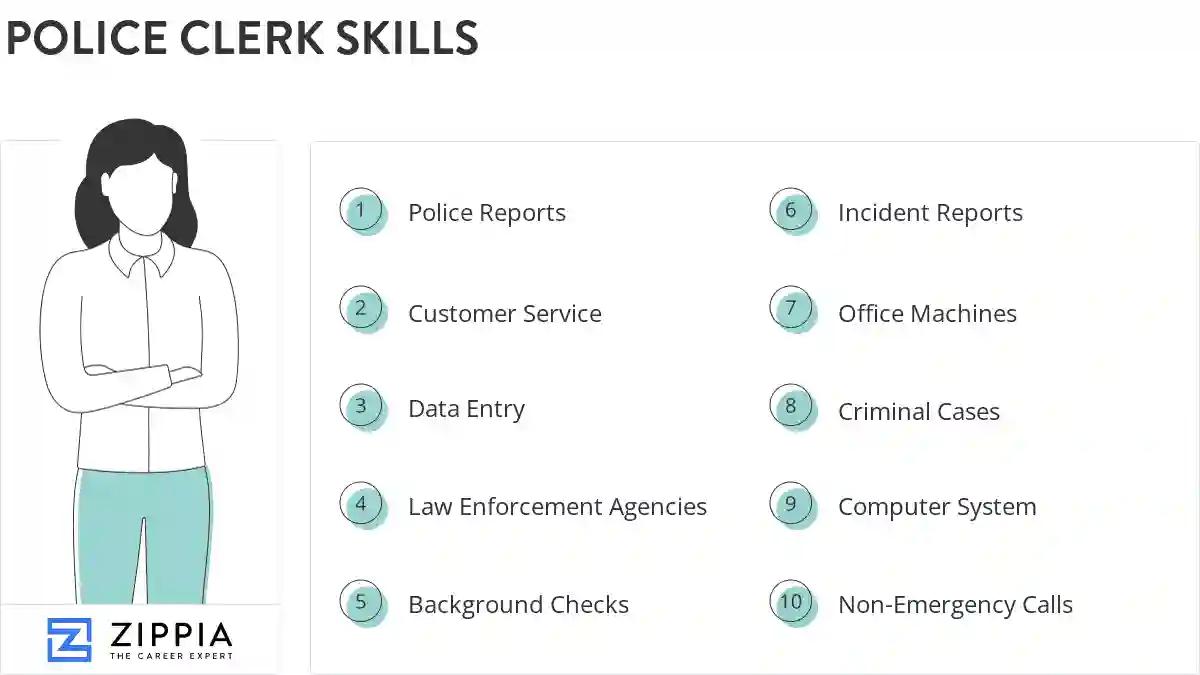
The most important skills for a police clerk resume and required skills for a police clerk to have include:
- Police Reports
- Customer Service
- Data Entry
- Law Enforcement Agencies
- Background Checks
- Incident Reports
- Office Machines
- Criminal Cases
- Computer System
- Non-Emergency Calls
- Office Equipment
- Subpoenas
- NCIC
- Direct Calls
- Notary
- Crime Reports
- CAD
- Police Station
- Front Desk
- Process Payments
- Telephone Calls
- Criminal History
- Traffic Reports
- Computer Aided Dispatch
- Computer Programs
- Word Processing
Updated January 8, 2025
