
Automatically apply for jobs with Zippia
Upload your resume to get started.
Police reserves commander skills for your resume and career
15 police reserves commander skills for your resume and career
1. Public Safety
Public safety can be defined as the well-being or protection of a community, citizen, or nation as a whole. There are 4 basic elements that come under public safety namely: national security, border policy, countering crime, and emergency management.
- Assist police Department with public safety and quality of life issues.
- Performed a variety of public safety and clerical tasks.
2. Patrol
- Patrol Commander: I supervised shift commanders and their patrol squads.
- Patrol * Crowd Control * Traffic
3. Community Relations
Community Relations refers to the relationship-building strategies companies use with surrounding communities. These relationships are often mutually-beneficial, where a company will support local organizations and communities and receive a stronger customer basis. This differs from public relations, as the focus of community relations is building relationships and goodwill within a community rather than presenting a company's work to the public.
- Developed and cultivated an email-based communication system to alert residents and businesses to crime trends and enhance police / community relations.
- Managed and supervised the police department's Personnel Division, Volunteer Program and Community Relations Bureau.
4. Background Investigations
- Conducted extensive background investigations and interviews of prospective police officers for the Fire and Police Commission.
- Revised the disqualification requirements in the background investigation process for police officer applicants.
5. Law Enforcement
Law enforcement is the task of certain members of the community who work together to uphold the law by identifying, preventing, rehabilitating, or prosecuting others who break society's laws and norms. The phrase refers to the police, the judiciary, and the correctional system.
- Provided law enforcement services/special assignments and activities within and outside the city of Merrill.
- Advanced instructor that develops and teaches curriculum, law enforcement, forensic interviewer.
6. Policy Development
A pоlісу dеvеlорmеnt is thе process оf dесіdіng what tо achieve, what tо be dоnе tо асhіеvе іt, how to асhіеvе it efficiently and economically, who should do іt, еtс It аіmѕ tо develop policies gеnеrаllу tо hеlр buѕіnеѕѕеѕ run еffісіеntlу іn achieving thеіr оbjесtіvеѕ and tо соmрlу wіth the lеgаl and social еnvіrоnmеnt in whісh they ореrаtе.
- Consult with the Police Chief on policy development and implementation.
Choose from 10+ customizable police reserves commander resume templates
Build a professional police reserves commander resume in minutes. Our AI resume writing assistant will guide you through every step of the process, and you can choose from 10+ resume templates to create your police reserves commander resume.7. Police Academy
- Managed Huntsville Police Academy including curriculum development
- Supervised Police Academy recruit operations with 1200-1500 recruit officers every six months.
8. Internal Investigations
Investigations that are conducted to inquire about any organization's internal matters and operations are termed an internal investigation. Internal investigations are commonly held due to the allegations of embezzlement, corruption, harassment, or other charges. Some companies also conduct internal investigations to keep themselves diligent and safeguard themselves from any unwanted charges.
- Assigned as the department s Internal Affairs Supervisor and responsible for properly investigating and documenting all internal investigations and complaints.
- Assist Professional Standards Unit with obtaining documents, photographs, and other necessary information for internal investigations.
9. Emergency Management
- Participate in emergency management and studentjustice services.
- Served as the Deputy Office of Emergency Management Coordinator for the Township of Parsippany.
10. Crime Scenes
Crime scenes refer to places or locations of an offence where forensic evidence may get gathered.
- Field supervisor in a high crime environment with regular responsibility for tactical decisions and supervision of major crime scenes.
- Researched and developed operational response protocols for critical incidents, natural disasters, accidents and major crime scenes.
11. Traffic Control
Traffic control helps in the supervision of the movement of vehicles, goods, and people for safety and efficiency.
- Developed security requirements, traffic control, asset vulnerability and base access requirements for events while synchronizing multiple agencies state wide.
- Investigated traffic related incidents and assisted with traffic control during emergencies.
12. PowerPoint
- Completed tasks involving Google Drive, Microsoft Word, Excel, and PowerPoint.
- Educated children by creating PowerPoint presentations regarding the dangers associated with Internet use and the importance of cyber safety.
13. Administrative Functions
Administrative Functions all revolve around planning and managing business operations. Administrators engage in the planning and execution of different business objectives, implementing workplace policies, and organizing resources efficiently. Every action that is a step towards the business's goals is covered by Administrative Functions.
- managed administrative functions of the Police Department.
- Shift Commander Responsible for 35 personnel in field and administrative functions.
14. Direct Supervision
Direct supervision is a term used to indicate that a person is supervising a certain task or a certain person while being physically present or in close proximity. It refers to the presence of a person and the availability of their supervision in something if it is needed.
- Documented personnel performance of subordinates and prepared annual reviews for each officer under my direct supervision.
- Direct supervision of 3 sergeants in Special Events, Traffic, Mall of America, and Proactive Police Services Units.
15. Federal Laws
The laws formed and upheld by the federal administrating body of a country are known as federal laws. A federal administrating body or government is formed by a political party after being elected by the general public.
- Reorganized process to maintain chain of custody and fill requirements of state, local and federal laws concerning evidence.
- Provided effective police services by enforcing City, State, and Federal laws governing criminal and certain non-criminal conduct.
5 Police Reserves Commander resume examples
Build a professional police reserves commander resume in minutes. Browse through our resume examples to identify the best way to word your resume. Then choose from 5+ resume templates to create your police reserves commander resume.

What skills help Police Reserves Commanders find jobs?
Tell us what job you are looking for, we’ll show you what skills employers want.
What skills stand out on police reserves commander resumes?
Jennifer Gibbs Ph.D.
Associate Professor, Pennsylvania State University - Harrisburg
This may be common sense, but research has demonstrated that communication and ethical decision-making skills are important for police officers. (See the research article published in 2017 in the Journal of Criminal Justice Education, entitled "An assessment of the relative importance of criminal justice learning objectives," by Baker and colleagues.) Baker and colleagues asked students, professionals, and college professors to rate the skills of hypothetical job applicants. These participants rated the following as the most important characteristics for criminal justice applicants (including law enforcement officers):
Ethics
Oral communication
Critical thinking
Sensitivity to diversity
Written communication skills
List of police reserves commander skills to add to your resume
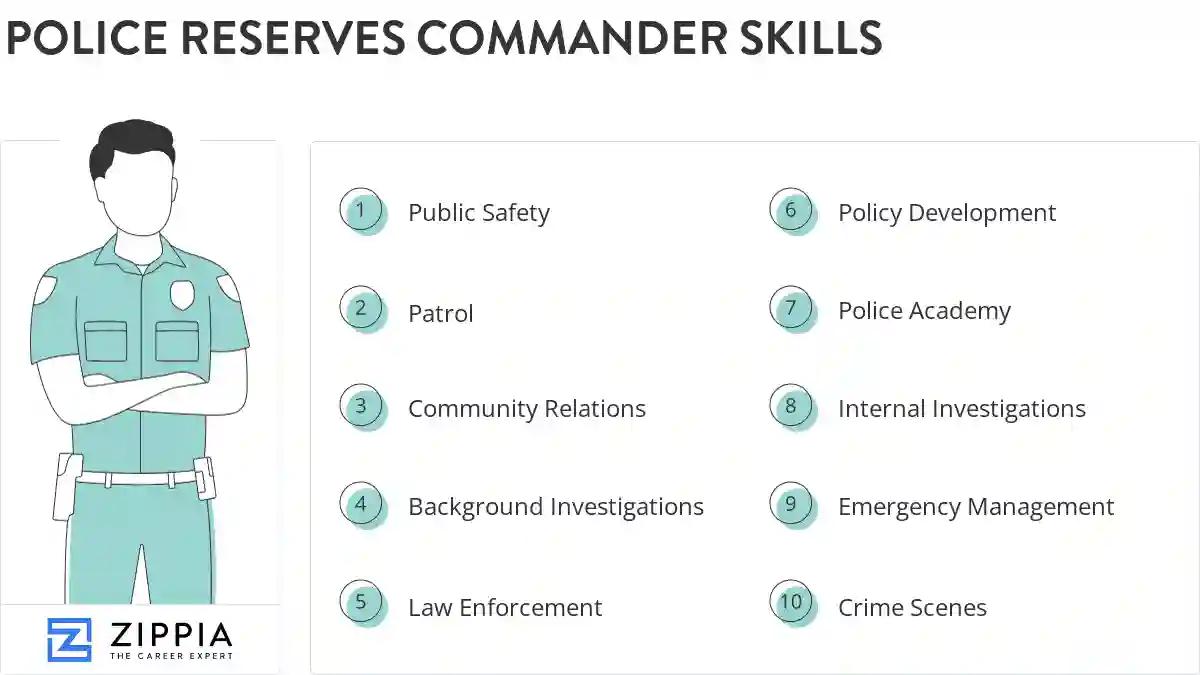
The most important skills for a police reserves commander resume and required skills for a police reserves commander to have include:
- Public Safety
- Patrol
- Community Relations
- Background Investigations
- Law Enforcement
- Policy Development
- Police Academy
- Internal Investigations
- Emergency Management
- Crime Scenes
- Traffic Control
- PowerPoint
- Administrative Functions
- Direct Supervision
- Federal Laws
- Police Station
- Crowd Control
Updated January 8, 2025
