Explore jobs
Find specific jobs
Explore careers
Explore professions
Best companies
Explore companies
What is a principal analyst and how to become one
As a principal analyst, your responsibilities include assisting in preparing required documents, conducting reviews, ensuring projects and business objectives are well understood by the project team, and supervising the progress of the team. Furthermore, you are to ensure proper solutions are provided to every need or requirement and provide training or coaching to junior staff. Beyond all these, you will be required to regularly research the latest processes and computer advancements to improve efficiency and timely completion of projects. Keeping a record of progress and updating the team on new developments are also among the things you will need to do as a principal analyst.
You need a bachelor's degree in business or a related field to get this job. Also, you need to possess advanced technical and problem-solving skills and must be very good at using Microsoft Word and excel. Principal analysts earn an annual average salary of $104,714 or $50.34 an hour.
What general advice would you give to a principal analyst?
Erik Johnson Ph.D.
Assistant Professor of Economics, Carthage College
Avg. Salary $114,156
Avg. Salary $59,228
Growth rate 9%
Growth rate 0.3%
American Indian and Alaska Native 0.19%
Asian 14.44%
Black or African American 10.59%
Hispanic or Latino 11.30%
Unknown 5.03%
White 58.45%
Genderfemale 24.38%
male 75.62%
Age - 42American Indian and Alaska Native 3.00%
Asian 7.00%
Black or African American 14.00%
Hispanic or Latino 19.00%
White 57.00%
Genderfemale 47.00%
male 53.00%
Age - 42Stress level is manageable
7.1 - high
Complexity level is advanced
7 - challenging
Work life balance is fair
6.4 - fair
Principal analyst career paths
Key steps to become a principal analyst
Explore principal analyst education requirements
Start to develop specific principal analyst skills
Skills Percentages Portfolio 16.11% ERP 7.82% Project Management 5.45% Data Analysis 4.73% Process Improvement 4.45% Complete relevant principal analyst training and internships
Accountants spend an average of 6-12 months on post-employment, on-the-job training. New principal analysts learn the skills and techniques required for their job and employer during this time. The chart below shows how long it takes to gain competency as a principal analyst based on U.S. Bureau of Labor Statistics data and data from real principal analyst resumes.Gain additional principal analyst certifications
More About CertificationsPrincipal analyst certifications can show employers you have a baseline of knowledge expected for the position. Certifications can also make you a more competitive candidate. Even if employers don't require a specific principal analyst certification, having one may help you stand out relative to other applicants.
The most common certifications for principal analysts include Project Management Professional (PMP) and IT Information Library Foundations Certification (ITIL).
Research principal analyst duties and responsibilities
- Develop EVM analysis reports and access reports on a monthly basis for the use of the IPT leads.
- Manage administration and supervise development of logistics policies and programs to ensure they meet the changing conditions in program requirements.
- Mine CRM software and leverage professional network for high quality referrals.
- Maintain defect-free deployment of software solutions through thorough planning, testing and QA efforts.
Get principal analyst experience
Generally, it takes 4-6 years to become a principal analyst. The most common roles before becoming a principal analyst include senior analyst, consultant team lead and project manager.Prepare your principal analyst resume
When your background is strong enough, you can start writing your principal analyst resume.
You can use Zippia's AI resume builder to make the resume writing process easier while also making sure that you include key information that hiring managers expect to see on a principal analyst resume. You'll find resume tips and examples of skills, responsibilities, and summaries, all provided by Zippi, your career sidekick.
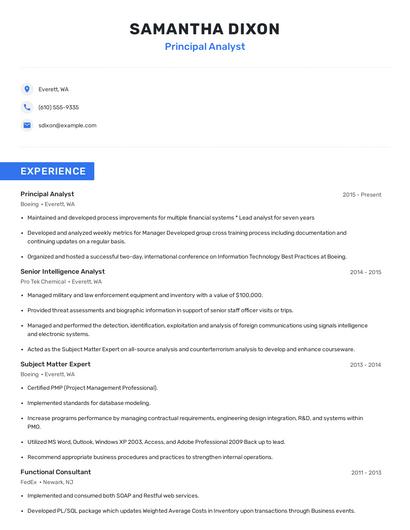
Choose from 10+ customizable principal analyst resume templates
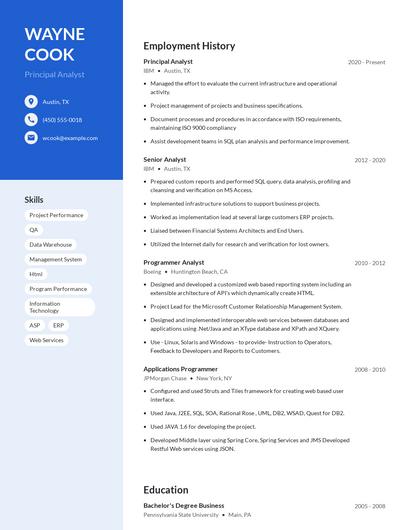
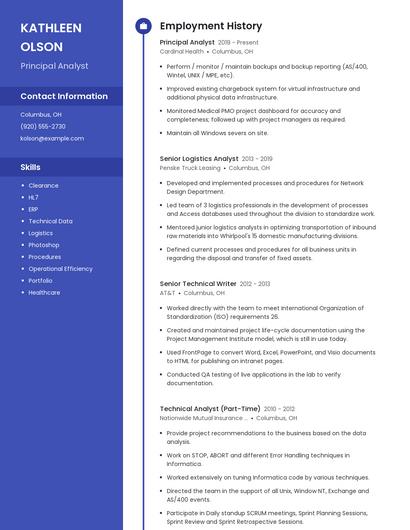
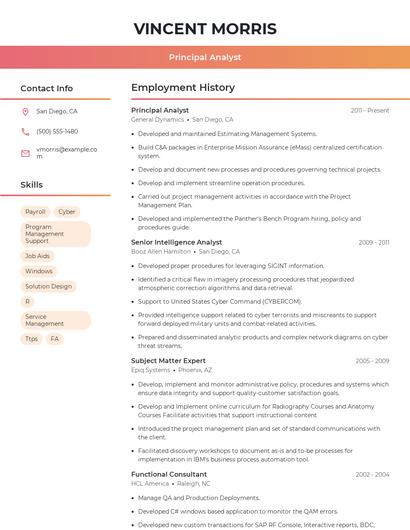
Build a professional principal analyst resume in minutes. Browse through our resume examples to identify the best way to word your resume. Then choose from 10+ resume templates to create your principal analyst resume.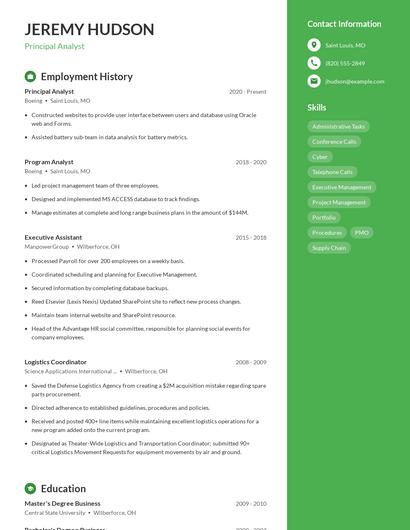
Apply for principal analyst jobs
Now it's time to start searching for a principal analyst job. Consider the tips below for a successful job search:
- Browse job boards for relevant postings
- Consult your professional network
- Reach out to companies you're interested in working for directly
- Watch out for job scams
How did you land your first principal analyst job

Are you a principal analyst?
Share your story for a free salary report.
Average principal analyst salary
The average principal analyst salary in the United States is $114,156 per year or $55 per hour. Principal analyst salaries range between $87,000 and $149,000 per year.
What am I worth?

How do principal analysts rate their job?
Principal analyst reviews

Challenges, problem-solving,communicating with differnet individuals
Generating data and consulting. Using Microsoft excel and Google sheets.
Sitting for long periods of time.
Too much detail oriented
Updated January 8, 2025
