
Automatically apply for jobs with Zippia
Upload your resume to get started.
Principal firmware engineer skills for your resume and career
15 principal firmware engineer skills for your resume and career
1. Python
Python is a widely-known programming language. It is an object-oriented and all-purpose, coding language that can be used for software development as well as web development.
- Design and implement scripts for system automation and management utilizing Visual Basic, Python and other proprietary languages.
- Designed and implemented network management and diagnostic processing using a combination of C++ and Python.
2. Debugging
- Provided customer products support to WCDMA L1 issue analysis, debugging and fixing.
- NOTE: Debugging and Diagnosing the MSP430 MCU based H/W and Firmware involved heavy usage of Tektronix Oscilloscope.
3. SSD
- Documented and worked with HW team to create the interface between FW and HW in next generation SSD SOC.
- Designed and developed Flash Translation Layer (FTL) firmware for enterprise class SSD drive.
4. Linux
Linux is a Unix-like operating system. Just like Windows, Mac OS, and IOS, Linux is an operating system used by millions across the globe. Android itself is powered by the Linux operating system. Linux manages all the hardware resources that are associated with your computer. The software is famous because of the protection it grants from viruses, malware, and crashes. The Linux operating system is entirely free and is an open-source software meaning it can be altered by those equipped with the knowledge to code.
- Worked on Linux environment hybrid firmware development simulation and testing.
- Developed Linux driver for force-sensitive touch panel.
5. Software Development
Software development is the mechanism by which programmers create computer programs. The Software Development Life Cycle (SDLC) is a framework for developing applications that follow technological needs and consumer requirements. It consists of many stages. The SDLC establishes an international standard that software developers can use to enhance and create their programs. It provides a well-defined framework for software developers to pursue in the production, maintenance, and design of premium quality software. The aim of the software development process is to create high-quality software on time and within budget.
- Managed the Dallas facility software development and system administration groups with authority over multiple concurrent projects exceeding a $3M budget.
- Analyzed software errors and directed detailed resolutions to appropriate software development teams, decreasing product software turnaround time and effectiveness.
6. Bluetooth
Bluetooth refers to a short-range connection made wirelessly between different devices. One of the most popular uses of this connection is hands-free phone calls, where an earbud is connected through Bluetooth to a cell phone so that calls can be handled without holding a physical phone. While Bluetooth can be incredibly useful and versatile, it does not offer the long-range and multi-device use that WiFi can offer.
- Assisted in design and implementation of the interface between the data transfer application subsystem and the PPP over Bluetooth protocol stack.
- Evaluated & designed IP Radio & Video software integration for infotainment platform * Developed software for Bluetooth for proprietary communication.
Choose from 10+ customizable principal firmware engineer resume templates
Build a professional principal firmware engineer resume in minutes. Our AI resume writing assistant will guide you through every step of the process, and you can choose from 10+ resume templates to create your principal firmware engineer resume.7. FPGA
- Developed Register Set Utility program in order to set FPGA (Field Programmable Gate Array) register value.
- Developed I2C bus data driver (write/read) for FPGA through parallel port (LPT1).
8. SATA
- Developed SATA Host Interface code for ARM-based disk controller, enabling debug testing and enhancing functionality.
- Designed and Implemented proprietary SATA Driver for VxWorks and NetBSD operating systems.
9. SPI
SPI stands for "serial peripheral interface," which is a communication interface that transfers data between two electronic devices. This allows data to be transferred in both directions between the devices simultaneously, known as "full duplex mode." This mode differs from a "parallel" interface, which requires more complex and longer wiring.
- Specified a communication Protocol and implemented it over SPI bus in uCOS environment.
- Project: Industrial protection using smoke sensor This project involves MCP3201 SPI ADC to AT89S52 MCU with the smoke detection sensor.
10. RTOS
- Added DMA functionality to UART driver on THREADX RTOS.
- Improved the LCE Brick system performance by 30% (ARM9, RTXC RTOS, Track TCP/IP stack).
11. RF
- Design and implement low-level DSP framework to interface with Digi RF, ARM processor and GSM/GPRS/EDGE hardware blocks.
- Developed a near L-band satellite transmitter and modulator that demonstrated the feasibility of RF transmission equipment with ultra low unwanted emissions.
12. Feature Development
- Collected customer requirements as input to product line management and R&D for new product/feature development.
- Designed and maintained base C++ classes and interfaces to support feature development by the team.
13. Windows
Windows is a chain of operating systems that controls a computer and is developed by Microsoft. Every version of Windows consists of GUI (graphical user interface), with a desktop that allows the user to open their files.
- Developed and supported a RAID 5 driver for Windows and MAC OS X.
- Supported a Health Care client by designing and developing additional functionality to their existing applications using Visual Basic under Windows NT.
14. FW
- Developed FW for an ARM Cortex (CM3) based System On a Chip (SOC).
- Involved in system architecture improvement for FW control efficiency and memory bandwidth reduction.
15. I2C
12C is a cloud-based database provided by Oracle and it's the first of its kind coming from the company. It's a high-performance database for enterprises with a multitenant framework that allows for seamless consolidation without having to enforce changes in the applications used.
- Verified systems communications using oscilloscopes, logic analyzers, and I2C protocols.
- Developed I2C communication for display data.
5 Principal Firmware Engineer resume examples
Build a professional principal firmware engineer resume in minutes. Browse through our resume examples to identify the best way to word your resume. Then choose from 5+ resume templates to create your principal firmware engineer resume.

What skills help Principal Firmware Engineers find jobs?
Tell us what job you are looking for, we’ll show you what skills employers want.
List of principal firmware engineer skills to add to your resume
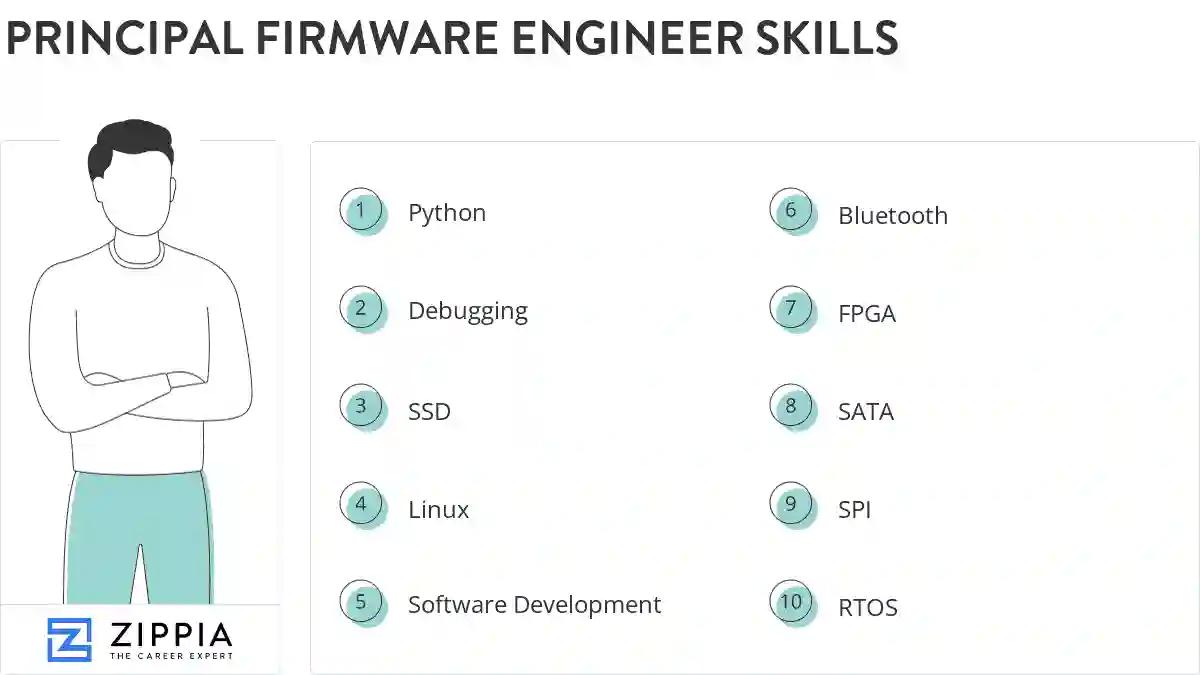
The most important skills for a principal firmware engineer resume and required skills for a principal firmware engineer to have include:
- Python
- Debugging
- SSD
- Linux
- Software Development
- Bluetooth
- FPGA
- SATA
- SPI
- RTOS
- RF
- Feature Development
- Windows
- FW
- I2C
- SOC
- DSP
- Assembly Language
- MATLAB
- USB
- Disk
- OS
- ASIC
- Embedded C
- UART
- Mentor Graphics
- Prototyping
- Microcontrollers
- CPU
- HW
- Ethernet
- BLE
- JTAG
- Java
- Product Development
- Nand
- GPS
- Emulators
- Eclipse
- Configuration Management
- Power Management
- API
- PCI
- IoT
Updated January 8, 2025
