
Automatically apply for jobs with Zippia
Upload your resume to get started.
Prn radiology technologist skills for your resume and career
15 prn radiology technologist skills for your resume and career
1. Patients
- Provided outstanding customer service to patients by providing accurate explanations and instructions regarding their procedure.
- Provided history pertinent to patients care for radiologist to make accurate and informed diagnosis
2. ARRT
- Followed radiation safety measures and used radiation protection devices in accordance with ARRT standards and governmental regulations.
- Perform routine diagnostic imaging procedures according to departmental protocol, policy and ARRT procedural standards.
3. Radiologic Technologist
- Weekend Radiologic Technologist and covered when technologist were sick or on vacation.
- Performed up to 20 hours of PRN Radiologic Technologist duties a week.
4. CPR
Cardiopulmonary resuscitation or CPR is a medical procedure that involves chest compression to help a patient breathe. This artificial ventilation helps in keeping the brain function in place and regulates blood throughout the body. CPR is a lifesaving procedure that is used in emergencies.
- Completed all mandatory education and CPR certification.
- Instructed CPR to the community on a monthly basis which included testing.
5. Surgery
- Experienced in performing examinations in radiology, surgery, and the emergency department.
- Work at a variety of locations including Plaza, Jacksonville and Orange Park Surgery centers.
6. Radiographic Procedures
- Perform various radiographic procedures utilizing fixed and mobile equipment; leverage computed and direct digital radiography expertise to produce quality images.
- Perform diagnostic radiographic procedures by utilizing correct technique selection, patient positioning, and application of immobilization and radiation protection devices.
Choose from 10+ customizable prn radiology technologist resume templates
Build a professional prn radiology technologist resume in minutes. Our AI resume writing assistant will guide you through every step of the process, and you can choose from 10+ resume templates to create your prn radiology technologist resume.7. Pacs
Picture archiving and communication system or, as is more commonly shortened, PACS, is a type of imaging scan used in medical treatment and other such work which provides effective storing and access to images and scans created by a large variety of machinery and medical tools. This might include scans such as CTs and MRIs and even basic X-rays and the system can also potentially be used to store digitised versions of originally physical paper documents.
- Input patient information into computer, sent films to radiologist via PACS, distributed documentation, and answered pager immediately.
- Maintain solid understanding of imaging, equipment and imaging documentation software, including PACS image archive.
8. Patient Safety
- Demonstrated correct transfer techniques to ensure patient safety.
- Assured patient safety and satisfaction.
9. Patient History
- Functioned as a medical technologist aiding with lab testing, ekg's obtaining vitals and patient history.
- Obtain pertinent patient history, provide appropriate annotation of diagnostic images, submit images for physician review and complete appropriate documentation.
10. Diagnostic Procedures
Diagnostic procedures is a broad term that includes all the techniques medical professionals use to narrow down a disease or condition. Treating a patient only begins when doctors successfully diagnose the disease, so diagnostic procedures are crucial.
- Fulfilled all diagnostic procedures according to protocol, procedure manuals, and radiologist.
- Performed all diagnostic procedures including fluoroscopy.
11. X-Ray Equipment
X-ray equipment is used to generate images of tissues and structures inside of the body.
- Performed emergency, outpatient, inpatient and surgical imaging procedures using CR and DR x-ray equipment.
- Operated x-ray equipment to provide images of diagnostic quality.
12. Exposure Factors
- Developed critical thinking skills -Trained to obtain optimal images -Effective communication and patient care skills -Utilize proper exposure factors and radiation protection
- Utilized proper positioning criteria and technical exposure factors, performed all required imaging projections for given procedure.
13. C-Arm
- Positioned and operated C-arm during surgical and pain management procedures.
- Operated c-arm to aid physician to view and guide wire and catheter through blood vessels to area of interest.
14. Quality Patient Care
- Offer high-quality patient care alongside nursing staff Complete medical orders promptly as required
- Provide quality patient care; assist Radiologist with fluoroscopy procedures, practiced radiation safety for self and patient.
15. Technical Factors
- Selected proper equipment settings and technical factors.
- Determined technical factors for each examination; position and instruct the patient.
5 PRN Radiology Technologist resume examples
Build a professional prn radiology technologist resume in minutes. Browse through our resume examples to identify the best way to word your resume. Then choose from 5+ resume templates to create your prn radiology technologist resume.

What skills help PRN Radiology Technologists find jobs?
Tell us what job you are looking for, we’ll show you what skills employers want.
What prn radiology technologist skills would you recommend for someone trying to advance their career?
Karen Bubb
Department Head, Assistant Professor, Diagnostic Medical Imaging, Oklahoma State University - Oklahoma City
List of prn radiology technologist skills to add to your resume
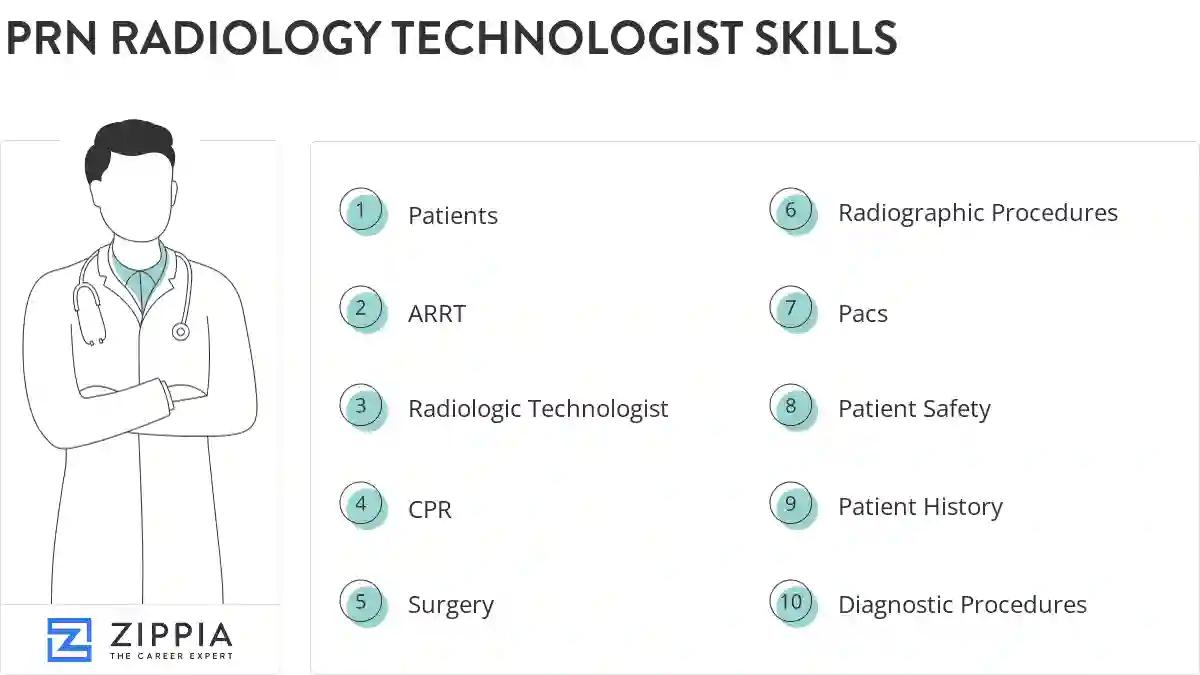
The most important skills for an prn radiology technologist resume and required skills for an prn radiology technologist to have include:
- Patients
- ARRT
- Radiologic Technologist
- CPR
- Surgery
- Radiographic Procedures
- Pacs
- Patient Safety
- Patient History
- Diagnostic Procedures
- X-Ray Equipment
- Exposure Factors
- C-Arm
- Quality Patient Care
- Technical Factors
- MRI
- PET
- Ct Scan
- ALARA
- Radiologic Equipment
- Radiologic Procedures
- Radiographic Equipment
- GI
- Medical History
- Data Entry
- Fluoroscopic Procedures
- Vital Signs
- Diagnostic Purposes
- Exam Rooms
- CR
- RIS
- Catheter
- EKG
- General Diagnostic
- DR
- Pain Management
- Contrast Materials
- Diagnostic Exams
- DEXA
- Patient Exams
- EMR
- ICU
- Hippa
- Digital Equipment
- Stretchers
- Epic
- Electrocardiogram
- X-Ray Exams
Updated January 8, 2025
