
Automatically apply for jobs with Zippia
Upload your resume to get started.
Process development chemist skills for your resume and career
15 process development chemist skills for your resume and career
1. R
R is a free software environment and a language used by programmers for statistical computing. The R programming language is famously used for data analysis by data scientists.
- Participate in the preparation of deviation reports as necessary for submission to R &D Management.
2. HPLC
- Purify oligos on HPLC units that collected either manually or automatically.
- Process development troubleshooting including analytical methods, such as HPLC, Agilent 1100 and 1200 series, ChemStation software.
3. Analytical Techniques
Analytical technique is a method or procedure for the analysis of some problem or a fact. It is used for the quantitative and qualitative determination of a problem using various technique.
- Develop analytical techniques and operational processes in support of plant operational mission.
- Managed transfer of 11 analytical techniques for a multimillion dollar manufacturing campaign.
4. Process Support
- Provided process support to Operation groups.
5. GMP
GMP stands for Good Manufacturing Practice. It is a system that ensures that all products like food, beverages, and medicinal drugs that are produced comply with the quality standards. It helps in minimizing the risks and hazards that cannot be eliminated after the testing of final products.
- Validated Master Operating Records (in-lab) before commencement of a GMP production campaign.
- Trained plant operators to run the new circuit in accordance to company's GMP.
6. NMR
The Nuclear Magnetic Resonance technique allows observing magnetic fields around an object. The NMR equipment requires monitoring and ensuring their correct and safe utilization.
- Analyzed compounds using a variety of scientific data instrumentation, such as NMR.
- Analyze samples by NMR, Mass, IR, HPLC, GC.
Choose from 10+ customizable process development chemist resume templates
Build a professional process development chemist resume in minutes. Our AI resume writing assistant will guide you through every step of the process, and you can choose from 10+ resume templates to create your process development chemist resume.7. Test Methods
Test methods are the steps in which thorough testing is conducted in a laboratory setting.
- Developed instructional specifications, test methods and written procedures for optimum Quality Assurance and Performance of the product.
- Trained approximately 30 new Chemists on various analyses using modern laboratory instruments, test methods and laboratory documentations.
8. Cost Savings
- Contract chemical development, pilot plant process yield optimization and cost savings for a six-step synthesis of fluorescent polymer precursor.
- Improved existing synthetic procedures, realizing cost savings of 30% in material, labor and time.
9. GLP
GLP stands for "good laboratory practice." This refers to the integrity and quality measures that non-clinical laboratories have in place to ensure accurate research and market testing. GLP is most often used in pharmaceutical companies where new drugs must be tested before being approved for sale, but the practice can also be used in food packaging and preparation test centers.
- Performed multiple GLP pesticide registration research studies and validations.
- Validated several instrumentation systems for routine GLP use.
10. Process Validation
Process validation refers to the accumulation and analysis of data, starting from the process design stage to production, which provides scientific evidence that the process can routinely deliver quality products. To develop an effective process validation strategy, you need to ensure that each of its three stages has been properly taken care of. The first stage is process design, where the processes are defined. The second stage is process qualification, where the process, which has been designed earlier, is evaluated to make sure it can reproduce reliable and consistent levels of quality. The final stage is continued process verification that involves ongoing validation to ensure the process is under control.
- Support for process validation, deviation and investigations.
- Generate complete and detailed documentation, assist with process validation protocols
11. ISO
- Develop controlled documents (SOP, CofA, technical data sheets, batch records, adhering to ISO 9000 regulations).
- Participated ISO 9001 and Six Sigma quality control tool environment programs.
12. Lab Scale
- Draft cGMP manufacture batch record and scale up to kilo lab scale in cGMP environment.
- Conducted lab scale and kilo scale manufacturing under cGMP and non-cGMP conditions.
13. Oligonucleotides
- Synthesize and analyze oligonucleotides using state of the art techniques in a cGMP environment.
- Manufactured development and production oligonucleotides.
14. Method Development
- Contributed significant biophysical/method development findings and presented to scientific management in development organization.
- Performed method development, validation, carried out quantitative and qualitative analyses in support of method transfers.
15. FDA
The Food and Drug Administration (FDA) is a division of the US Department of Health and Human Services that regulates the production and sale of food, pharmaceutical products, medical equipment, and other consumer goods, as well as veterinary medicine. The FDA is now in charge of overseeing the manufacture of products like vaccines, allergy treatments, and beauty products.
- Gained working experience with FDA, EPA, and government safety regulations and requirements.
- Performed lab audits to make sure lab was in compliance with FDA regulations.
5 Process Development Chemist resume examples
Build a professional process development chemist resume in minutes. Browse through our resume examples to identify the best way to word your resume. Then choose from 5+ resume templates to create your process development chemist resume.

What skills help Process Development Chemists find jobs?
Tell us what job you are looking for, we’ll show you what skills employers want.
What skills stand out on process development chemist resumes?
Stephanie Hooper Marosek Ph.D.
Chair, Associate Professor, Methodist University
What soft skills should all process development chemists possess?
Shelley Minteer Ph.D.
Dale and Susan Poulter Endowed Chair in Biological Chemistry, Associate Chair of Chemistry, University of Utah
What process development chemist skills would you recommend for someone trying to advance their career?
Dennis Province Ph.D.
Professor, Harding University
A gap year usually implies finding work as a research technician before applying to graduate or professional school. If this is the case, one question that employers and graduate programs have about their applicants are about their fitness: can they withstand the rigor at the next level? A recent graduate needs to show evidence that they are responsible and timely. The gap year should be filled with activities that show this.
What type of skills will young process development chemists need?
Dr. Brian Augustine Ph.D.
Professor of Chemistry and Chair, High Point University
What hard/technical skills are most important for process development chemists?
Dunwei Wang Ph.D.
Margaret A & Thomas A Vanderslice Chair in Chemistry, Professor of Chemistry, Chairperson of Chemistry Department, Boston College
List of process development chemist skills to add to your resume
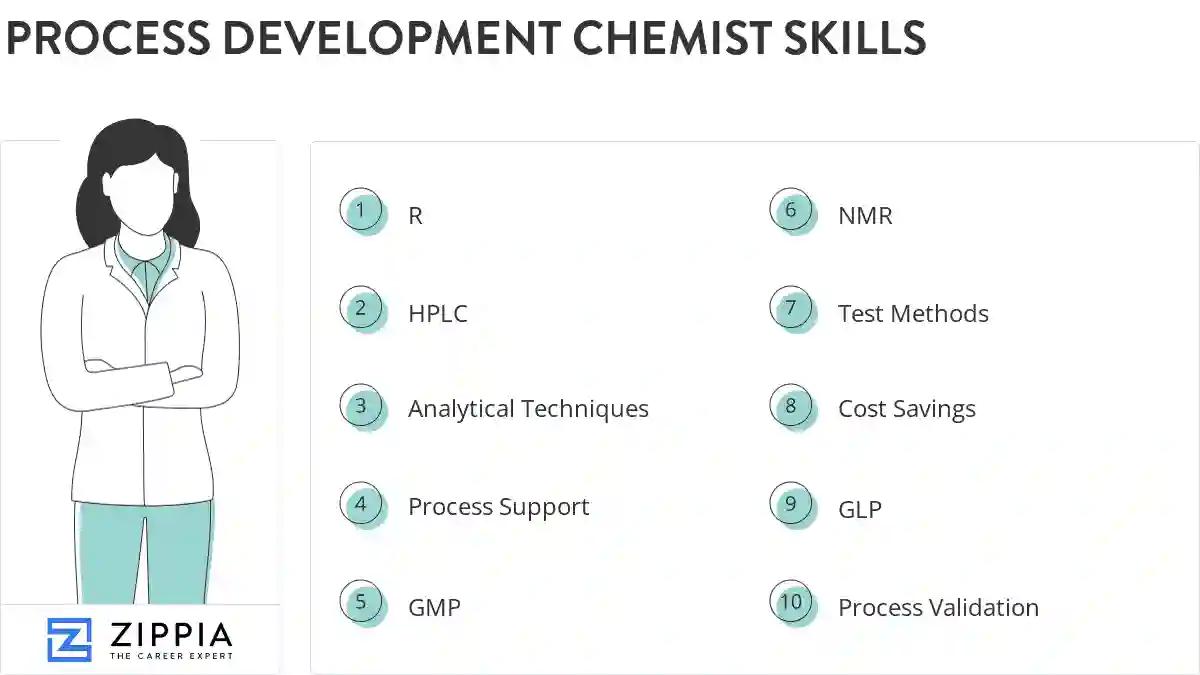
The most important skills for a process development chemist resume and required skills for a process development chemist to have include:
- R
- HPLC
- Analytical Techniques
- Process Support
- GMP
- NMR
- Test Methods
- Cost Savings
- GLP
- Process Validation
- ISO
- Lab Scale
- Oligonucleotides
- Method Development
- FDA
- GCMS
- Analytical Data
- Pilot Plant
- Process Improvement
- GC
- Ms
- Apis
- QC
- Troubleshoot
- Product Development
- IR
- Chemical Plant
- Product Quality
- Laboratory Support
- QA
- UV-Vis
- Pilot Scale
- Production Processes
- Distillation
- DOE
- DSC
- Plant Support
- Synthesis
- Laboratory Experiments
- Lims
Updated January 8, 2025
