Explore jobs
Find specific jobs
Explore careers
Explore professions
Best companies
Explore companies
Job outlook for process development engineers in the United States
Process development engineer job growth summary. After extensive research, interviews, and analysis, Zippia's data science team found that:
The projected process development engineer job growth rate is 10% from 2018-2028.
About 30,600 new jobs for process development engineers are projected over the next decade.
Process development engineer salaries have increased 6% for process development engineers in the last 5 years.
There are over 63,820 process development engineers currently employed in the United States.
There are 118,616 active process development engineer job openings in the US.
The average process development engineer salary is $89,754.
Are process development engineer jobs in demand?
Process development engineer job and salary trends over time
Process development engineer jobs over time
Process development engineer job growth rate over time
| Year | # of jobs | % of population |
|---|---|---|
| 2021 | 63,820 | 0.02% |
| 2020 | 63,114 | 0.02% |
| 2019 | 63,690 | 0.02% |
| 2018 | 61,219 | 0.02% |
| 2017 | 58,322 | 0.02% |
Average process development engineer salary over time
Process development engineer salary by year
| Year | Avg. salary | Hourly rate | % Change |
|---|---|---|---|
| 2026 | $89,754 | $43.15 | +1.1% |
| 2025 | $88,815 | $42.70 | +1.1% |
| 2024 | $87,827 | $42.22 | +1.4% |
| 2023 | $86,656 | $41.66 | +1.9% |
| 2022 | $85,072 | $40.90 | +1.0% |
Process development engineer jobs by state
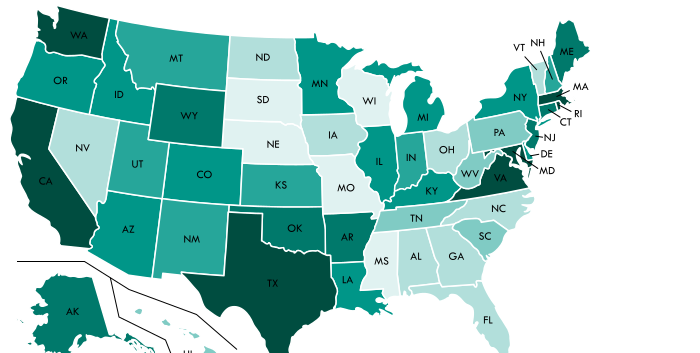
Most common states for process development engineers
| Rank | State | Population | # of jobs | Employment/ 1000ppl |
|---|---|---|---|---|
| 1 | Washington | 7,405,743 | 3,249 | 44% |
| 2 | District of Columbia | 693,972 | 283 | 41% |
| 3 | Minnesota | 5,576,606 | 1,848 | 33% |
| 4 | Massachusetts | 6,859,819 | 2,137 | 31% |
| 5 | North Dakota | 755,393 | 214 | 28% |
| 6 | Wyoming | 579,315 | 157 | 27% |
| 7 | Nebraska | 1,920,076 | 493 | 26% |
| 8 | Montana | 1,050,493 | 275 | 26% |
| 9 | Arizona | 7,016,270 | 1,645 | 23% |
| 10 | Delaware | 961,939 | 226 | 23% |
| 11 | Virginia | 8,470,020 | 1,857 | 22% |
| 12 | New Mexico | 2,088,070 | 454 | 22% |
| 13 | New Hampshire | 1,342,795 | 295 | 22% |
| 14 | Alaska | 739,795 | 161 | 22% |
| 15 | Pennsylvania | 12,805,537 | 2,680 | 21% |
| 16 | Indiana | 6,666,818 | 1,392 | 21% |
| 17 | Wisconsin | 5,795,483 | 1,219 | 21% |
| 18 | Oregon | 4,142,776 | 852 | 21% |
| 19 | Kansas | 2,913,123 | 614 | 21% |
| 20 | South Dakota | 869,666 | 186 | 21% |
Most common cities for process development engineers
| Rank | City | # of jobs | Employment/ 1000ppl | Avg. salary |
|---|---|---|---|---|
| 1 | Goleta | 3 | 10% | $96,857 |
| 2 | Danvers | 1 | 4% | $100,715 |
| 3 | Amherst | 1 | 3% | $99,957 |
| 4 | Chelmsford | 1 | 3% | $100,539 |
| 5 | Fayetteville | 2 | 2% | $90,946 |
| 6 | Cupertino | 1 | 2% | $104,921 |
| 7 | East Hartford | 1 | 2% | $92,219 |
| 8 | Middletown | 1 | 2% | $92,143 |
| 9 | Saint Paul | 4 | 1% | $88,428 |
| 10 | Fremont | 3 | 1% | $105,264 |
| 11 | Santa Ana | 3 | 1% | $95,586 |
| 12 | Hawthorne | 1 | 1% | $95,785 |
| 13 | Milpitas | 1 | 1% | $104,986 |
| 14 | Dallas | 2 | 0% | $96,635 |
| 15 | Indianapolis | 2 | 0% | $86,338 |
| 16 | Chicago | 1 | 0% | $90,100 |
Process Development Engineer job outlook: Expert opinions
Our panel of process development engineer experts
Arizona State University at the Polytechnic Campus
University of Alabama at Huntsville
University of Michigan - Ann Arbor
North Carolina State University
Worcester Polytechnic Institute
Oklahoma State University
Xavier University

North Dakota State University

South Dakota School of Mines and Technology

North Dakota State University

University of Denver

University of Pittsburgh

Weber State University
New Mexico State University

East Tennessee State University
Binghamton University
Clarkson University

California State Polytechnic University - Pomona
Jerry Gintz CMfgE
Teaching ProfessorArizona State University at the Polytechnic Campus
Manufacturing Engineering
What general advice would you give to a Process Development Engineer?
Jerry Gintz CMfgE: When entering a career in manufacturing engineering, consider starting as a technician to gain experience with the company before transitioning into engineering. This will allow you to build confidence and better understand the production systems you will be responsible for as an engineer.
What Process Development Engineer skills would you recommend for someone trying to advance their career?
Jerry Gintz CMfgE: From a manufacturing engineering perspective, the most important skills an engineer will need is the ability to understand, design, assemble, and deploy production capable systems. This includes an expertise with computer-aided engineering tools to assist in the design and verification of engineered systems before a company expends capital on the equipment.
What will help Process Development Engineers increase their earning potential?
Jerry Gintz CMfgE: From a manufacturing engineering perspective, compensation is normally tied to capability so the more relevant skills a candidate has entering the workforce the higher compensation they can expect to receive. This is especially true in manufacturing given the shortage of qualified engineering talent available for hire. Additionally, consider focusing on industrial automation as a resource to aid efficient production. Manufacturing is always looking to increase efficiency and a foundational knowledge of industrial automation systems will serve you well as you build a career in manufacturing engineering.
What Process Development Engineer skills would you recommend for someone trying to advance their career?
Ana Wooley Ph.D.: For a graduate beginning their career in Industrial Systems Engineering, my advice is to be genuinely proactive and to take initiative. This field, like any other, comes with a steep learning curve as you familiarize yourself with the company's operations, culture, and processes. Actively seek out and engage with experienced colleagues who can mentor and guide you. Don’t hesitate to volunteer for challenging tasks, as these opportunities will significantly improve your learning and skill development. Another piece of advice I would give is not to be discouraged if you find yourself not enjoying your first job. It's important to remember that you never truly know until you experience it firsthand. This initial job can be a great learning opportunity, helping you identify what aspects of the field you don't enjoy and guiding you towards roles that are a better fit for your interests and skills. Every experience, even those that are not ideal, contributes to your overall career growth and helps you identify your career path.
What will help Process Development Engineers increase their earning potential?
Todd Allen: -work hard to develop professional networks
- get the details right
- the way you present is as important as your technical knowledge
Dr. Gregory Buckner Alumni Distinguished Undergraduate Professor
Alumni Distinguished Undergraduate ProfessorNorth Carolina State University
Manufacturing Engineering
What general advice would you give to a Process Development Engineer?
Dr. Gregory Buckner Alumni Distinguished Undergraduate Professor: Experience with robotics and automation, additive manufacturing, and CNC machining processes. Understanding the emerging roles of data analytics and artificial intelligence in process optimization and quality control.
What Process Development Engineer skills would you recommend for someone trying to advance their career?
Dr. Gregory Buckner Alumni Distinguished Undergraduate Professor: One way to maximize your salary potential is to continue the formal education process by taking graduate engineering or business courses. Many employers reimburse the tuition expenses, and with the increasing availability of online courses you can earn a master's degree in engineering or an MBA one course at a time.
What will help Process Development Engineers increase their earning potential?
Dr. Gregory Buckner Alumni Distinguished Undergraduate Professor: I'd encourage students to embrace new technical challenges and opportunities to learn and collaborate in an industrial setting, which can be quite different from the academic setting. I'd emphasize the importance of developing communication and team working skills, and building professional relationships. I'd also encourage students to join professional societies related to their field and keep updated on new manufacturing trends.
Michael Buechler
Professor Manufacturing TechnologyWhat general advice would you give to a Process Development Engineer?
Michael Buechler: I counsel my students to know their worth and know the job market. Most important is starting out in a position that challenges you and provides training for future wage and skill growth. Many graduates can get caught in a job that pays the bills but may not provide a path to the next career step. Be ambitious and seek to attain the advanced skills quickly but keep in mind the field is complex and there is a lot to learn. If you are in a high wage position but it does not provide the training or room for advancement it might not be the best career option.
What Process Development Engineer skills would you recommend for someone trying to advance their career?
Michael Buechler: Model based definition, highly technical computer skills, 5 axis & familiarity with macros is going to be the future of advanced manufacturing. It is paramount that high skill individuals START with as much set-up experience as possible. In order to command 100k + as a programmer you need to know the correct inputs and physics of the manufacturing program you are making
What will help Process Development Engineers increase their earning potential?
Michael Buechler: I would suggest beginning career individuals maintain an open mind as to where their carrer leads, they may find interest in areas of manufacturing not previously known or explored by them. Also work especially hard early in your career and try and find an employer that gives you the best opportunity to grow professionally and learn new skills.
What Process Development Engineer skills would you recommend for someone trying to advance their career?
Asad Salem Ph.D: In the contemporary engineering sphere, commanding expertise in environmental conservation and global warming mitigation technologies is indispensable. This proficiency spans across clean and low carbon footprint solutions, renewable energy sources, energy storage, new materials, health considerations, water resource management, transportation systems, and innovative manufacturing processes. Simultaneously, a robust mastery of artificial intelligence, data analytics, and cybersecurity is gaining importance. Furthermore, a profound comprehension of sustainable practices and collaborative technologies is anticipated to assume an increasingly pivotal role in the continually evolving field of engineering.
Jianyu Liang
Director of Materials and Manufacturing Engineering Program, Department of Mechanical and Materials Engineering, WPIWorcester Polytechnic Institute
Materials Engineering
What general advice would you give to a Process Development Engineer?
Jianyu Liang: At the start of your career, actively engaging in the manufacturing professional communities to develop an in-depth understanding of the current high-demand areas and the trends in the industry will help you position yourself in high-demand areas. This proactive approach allows you to make informed decisions on obtaining relevant certifications or advanced education, tailoring your skill set to meet the evolving needs of the industry. Proactively engaging in projects and practices to grow your experience. Building a strong professional network and finding mentors in the industry can provide guidance, expose you to new opportunities, and offer insights on navigating your career path effectively. Embracing continuous learning and staying abreast of technological advancements in manufacturing, such as automation, robotics, and digital manufacturing technologies, will ensure you remain a valuable asset to employers. Demonstrating flexibility and a willingness to adapt to new methods and technologies can set you apart in a competitive job market.
What Process Development Engineer skills would you recommend for someone trying to advance their career?
Jianyu Liang: For manufacturing engineers, the next 3-5 years promise significant evolution due to advancements in technology and changes in manufacturing processes. Here are some skills that are expected to become more important and prevalent in the field: proficiency in automation and robotics, advanced data analysis and data-driven optimization, digital twin technology, additive manufacturing and 3D printing, application of artificial intelligence and machine learning in manufacturing, cybersecurity for manufacturing systems, and supply chain management.
What will help Process Development Engineers increase their earning potential?
Jianyu Liang: Get Your Hands Dirty: There's no substitute for hands-on experience. The lessons learned through direct involvement are invaluable, offering insights and skills that theoretical knowledge alone cannot provide. Embrace every opportunity to participate in projects, volunteer for tasks, and experiment within your role. This proactive approach not only accelerates your learning but also showcases your work ethic and dedication to potential mentors and leaders.
Be Mindful and Intentional in Your Job: While immersing yourself in your work, adopt a reflective practice. Actively seek feedback and analyze your experiences. This intentional approach to learning from every task helps to grow your skills rapidly.
Be Open-Minded and Adaptable: The landscape of nearly every industry is rapidly evolving, particularly with the integration of automation and artificial intelligence (AI). These technologies are not just changing the way we work; they are reshaping the skills and roles in demand. Stay open to new ideas, technologies, and methodologies. Continuous learning and adaptability are key to remaining relevant and thriving in a tech-driven workplace. Attend workshops, webinars, and courses on emerging technologies and trends in your field to keep your skills sharp and your perspective fresh.
Cultivate a Professional Network: Building relationships within your industry is crucial. Networking isn't just about finding job opportunities; it's about learning from peers, gaining insights into industry trends, and establishing a support system. Attend industry conferences, join professional organizations, and engage in communities related to your field. These connections can provide guidance, mentorship, and support as you navigate your career path.
What general advice would you give to a Process Development Engineer?
Guiping Hu Ph.D.: People like the diversity and flexibility of being an industrial engineer. You can work on all kinds of problems with your industrial engineering skills. However, if you are only looking for a very narrow area in a specific engineering discipline, industrial engineering may not be right for you since we focus on system efficiency improvement and welfare of the workers.
Dr. Heidrun Schmitzer
Professor and ChairXavier University
Department Of Physics
What skills stand out on Process Development Engineer resumes?
Dr. Heidrun Schmitzer: Programming languages, numerical design and simulation tools, knowledge of various measurement equipment.
What soft skills should all Process Development Engineers possess?
Dr. Heidrun Schmitzer: Communication, teamwork.
What hard/technical skills are most important for Process Development Engineers?
Dr. Heidrun Schmitzer: Depends on the engineering career, but in general, an ability to know how to use design software, measurement/testing, and analysis equipment, in addition to prototyping and fabrication tools
What skills will help Process Development Engineers earn the most?
Dr. Heidrun Schmitzer: Problem-solving, troubleshooting, independent learner.
Dr. David Grewell Ph.D.
Department Chair and ProfessorNorth Dakota State University
Industrial and Manufacturing Engineering Department
What skills stand out on Process Development Engineer resumes?
Dr. David Grewell Ph.D.: The resume of an IE will detail the ability to solve problems and optimize processes for a broad range of industries, including healthcare, transportation, financial, entertainment, manufacturing, and human resources. These skills are further highlighted by the fact that the IE curriculum includes aspects of business management.
What hard/technical skills are most important for Process Development Engineers?
Dr. David Grewell Ph.D.: An IE must be able to break down complex problems into manageable issues and provide solutions for these problems that face the world in today's complex interconnected systems. A background in statistics, design and analysis, process management, and a strong foundation in the engineering disciplines make this possible.
What skills will help Process Development Engineers earn the most?
Dr. David Grewell Ph.D.: Good communication and leadership skills that are embedded in their curriculum enable IE's to quickly move up the corporate ladder and become the CEO of the nation's leading companies.
What are the biggest trends we'll see in the Process Development Engineer job market given the pandemic?
William Cross Ph.D.: The biggest job market trends given the pandemic are working from home, and slightly delayed hiring - in Metallurgical Engineering at SD Mines, it took about 9-12 months for our Spring 2020 graduates to be hired to levels that took less than three months pre-pandemic, although eventually most of our graduates have been placed. The Fall 2020 graduates have seen a similar delay.
I expect some of the work from home will remain into the future, but do not expect the delayed hiring to extend for too much longer. I also expect that in some fields the pandemic has accelerated trends towards greater automation of job functions.
What soft skills should all Process Development Engineers possess?
William Cross Ph.D.: The soft skills that all graduates should possess are primarily in communication - speaking/writing clearly, and listening/reading comprehension - and in teamwork skills. Being able to function in a variety of roles on a team is very important to success in many jobs.
How have salaries changed over time for Process Development Engineers?
William Cross Ph.D.: This of course depends on the time range to which the question refers. Over the last 4-5 years salaries have been rather flat on average going by SD Mines graduates in Metallurgical Engineering, although this is working off a rather high baseline. SD Mines has been recognized as the top engineering schools in the nation for return on investment, and Metallugical Engineering has an above average starting salary for SD Mines at around $65,000/year.
Andriy Voronov
ProfessorNorth Dakota State University
Coatings and Polymeric Materials Department
Will there be an enduring impact of the coronavirus pandemic on Process Development Engineers?
Andriy Voronov: Since pandemic is not over yet, there may be only a guess on how significant this impact can be. I think answering this question resonates with more general one, namely, "Will our life after COVID-19 be the same as before?" We all want to be positive about that but are just not certain. Moreover, I think in some professional aspects in most fields, changes are unavoidable. Working from home, attending virtual conferences, taking part in Zoom meetings, even virtual get together with colleagues will most probably remain to be a new post-pandemic working routine, by all advantages and disadvantages this may bring to most recent graduates. Speaking about materials science, I hope and do believe that there will be global and impactful factors other than coronavirus pandemic, such as novel materials trends, technological innovations etc., to take into account for graduates.
What certifications/licenses/courses can have the biggest impact for Process Development Engineers?
Andriy Voronov: I think most graduate programs in materials science offer opportunities for interdisciplinary research and educational activities. Their philosophy is to educate and prepare job prospects by providing advanced aspects of work, including extensive collaborations between departments, programs, institutions or with industrial partners. Offering specialized trainings in various areas, graduate programs aim to merge basic and applied research within the certain field. With this said, quit often graduate programs work also with leading industrial scientists who help to provide to the graduates new and practical directions to become competitive at the job market. Answering your question more specifically, graduate programs do target as complementary and comprehensive education as possible. It will be interesting to hear from graduates what courses they took have the biggest impact for them, as well as if they need any additional certifications/licenses and which specifically.
How have salaries changed over time for Process Development Engineers?
Andriy Voronov: Being materials scientist means being able to do lot of things starting from fundamental research on material properties and characterization up to developing entirely new formulations and modify them to make new products suitable for new applications. One should be prepared to work in research lab, but also in pilot plants, as well as in manufacturing facilities. As for the soft skills, those are critical thinking, problem solving, communication, written and oral, including ability to communicate science to scientists, but also nonscientific audience, also flexibility and adaptability in (always) willing to learn. Although not a soft skill, but rather technical one, do not forget about fundamental knowledge and understanding of materials specifics and properties one works with.
Dr. Matt Howard Gordon Ph.D.
Professor & Chair, Mechanical & Materials EngineeringUniversity of Denver
Department of Mechanical & Materials Engineering
Will there be an enduring impact of the coronavirus pandemic on Process Development Engineers?
Dr. Matt Howard Gordon Ph.D.: I think so. At least for a couple years.
What will help Process Development Engineers increase their earning potential?
Dr. Matt Howard Gordon Ph.D.: I stress outside the class experiences - internships, undergraduate research, and/or study abroad. I believe all help with earning potential. And maybe students should consider getting their PE.
What's a good job out of college for Process Development Engineers?
Dr. Matt Howard Gordon Ph.D.: I think any technical job is a good job for engineers. You build experience, ideally in an area of interest, making it easier to get your next job.
What are the biggest trends we'll see in the Process Development Engineer job market given the pandemic?
Karen Bursic Ph.D.: More and more companies are realizing that many of the things that people do can be done just as effectively at home. I think this is particularly true for many of the things that IEs do...from data analytics to building optimization models to engineering economic analysis. So students don't always have to limit their job searches to a particular geographic region given personals situations and companies have bigger candidate pools for many positions. In addition, IEs typically graduate with plenty of experience in communicating their work in multiple ways including using online platforms. Working at home also means job candidates need strong professional and ethical skills which we often integrate into our IE coursework and many of our students learn via our cooperative education program.
What certifications/licenses/courses can have the biggest impact for Process Development Engineers?
Karen Bursic Ph.D.: Right now, the Lean Six Sigma certifications as well as certifications or coursework in Supply Chain Management.
What will help Process Development Engineers increase their earning potential?
Dr. A. Tye Gardner Ph.D.: Getting a master's degree goes a long way to making candidates stand out and improving earnings. My recommendation is to tailor your MS degree to the specific field you're interested in working in, because employers really want to see candidates that are passionate about the field, and very few people survive a graduate degree without at least a little passion. Available salary data indicates that if you choose an affordable program (let's just say Weber State University), it takes only a few years to pay off the added cost, increases starting salaries, and dramatically improves long-term earning potential. Moreover, you can find electrical engineers with MBAs at C-level positions all over the country. It turns out being an EE makes you a good candidate for business leadership.
What's a good job out of college for Process Development Engineers?
Edward Pines Ph.D.: I like to say a good job is the one that gets you ready for the next job and beyond in your career path. And, even a job that's not ideal can provide a lot of learning. A lot of my job these days is working with student entrepreneurs and some of them are seeking corporate or government sector employment first to develop industry knowledge and experience before developing an entrepreneurial idea. Many engineers learn more about themselves and their interests in their first job. They can develop their social and communication skills at the same time.
What technical skills for a Process Development Engineer stand out to employers?
Edward Pines Ph.D.: Self-directed learning, communications-written and oral, and teaming are critical skills no matter your technical area. In the industrial engineering world, there is a wide range of interests. Industrial engineers might seek careers in area such manufacturing or supply chain or operations research or ergonomics, and in multiple business sectors. So, consider your skills as applied in your area of interest. Statistics and data science are critical no matter where one works in an industrial engineering role. Selling your ideas to stakeholders is a skill that will help you market your technical skills where you work and beyond.
Jared Wilson
Assistant Professor and Faculty CoordinatorEast Tennessee State University
Surveying and Mapping
Are there any particularly good places in the United States for Process Development Engineers to find work opportunities?
Jared Wilson: Within the field of land surveying and related employment opportunities, work is available. However, in my experience, work may not be in the exact location a person wishes to live. So, a move may be necessary, or potentially traveling to where the work is located. Should a graduate, or person for that matter, want to work, work is available.
What certifications/licenses/courses can have the biggest impact for Process Development Engineers?
Junghyun Cho Ph.D.: The application of machine learning to materials science is growing, so any courses related to machine learning and data science can be beneficial. Traditionally biomaterials and biomedical engineering topics are not covered much in the materials science curriculum, but the courses covering these topics will be of use. In materials science, there are not many licenses that can be pursued before graduation.
What technical skills for a Process Development Engineer stand out to employers?
Tracy Farrell: Technical skills that employers are seeking include "real" computer skills like Microsoft Office Suite tools, proper communication skills via email and website development and postings, developing proper document format that is appropriate to send to stakeholders (i.e., letter formatting, report writing, email formatting); strong communication skills that include speaking professionally and respectfully to stakeholders as well as writing professionally (i.e., making eye contact when speaking, proper handshake, respectful dialogue including questioning); project management - knowing how to organize work and develop a timeline that includes who will be responsible for what and follow through; data analysis - being able to not only present data in an organized and understandable manner; but, be able to interpret data correctly offering the justification behind what they are interpreting and why.
Respectfully, today's graduates do not understand that being able to text and use social media does not prepare them for "real" computer skills. Many students that I have in high school and in college do not have proper writing skills, document formatting skills, or document management skills to know how to save documents properly and where to save to.
Will there be an enduring impact of the coronavirus pandemic on Process Development Engineers?
Tracy Farrell: I believe there will be an enduring impact of the coronavirus pandemic on graduates. Positively, they are now prepared to work in a variety of work environments: in-person, hybrid, and remote only. Navigating the changing schedules and technologies have put graduates at an advantage.
Negatively, some graduates may not have adjusted well to hybrid or remote only learning; therefore, putting them at a disadvantage to be able to adjust easily and successfully to managing time and organizing their "work space" to be productive in hybrid or remote only environments. These graduates will need to improve time management and organizational skills in order to be successful.
What's a good job out of college for Process Development Engineers?
Tracy Farrell: A "good" job out of college, in my opinion, is an entry-level position with a company that provides advancement. I would recommend that if graduates did not take advantage of internship opportunities, early and often, they will be at a disadvantage to "think they know it all" and have proven not to be as successful. Entry positions offer valuable training and teach transferable skills that can only be gained in entry-level positions (or internships) like communication skills, time management, organization, teamwork, aspects of all positions.
I strongly recommend that a graduate start interning well before they graduate. Internships can serve as "entry-level positions" providing opportunities for learning, growth, and hands-on experience they would not have otherwise. NYS high school business education programs have been offering internships for years, for credit, and many students do not take advantage of these programs.
Jonathan Puthoff
Associate ProfessorCalifornia State Polytechnic University - Pomona
Chemical and Materials Engineering
What are the biggest trends we'll see in the Process Development Engineer job market given the pandemic?
Jonathan Puthoff: I predict a reconsideration of what "attendance" means in a workplace. Knowledge workers have always had some leeway to work from home, but workplaces that have found near-universal remote collaboration congenial may consciously move toward that model. Workers who are afforded more options to work from home should consider carefully the level of support that their employer provides for doing this and should be prepared to negotiate over the exact terms.
What skills stand out on Process Development Engineer resumes?
Jonathan Puthoff: Collaboration and communication skills. I also think that students should graduate knowing at least one field-specific software design tool or package, as well as some evidence that they can learn more on the job. Finally, workplaces are more diverse in terms of the generations, ethnicities, and genders represented than they have been at any time in the past, so students who have a wide variety of out-of-classroom experiences (and presumably make more considerate colleagues) could do well to highlight those.
Are there any particularly good places in the United States for Process Development Engineers to find work opportunities?
Jonathan Puthoff: I always encourage students to look as far afield as their personal circumstances and skill set can accommodate. Geography is a relatively minor constraint in a world with well-developed travel and telework options. I also anticipate that early- and mid-career relocation will be an option or requirement at some point for most tech workers. For these reasons, I think that associating particular opportunities with particular regions might not be a good strategy in an entry-level job search. Graduates should rather identify opportunities and ask "Can I see myself working in this region for the opening years of my career?", understanding that the location will likely change depending on factors both internal and external to their employer.