
Automatically apply for jobs with Zippia
Upload your resume to get started.
Process development scientist skills for your resume and career
15 process development scientist skills for your resume and career
1. GMP
GMP stands for Good Manufacturing Practice. It is a system that ensures that all products like food, beverages, and medicinal drugs that are produced comply with the quality standards. It helps in minimizing the risks and hazards that cannot be eliminated after the testing of final products.
- Assisted in Validation and Qualification of equipment of a GMP manufacturing facility.
- Authored batch production records and directly supervised GMP processing.
2. Data Analysis
- Supervised validation/stability batch manufacture in production; Wrote documentation / executed cleaning and process validation sampling / data analysis.
- Conducted the development activities (design of experiment) and data analysis with the statistical software like JMP.
3. Technical Reports
Technical reports are a type of document that is used to indicate either the progress, result, or process of scientific research or the state of problems occurring within such research. A technical report may also showcase the report's overall conclusion and may also include recommendations. This kind of report does not require a peer review and isn't published officially but distributed within the organizations where it was formed.
- Authored and approved technical reports, SOP, validation protocols and manufacturing instructions.
- Documented the details of each experimental operation, analyzed and interpreted data, and wrote technical reports.
4. Harvest
- Improved the cell culture harvest titer without compromising the product quality requirements.
- Operated continuous centrifugation, depth filtration and microfiltration during pilot scale cell culture harvest.
5. CMC
CMC stands for "chemistry, manufacturing, and controls," which represents a standard procedure when producing new pharmaceutical drugs. First the drug is developed through chemical tests and analysis, then the drug is manufactured. Before the pharmaceutical can be offered to the public, it must be tested on individuals, often animal test subjects first and then human beings. This allows pharmacists to determine whether the drug must be reconsidered, reproduced, or whether any side effects accompany the drug.
- Participated in CMC meetings to define process development goals for purification department.
- Authored several Formulation CMC documents for IND and EMA submissions.
6. Statistical Analysis
- Collected data and performed statistical analysis using software.
- Collect and analysis data; use JMP to perform statistical analysis as needed.
Choose from 10+ customizable process development scientist resume templates
Build a professional process development scientist resume in minutes. Our AI resume writing assistant will guide you through every step of the process, and you can choose from 10+ resume templates to create your process development scientist resume.7. Tech Transfer
- Involved in final stage R&D, scale-up, process optimization, tech transfer/training, and process validation activities.
- Work in collaboration with Operations group to execute protocols, experimental plans, critical production batches, and tech transfers.
8. Analytical Methods
An analytical method is a method used to determine the chemical or physical property of a substance. It is a procedure to determine the relationship between different variables. This method can be conducted by combining scientific methods with any kind of formal process to solve a problem or prove a fact.
- Develop analytical methods for analyzing, qualifying and troubleshooting incoming raw materials, in-process intermediates and prototype reagents/products.
- Characterized degradation products, developed analytical methods and conducted method validation.
9. Product Quality
Product quality is the basic element of a business. It means to add features in a product or service in such a way that it meets the needs and wants of the customers. Enhancing the product quality also means improve the goods from any existing defects to ensure customer satisfaction.
- Accepted challenge to optimize performance of manufacturing processes by improving product quality, increasing production capacity, and reducing costs.
- Developed new exam gloves product Led projects for continuous process/product quality improvement and cost reduction for K-C Safeskin operation in Thailand.
10. Process Characterization
- Authored and executed Product and Process Characterization Protocols in Formulation for new and old products process transfers or process enhance.
- Developed strategies for process characterization studies and validation work.
11. IND
IND which stands for "Investigational New Drug" are drug applications submitted to the Food and Drug Administration (FDA). Some IND is submitted to start clinical trials to gain marketing approval for commercial purposes while others are purely research-oriented to study an unapproved drug for a patient population or new evidence.
- Prepare IND sections for filing.
- Supported efforts for IND filing.
12. DOE
DOE, DOX, or design of experiments is a term used to refer to a part of applied statistics whose main focus is to conduct and observe controlled tests with the ultimate goal of understanding and explaining how information and results might vary under different hypotheses and circumstances and how such variables affect the results and tests. Design of experiments is used in marketing, politics, various sciences, and, of course, experiments.
- Executed DOE experiments and analyzed data.
- Create and develop Standard Operation Procedure (SOP) of processes based on DoE, FMEA.
13. Manufacturing Support
- Managed product transfers and provided manufacturing support.
- Provided quality and manufacturing support.
14. Drug Substance
- Created Material Impact Assessments (MIA) for raw materials and consumables used for the manufacturing of drug substance.
- Performed LC-MS/MS analysis for the identification and structure elucidation of drug substance degradation products and impurities.
15. HPLC
- Process development, Synthesis, UFDF and HPLC equipment scale up and process validation.
- Performed media optimization, SDS-PAGE, ELISA & HPLC and SOP generation.
5 Process Development Scientist resume examples
Build a professional process development scientist resume in minutes. Browse through our resume examples to identify the best way to word your resume. Then choose from 5+ resume templates to create your process development scientist resume.

What skills help Process Development Scientists find jobs?
Tell us what job you are looking for, we’ll show you what skills employers want.
What skills stand out on process development scientist resumes?
Rev. Grace Song
Won Buddhist Studies Department Chair, Won Institute
-Ability to facilitate discussion and various meditation exercises
-Experience teaching online and offline
-High level of cultural humility
What soft skills should all process development scientists possess?
Rev. Grace Song
Won Buddhist Studies Department Chair, Won Institute
-Good time management skills
-Ability to resolve conflicts
-Self-aware
-Values collaboration
What hard/technical skills are most important for process development scientists?
Rev. Grace Song
Won Buddhist Studies Department Chair, Won Institute
-Certificated mindfulness instructor
-Experience running retreats/workshops
What process development scientist skills would you recommend for someone trying to advance their career?
Scott Johnson
Professor and Director, University of Maine
What type of skills will young process development scientists need?
Joe Harrison
Animal Scientist and Extension Specialist, Washington State University
What technical skills for a process development scientist stand out to employers?
Dr. Joey Neilsen
Assistant Professor, Villanova University
List of process development scientist skills to add to your resume
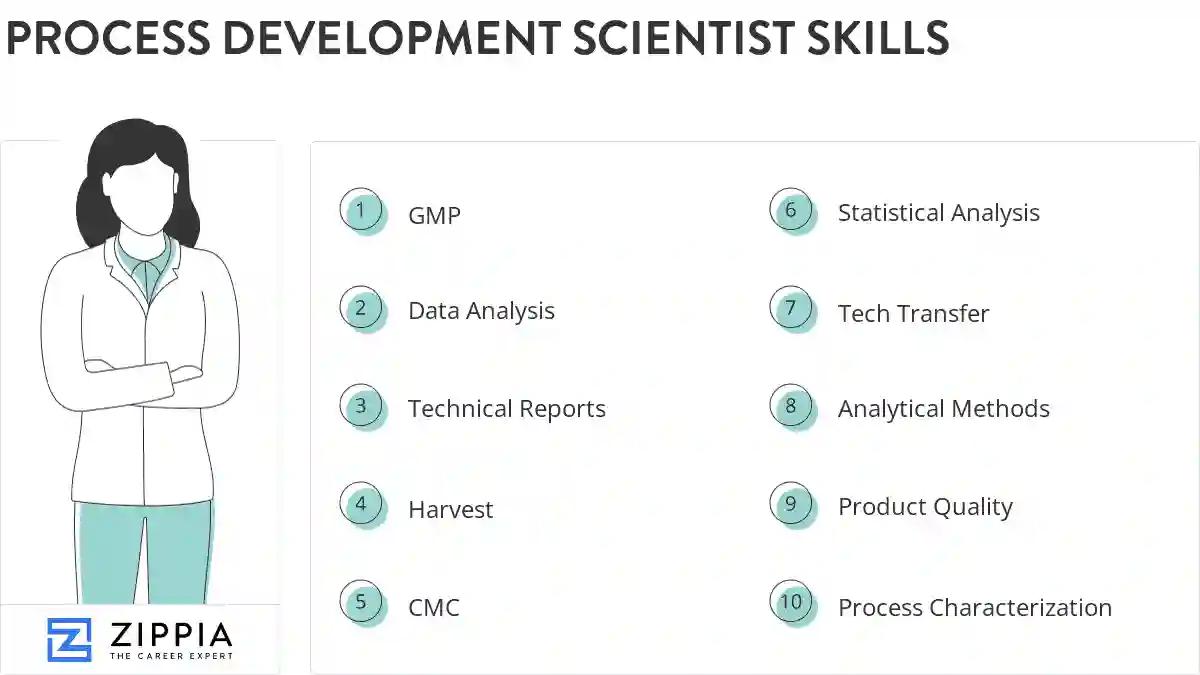
The most important skills for a process development scientist resume and required skills for a process development scientist to have include:
- GMP
- Data Analysis
- Technical Reports
- Harvest
- CMC
- Statistical Analysis
- Tech Transfer
- Analytical Methods
- Product Quality
- Process Characterization
- IND
- DOE
- Manufacturing Support
- Drug Substance
- HPLC
- Dosage Forms
- FDA
- Product Development
- Development Reports
- Experimental Data
- Technical Support
- Clinical Trials
- QC
- Formulation Development
- Centrifugation
- Elisa
- Liquid Chromatography
- CMO
- Cell-Based Assays
- GLP
- Visualization
- Media Development
- Test Methods
- Pilot Scale
- PCR
- Process Validation
- Cell Lines
- Electrophoresis
- SDS-PAGE
- SME
- QbD
- Assay Development
- TFF
- Process Optimization
- Pilot Plant
- Production Process
Updated January 8, 2025
