Explore jobs
Find specific jobs
Explore careers
Explore professions
Best companies
Explore companies
Job outlook for process improvement consultants in the United States
Process improvement consultant job growth summary. After extensive research, interviews, and analysis, Zippia's data science team found that:
The projected process improvement consultant job growth rate is 11% from 2018-2028.
About 108,400 new jobs for process improvement consultants are projected over the next decade.
Process improvement consultant salaries have increased 8% for process improvement consultants in the last 5 years.
There are over 11,943 process improvement consultants currently employed in the United States.
There are 86,144 active process improvement consultant job openings in the US.
The average process improvement consultant salary is $88,903.
Are process improvement consultant jobs in demand?
Process improvement consultant job and salary trends over time
Process improvement consultant jobs over time
Process improvement consultant job growth rate over time
| Year | # of jobs | % of population |
|---|---|---|
| 2021 | 11,943 | 0.00% |
| 2020 | 11,514 | 0.00% |
| 2019 | 11,258 | 0.00% |
| 2018 | 10,837 | 0.00% |
| 2017 | 10,395 | 0.00% |
Average process improvement consultant salary over time
Process improvement consultant salary by year
| Year | Avg. salary | Hourly rate | % Change |
|---|---|---|---|
| 2026 | $88,903 | $42.74 | +2.8% |
| 2025 | $86,469 | $41.57 | +2.0% |
| 2024 | $84,796 | $40.77 | +1.4% |
| 2023 | $83,619 | $40.20 | +1.4% |
| 2022 | $82,483 | $39.66 | +0.0% |
Process improvement consultant jobs by state
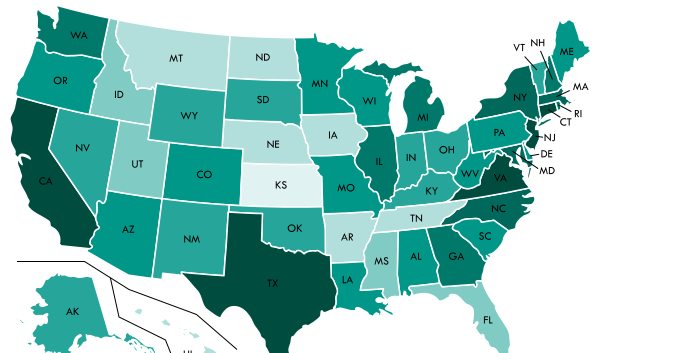
Most common states for process improvement consultants
| Rank | State | Population | # of jobs | Employment/ 1000ppl |
|---|---|---|---|---|
| 1 | District of Columbia | 693,972 | 529 | 76% |
| 2 | Vermont | 623,657 | 135 | 22% |
| 3 | Massachusetts | 6,859,819 | 1,366 | 20% |
| 4 | Delaware | 961,939 | 196 | 20% |
| 5 | Rhode Island | 1,059,639 | 206 | 19% |
| 6 | South Dakota | 869,666 | 168 | 19% |
| 7 | New Hampshire | 1,342,795 | 247 | 18% |
| 8 | New Mexico | 2,088,070 | 348 | 17% |
| 9 | Maine | 1,335,907 | 231 | 17% |
| 10 | Utah | 3,101,833 | 486 | 16% |
| 11 | West Virginia | 1,815,857 | 288 | 16% |
| 12 | Illinois | 12,802,023 | 1,911 | 15% |
| 13 | Virginia | 8,470,020 | 1,276 | 15% |
| 14 | Alabama | 4,874,747 | 709 | 15% |
| 15 | Idaho | 1,716,943 | 258 | 15% |
| 16 | South Carolina | 5,024,369 | 701 | 14% |
| 17 | Oregon | 4,142,776 | 582 | 14% |
| 18 | Connecticut | 3,588,184 | 488 | 14% |
| 19 | Wyoming | 579,315 | 81 | 14% |
| 20 | California | 39,536,653 | 4,972 | 13% |
Most common cities for process improvement consultants
| Rank | City | # of jobs | Employment/ 1000ppl | Avg. salary |
|---|---|---|---|---|
| 1 | Dover | 4 | 11% | $85,698 |
| 2 | Frankfort | 3 | 11% | $79,007 |
| 3 | Annapolis | 3 | 8% | $98,252 |
| 4 | Lansing | 6 | 5% | $90,937 |
| 5 | Baton Rouge | 7 | 3% | $85,155 |
| 6 | Hartford | 4 | 3% | $101,744 |
| 7 | Topeka | 4 | 3% | $63,903 |
| 8 | Des Moines | 4 | 2% | $70,176 |
| 9 | Montgomery | 4 | 2% | $86,547 |
| 10 | Tallahassee | 4 | 2% | $80,481 |
| 11 | Little Rock | 3 | 2% | $70,769 |
| 12 | Washington | 5 | 1% | $104,779 |
| 13 | Atlanta | 4 | 1% | $89,505 |
| 14 | Saint Paul | 4 | 1% | $89,229 |
| 15 | Sacramento | 3 | 1% | $106,892 |
| 16 | Indianapolis | 4 | 0% | $78,379 |
| 17 | Phoenix | 4 | 0% | $87,394 |
| 18 | Boston | 3 | 0% | $98,180 |
Process Improvement Consultant job outlook: Expert opinions
Our panel of process improvement consultant experts
University of West Florida

Lewis-Clark State College
Xavier University

Coastal Carolina University
Florida State University
UMass Lowell

University of Nevada, Reno
Bucknell University
The University of North Carolina at Greensboro

Ohio Wesleyan University
Drexel University

Bay Path University
Drew University
Molloy College

Alfred University

University of Georgia, Terry College of Business
North Carolina State University
University of Pittsburgh - Bradford
Elon University
Lake Superior State University
What will help Process Improvement Consultants increase their earning potential?
Dr. Haris Alibašić Ph.D., MPA: "In the next 3-5 years, specific skills are poised to become increasingly important in business: Data Literacy, Digital Proficiency, Emotional Intelligence, Sustainability, Resilience, and Social Responsibility. However, the most necessary lasting skill that benefited my career is Effective Communication. Being able to communicate effectively is an indispensable skill."
What skills will help Process Improvement Consultants earn the most?
Jenny Scott: -Emotional Intelligence
-Relevant industry experience (expertise)
-Written and oral presentation communication
-Ability to relate and connect . . .the best strategy in the world will live on paper only if the leader is not able to relate to their people (all stakeholder groups) and connect. Leadership involves three key elements: People - Influence - Goals. The most effective leaders are able to ethically influence their followers for the purpose of attaining the organization's mission and goals.
Mike Halloran
Teaching Professor, Management and Entrepreneurship, Taskforce Member, Center for InnovationXavier University
Management Department
What soft skills should all Process Improvement Consultants possess?
Mike Halloran: -Leadership
-Working well with others
-Oral and written communication
- Thinking analytically, creatively, and strategically
-Leadership
-Time management
- Motivation and drive
Sourav Batabyal Ph.D.
Assistant Professor, Finance and EconomicsCoastal Carolina University
Finance and Economics Department
What skills stand out on Process Improvement Consultant resumes?
Sourav Batabyal Ph.D.: Problem-solving, Creative thinking, Data Analytics, Competitive Strategies, Communication, Leadership and Team Building, Decision making.
C. Darren Brooks Ph.D.
Assistant Department Chair and Executive Director, Center for Human Resource ManagementFlorida State University
Department of Management and the Center for Human Resource Management
What soft skills should all Process Improvement Consultants possess?
C. Darren Brooks Ph.D.: While advancements in technology, artificial intelligence (AI), and data analytics occupy center stage in many areas of management practice, soft skills continue to be seen as equally or even more important skills for success in the field of management. Soft skills are typically described as personal attributes, qualities, and characteristics that enable us to interact more effectively with others. In most fields of management, our ability to communicate, work with, and interact with other people constitutes a significant portion of the work we do. Consequently, employers are focused on identifying candidates who possess strong skills are areas of communication (verbal, written, and non-verbal), leadership and followership, collaboration, an ability to work in teams, intellectual curiosity, adaptability, conflict management, problem-solving, creativity.
What hard/technical skills are most important for Process Improvement Consultants?
C. Darren Brooks Ph.D.: As stated earlier, the field of management is broad and encompasses all industries and sectors. Consequently, the technical skills necessary to succeed will vary according to the specific knowledge and experiences required to understand the nuances of an organization. Accordingly, graduates who have business acumen and technical competency in a particular discipline or industry would be better positioned for employment opportunities. As a result, I always place emphasis on gaining internships and work experience concurrently with academic study. These experiences will provide a real-world understanding of the type of skills necessary to succeed in organizations as well as offer industry-specific knowledge. However, for many graduates, their practical skills are limited. In this case, it is important to ensure you have more generalizable skills that are applicable across industries, such as building digital fluency, analytical fluency, writing skills, and strong Excel skills. When speaking with consulting firms and industry employers, they repeatedly reference the need for graduates to demonstrate more advanced Excel skills.
What skills will help Process Improvement Consultants earn the most?
C. Darren Brooks Ph.D.: According to the Bureau of Labor Statistics, employment in management occupations will grow over the next decade by 9%. Due to the broad array of management opportunities, variations in skills necessary for success are likely to exist based on the type of management work being performed and the industry or sector. However, there are general management skills or competencies necessary for success, including management consulting, that employers continually seek from graduates. The ten most sought-after skills include the following: critical thinking, intellectual curiosity, innovation/creativity, problem-solving, analytical fluency, digital fluency, adaptability, resilience, aptitude for collaboration and teamwork, and human capital management.
What skills stand out on Process Improvement Consultant resumes?
C. Darren Brooks Ph.D.: Requisite skills relevant for management consulting roles that should be visible to employers can be grouped into the following three broad categories : (1) functional expertise and/or specialization of knowledge in particular areas or disciplines, (2) strong business analytics skills, and (3) the ability to lead projects or teams. Considering the broad nature of management, and particularly management consulting, skills should reflect the specific needs of the organization or industry of practice. For example, individuals working in executive compensation would require a different set of demonstrated skills on their resume than someone engaging in performance systems analysis to support process re-engineering within a manufacturing setting. Additionally, since management professionals work in and/or lead teams, being personable, engaging, proactive, demonstrated leadership, and an ability to handle difficult situations are all skills and competencies highly sought after. In sum, regardless of the industry or sector, most employers look for skills displayed both on a resume and then demonstrated during the selection process that shows the applicant possesses the capability to work within a team, has sound analytical skills, the ability to communicate complex information, resolve conflict and solve problems.
Michael Ciuchta Ph.D.
Associate Professor, Program Coordinator, Masters of Science in EntrepreneurshipUMass Lowell
Department of Marketing, Entrepreneurship & Innovation
What skills stand out on Process Improvement Consultant resumes?
Michael Ciuchta Ph.D.: If we are talking about personal skills, I would stress skills that reflect an entrepreneurial mindset, such as innovativeness and initiative. I would also emphasize as much as possible prior experience in the relevant area.
What soft skills should all Process Improvement Consultants possess?
Michael Ciuchta Ph.D.: In addition to the above, in today's environment, it is important that people are adept at improvising. For long-term career success in any field, sound leadership skills are critical. It is important to be able to formulate, communicate and execute a compelling vision for where you want to take your organization.
What skills will help Process Improvement Consultants earn the most?
Michael Ciuchta Ph.D.: Although certain careers will pay more on average than others (and this discrepancy can be significant and should not be discounted, especially if a student is taking on debt to pursue an education), I strongly feel that people are best off in the long run if they stay authentic to who they are and what they are passionate about.
What hard/technical skills are most important for Process Improvement Consultants?
Michael Ciuchta Ph.D.: Many people would consider communication a "soft" skill, but there is a technical aspect of it that is overlooked. Programming and data analytics are probably the most marketable skills right now.
Jim McClenahan
Director of Career and Corporate OutreachUniversity of Nevada, Reno
College of Business
What skills stand out on Process Improvement Consultant resumes?
Jim McClenahan: Most importantly, skills that are customized for the job you are applying. Someone could work in a restaurant and have great customer management skills that would work well in a bank. The key is identifying "transferrable skills"-how what you did is relevant for the job you are applying. The applicant has to articulate that-don't expect the committee, screener, or HR Recruiter to make the connections. For business majors, the skills that differentiate applicants are technical skills when they are relevant to the job. Data analysis, coding, SQL are often looked for by employers that have a tech focus as preferred skills.
Are there any particularly good places in the United States for Process Improvement Consultants to find work opportunities?
Jim McClenahan: The trend of great opportunities consolidating in major metropolitan areas seems to be reversing. With working remotely appearing to be a permanent feature/benefit, find a place to live that offers a lower cost and great quality of life for you and your family! Build a variety of skills and achievements in different areas and find the right culture that matches your skills.
Neil Boyd Ph.D.
David J. & Deborah West Professor of Management; Chair, Management and Organizations DepartmentBucknell University
Management and Organizations Department
What skills will help Process Improvement Consultants earn the most?
Neil Boyd Ph.D.: A combination of hard and soft skills, but at the end of the day, soft skills are critical to truly helping clients. And, for sure, they can be learned. This is a challenge for management education, but places like the Freeman College of Management at Bucknell work hard to develop soft skills in students primarily through coaching, experiential and community-based pedagogies, and professional development programming.
Dr. Dianne Welsh
Hayes Distinguished Professor, Founding Director Entrepreneurship Cross-Disciplinary ProgramThe University of North Carolina at Greensboro
Department of Marketing, Entrepreneurship, Hospitality & Tourism
What's a day at work look like for a Process Improvement Consultant?
Dr. Dianne Welsh: For entrepreneurs, a day at work is going to be anything but routine. We teach how to "pivot" and look for opportunities out of any situation. That's what they'll be looking for each day while keeping up with the routine work.
What will help Process Improvement Consultants increase their earning potential?
Dr. Dianne Welsh: Finding opportunities that evolve in a myriad of situations. These can be while a graduate in entrepreneurship works for a small/medium enterprise, a non-profit, or a larger company or even themselves. All businesses need entrepreneurs which is "to be creative and innovative in anything that creates value" (Welsh 2014). From my book Creative Cross-Disciplinary Entrepreneurship (Palgrave-Macmillan). Entrepreneurs are needed in every organization. By finding opportunities, bringing them to the attention of companies or individuals, or pursuing the opportunity themselves, an entrepreneur increases their earning potential. Finding opportunities is a daily endeavor.
Will there be an enduring impact of the coronavirus pandemic on Process Improvement Consultants?
Dr. Dianne Welsh: I believe all students will feel an enduring impact of the coronavirus pandemic from the perspective of knowing that one should be ready for anything, no matter when, no matter where. We teach this in entrepreneurship and it is the best degree to teach flexibility and dealing with ambiguity-the unknown. We teach how to "pivot" and look for opportunities out of any situation.
What Process Improvement Consultant skills would you recommend for someone trying to advance their career?
Dr. Robert Gitter: Too many students believe there is a direct relationship between one's major and the occupation they wind up in. The relationship is a lot less direct than they believe. If a student were to take a gap year, I would recommend getting an internship or volunteer in a field they might want to enter or perhaps additional coursework in an area of interest. Frankly, in 2019 I might have recommended traveling to new places during a gap year but would not make the same recommendation today.
Will there be an enduring impact of the coronavirus pandemic on Process Improvement Consultants?
Lauren D’Innocenzo Ph.D.: The coronavirus pandemic has certainly tightened the job market, with fewer available jobs in many sectors such as the service industry, but at the same time, has created many other opportunities for graduates in fields such as healthcare and supply chain. For new graduates, strategically considering opportunities may help to overcome some of the challenges presented in the current economy.
For example, if you are looking to gain experience in service, applying to service-oriented positions in IT or healthcare may offer more opportunities and give you more breadth of experience. I believe the potential for an enduring impact exists in a graduate's ability to adapt to changing demands and willingness to cast a wider net for available positions. Graduates who are myopically focused and unwilling to test their knowledge in different areas may not see the same opportunities, and over time, the lack of opportunities can add up. Now is a great time to work on your resilience and flexibility.
What type of skills will young Process Improvement Consultants need?
Lauren D’Innocenzo Ph.D.: We are seeing more and more the need for core skills (formerly known as soft skills). These skills include being able to work in a team, leadership, critical problem-solving, and negotiations, to name a few. Many employers see these skills as transferable across contexts and increase the likelihood that the individual will be able to work with others and think outside of the box in collaborative, knowledge-intensive environments. We know that much of the learning for jobs occurs on the job and having these core skills can really help you to stand out as a team-oriented individual, who is willing to think beyond their own needs, and can learn organizational-specific skills needed to succeed in the employer's company.
What experience really stands out on Process Improvement Consultant resumes?
Lauren D’Innocenzo Ph.D.: Similar to above, having experience around these core skills can really help anyone, including new graduates, stand out from the crowd. This experience can come from taking courses designed to build these skills or engaging in positions or internships that provide opportunities to grow these skills. For example, at Drexel University, we offer a program (Organizational Management) designed specifically to grow these skills through experiential learning that any student can take, regardless of undergraduate major. Outside of the classroom, being a peer leader, working as a camp counselor, or taking on an internship working in a team can be very helpful in building these skills. The key is to highlight these opportunities and skills in your resume. Don't just talk about the tasks you did, but describe the core skills needed for the position and built as a result of the position.
Additionally, remote and virtual work is not going away anytime soon. In fact, many organizations have offloaded brick and mortar locations and have strategically decided to rely more on remote business. Now more than ever, demonstrating your ability to successfully work in a remote environment will be extremely favorable for many employers.
Eleni Barbieri
Adjunct ProfessorBay Path University
School of Science and Management
What are the biggest trends we'll see in the Process Improvement Consultant job market given the pandemic?
Eleni Barbieri: The online shopping model already had a headstart before the pandemic, and the pandemic has exponentially increased this trend. Retail sale supervision and management positions are going to decrease. Computer programming, network management, internet security, warehouse management, logistics, and delivery-related employment positions are going to increase. Also, computers have enabled more and more large corporations to allow employees to work from home. Initially originating from a need to isolate employees during the pandemic, corporations are seeing great benefits with this practice, with little or no reduction in work output and high dollar value in not having to maintain workspaces for employees. Sadly, due to a tragic decrease of generation X consumers, due to the pandemic, businesses that targeted and relied on that segment of the population will suffer.
Specifically in the area of legal services, you will see a greater difficulty in recruiting and keeping entry-level service providers. The pandemic exposed the contamination risks to those working within in the legal service profession. The risk of future pandemics, current portrayal of the legal services profession in the media, and the ever-compounding avalanche of retirements due to those factors, will create a need for employers to find incentives for people to enter and stay in this demanding field of service.
What Process Improvement Consultant skills would you recommend for someone trying to advance their career?
Eleni Barbieri: I would highly recommend that they work to improve their communication skills. I suggest working to improve all aspects of their communication skills, verbal, nonverbal, and written. The current generation of entry-level employees is already lacking in when it comes to the communication skill set required, due to the advent of texting, emails, and all other forms of indirect communication. The ability to communicate clearly will be an invaluable asset no matter the profession they decide to pursue. While they are working on their communication skills, they should also focus on their abilities to accurately receive communications. Being able to actively listen will garner a better understanding of the message the speaker is trying to convey and the environment in which they find themselves immersed.
Additionally, they need to remain current regarding changes, updates, or trends in their chosen field. They need to remain plugged into data sources that can provide them with the vital information that they require to maintain their proficiency levels in order to successfully return to the academic environment after their gap year.
What general advice would you give to a Process Improvement Consultant?
Eleni Barbieri: Take advantage of every opportunity to intern, observe, or volunteer in the area of your chosen profession. Gather as much information as possible to assist you in making sure that the profession that you chose is the one that you really wantd. There are many different professions in the legal services field. Go in with an open mind and with your eyes wide open; sample all the ones you're interested in so that you can get on track to your ultimate career goal as soon as possible. Do your research to ensure that you pick the organization that best suits your ideals and your vision of an environment that inspires and motivates you to succeed.
Remember that you never stop learning. Stay informed. You will work with numerous people. Try to emulate the ones that you feel are the most successful and professional. Focus is everything. Have a short-term plan, a five-year plan, and a long-term plan. It's alright to adjust your plan as long as you keep your ultimate goals in sight.
What skills stand out on Process Improvement Consultant resumes?
Christopher Andrews: A combination of hard skills and soft skills. While hard skills include things like data analysis or experience using specific computer program applications, employers also value important soft skills such as attention to detail, time management, and teamwork. The latter might be implied or taken for granted but are critical nevertheless, especially for customer-facing jobs or those involving working with a group. While we're pretty good at defining and describing hard skills, I think we need to do better in helping students to articulate their soft skills and learn how to translate academic experiences and knowledge into things employers understand and value.
What are the biggest trends we'll see in the Process Improvement Consultant job market given the pandemic?
Brian Noll: The pandemic, for the most part, has not had an impact on the job market for students graduating from Molloy College with an accounting degree. The students of ours that had commitments at medium to large (Big 4) accounting firms started their positions as planned, albeit in a remote capacity. We experienced only a few individuals that had start dates deferred for a few months. In addition, the majority of our accounting students have been successful in obtaining internships for the fall of 2019 and spring of 2020.
What Process Improvement Consultant skills would you recommend for someone trying to advance their career?
Brian Noll: To study and pass the CPA Exam as soon as possible. Studies have shown that there is a higher likelihood of success on the exam when it is taken shortly after graduation. Once a graduate starts thier full time position they will have much less time available to focus on the exam. Most firms offer a bonus ($5,000 is the norm) for employees that pass the exam within one year of their start date, as having a CPA certification increases your future earning potential and grants a higher degree of upward mobility. One should consider taking a gap year towards passing the CPA exam to be a gift. In addition, students should continually sharpen their Excel skills. Having a CPA with strong Excel skills will make a graduate much more marketable.
What general advice would you give to a Process Improvement Consultant?
Brian Noll: To "put your head down" and do your work! Never complain about having to work additional hours as this is the norm in the accounting profession. Having a good work ethic is essential to success in your career. Lastly, stay off your phone! Your phone should be used for personal matters on your own time and not during work hours.
What are the biggest trends we'll see in the Process Improvement Consultant job market given the pandemic?
Jean Ellefson: COVID has accelerated the trends for traits that the next generations expect in an employer, including flexible virtual working capability, growing virtual business models with technology, analytics usage, and most importantly, purpose beyond profit. Students entering the workforce this year have the rare opportunity of joining companies that are demonstrating flexibility in strategy and adaptability in business execution, as these tend to be hiring. There are many companies and industries that have been surviving on the previous brick-and-mortar status quo, but COVID has accelerated the demise of these and made clearer the likely future successors. Employees are starting virtually with companies, which allows them a broader range of companies to pursue when tied with short-term geographical preferences or concerns.
Ron Aubé Ph.D.
Adjunct Professor of ManagementUniversity of Georgia, Terry College of Business
Department of Management
What are the biggest trends we'll see in the Process Improvement Consultant job market given the pandemic?
Ron Aubé Ph.D.: Covid-19 raised awareness about the importance of trust and flexibility in the workplace. Organizations have been forced to explore options beyond traditional office solutions and learned to adapt for different tasks and projects while maintaining employee morale and productivity. Remote work and entrusting employees is not only possible, but necessary, as well as profitable. Companies found that employees can remain effective and productive, while enjoying increased job satisfaction and progressive organizations look for opportunities to arrange talent-sharing partnerships with other organizations.
Remote work has in some ways dehumanized employees and much remains to be done to prioritize the well-being of employees, treating them as people first and workers second. Personal factors promoting physical health and emotional well-being are trendy. Gartner (2020) finds that 32 percent of organizations are replacing full-time employees with contingent workers as a cost-saving measure. The workforce will be increasingly distributed requiring new forms of management and leadership at the top and ways to enhance job satisfaction. Furthermore, the cross-generational workforce curve is being reshaped as many workers aged over 65 are retiring due to infection concerns. While young workers are currently more likely to be in jobs impacted by the crisis, this exodus of older workers opens the door for them to step in.
Unlike typical recessions where the consumption of goods collapses while services remain largely stable, this pandemic has created the opposite. The service industries (entertainment, travel, lodging, full-service restaurants, elective healthcare, and childcare) have been the most adversely affected driven by the impact of social distancing (Source: U.S. Bureau of Labor Statistics). Employment opportunities in production, transportation, storage, and selling of goods (excluding retail) are therefore expected to rise. Fueled by the new realities of social distancing and the increased need for digital collaborations in the workforce, fields related to artificial intelligence are growing at an accelerated pace.
Migration away from large urban centers is becoming noticeable as fewer people come to work and spend money in the city. As a result, the most significant drop in hiring has occurred in large metropolitan areas, while outside the cities, hiring is on the rise.
What Process Improvement Consultant skills would you recommend for someone trying to advance their career?
Ron Aubé Ph.D.: Across all spheres of the working population, people have been forced to undertake a crash course in technology, from audio-visual meetings to other online collaborative media. These skills are crucial and the engine of change in our "new normal" world. Among the companies being forced to try telecommuting, it is a safe bet that many will decide to adopt this more economical and efficient work arrangement and allow people to work from home.
Connecting with people remotely and bringing energy to communications requires excellent written communication and creativity in interacting via modern technology. A recent Gartner poll showed that 48 percent of employees will likely work remotely at least part of the time after COVID-19 versus 30 percent before the pandemic. Collaborating digitally in a remote and distributed context will require adjusting the employee experience with new strategies, goal-setting and employee evaluations. Developing excellent communication skills is crucial. Learn how to write clearly, concisely, and quickly. Avoid long sentences, get to the point. People have a short span of attention. Captivate your audience in the beginning of your communication.
Model after other successful writers and practice, practice, practice! The only way to get better at writing is to write. The "new normal" will be kind to those who can communicate effectively and persuasively. The workforce is composed of five different generations and it's crucial for the new generation to learn how to collaboration with older cohorts. As such, without the need to show reverence for older workers, show respect and willingness to learn. Conversely offer help. Reverse mentoring is very popular in many organizations. Knowledge transfer is beneficial for all.
What general advice would you give to a Process Improvement Consultant?
Ron Aubé Ph.D.: Be humble and coachable. Get several mentors and absorb all the knowledge you can from them. Learn from experienced workers and share your own knowledge. Older generations are not always as savvy with technology and reverse mentoring has proven productive whereas older experienced workers can teach the younger cohorts about how to navigate organizational and decision-making issues. Remote work has made this a bit more challenging but not impossible. Build your network. Get involved in everything and anything related to your field of expertise. Be seen. Share your knowledge. Be confident, yet humble and open to new ideas.
As the workplace is still undergoing significant behavior change forced by Covid-19, probably the best advice I could give to a graduate beginning her/his career is to be adaptable and seek to work for an organization with a culture of agility and innovation. Organizations refusing to change and adapt are doomed to fail ultimately. As a young graduate with the knowledge of technology, you have an enormous advantage over workers not possessing the ability to navigate the digital world so easily. Take advantage of it.
Steve Barr Ph.D.
Professor of Technology ManagementNorth Carolina State University
Department of Management Innovation & Entrepreneurship
What Process Improvement Consultant skills would you recommend for someone trying to advance their career?
Steve Barr Ph.D.: I generally discourage a "gap" year, unless necessary. If you take one, you need to be able to show that your activities are consistent with developing skills/abilities that will facilitate your career and value to potential employers. Taking a year off to "find yourself" does not cut it.
What general advice would you give to a Process Improvement Consultant?
Steve Barr Ph.D.: You have to think about a career and not just a job. It is not all about the money. If you take a job to "chase the money" you will be disappointed later. Find something that you are passionate about and give it your best. The money will work out over time. I see too many people who can't wait to retire but have to stay "for the money" due to their lifestyle and lack of savings. This is very sad. I may never retire, I really like what I am doing. It is not for the money.
Be prepared to move to take the first job/step in your career. You also need to be prepared for "constant learning" for your job, be it technological changes, supply chain changes, industry/economic value changes, etc. Your best option is to be able to show that you can "create value for the organization" in specific ways so you need to plan your education and career in a way(s) that enable you to "create value" in different organizations.
What are the biggest trends we'll see in the Process Improvement Consultant job market given the pandemic?
Steve Barr Ph.D.: Less full-time employees and more contract/1099 employees as firms do not want to ramp up with full-time employees given benefits requirements and the desire for flexibility in human resource management. This was starting before COVID, it will accelerate. More "remote work" even after COVID stops as employers will stop paying for expensive large office space rent. Less employment in large cities, look now at office space available in NYC, SF/Oakland, Chicago, LA, etc. Employers are fleeing high tax states like New York and Calif. Look at recent decisions by HP, Oracle, Tesla, etc. This is just the first wave. The new "rust belt" will be these large cities. I also look for more hiring by smaller vs. larger organizations.
Dr. Wes C. Chiang
Assistant Professor of MarketingUniversity of Pittsburgh - Bradford
Division of Management and Education
What type of skills will young Process Improvement Consultants need?
Dr. Wes C. Chiang: -They need to be literate in current technology for communications. Working and meeting from home potentially will become an abnormal-normal norm.
-Team work via online collaborations
-Self-disciplined and self-directed learning skill for the changing era
What experience really stands out on Process Improvement Consultant resumes?
Dr. Wes C. Chiang: It depends on what jobs, careers, and positions they are applying for. In general, they need to show their recent and relevant experiences and skills that match the job descriptions. On top of the general ones, they need to illustrate the following experiences:
-Technology communications
-Team work and collaborations
-Work-from-home experience
What are the biggest trends we'll see in the Process Improvement Consultant job market given the pandemic?
Brooke Buffington: The good news is that companies are still hiring and internships are still being offered. We are seeing a bit of a delay in the traditional hiring timeline, as companies navigate this unique marketplace. Therefore, companies may wait slightly longer than normal to extend offers.
What skills stand out on Process Improvement Consultant resumes?
Brooke Buffington: Skills that standout are often position specific, but there are always skills that a wide-variety of employers seek. These skills align with the competencies developed by the National Association of Colleges and Employers (NACE), which include skills in critical thinking/problem solving, oral/written communication, teamwork/collaboration, digital technology, leadership, professionalism/work-ethic, career management, and global/intercultural fluency.
Are there any particularly good places in the United States for Process Improvement Consultants to find work opportunities?
Brooke Buffington: This is a difficult question to answer as there are a wide variety of opportunities that a management student or management professional might pursue. I would recommend that applicants be open on location, which allows them to throw a wider net, and to consider more options during this time.
Marta Diaz
Assistant ProfessorLake Superior State University
Lukenda School of Business
What are the biggest trends we'll see in the Process Improvement Consultant job market given the pandemic?
Marta Diaz: "-The trend toward remote work and learning was already happening for several years, but the pandemic forced us to adapt faster to remote work and knowledge than we would have under our pre-pandemic rates.
-Remote work opportunities will continue to increase and become permanent in some industries. For example, some institutions leave high tax states for lower tax states and expect employees to work from anywhere in the world. Individuals also realize that remote work allows them to work and live where they want - avoiding long commutes.
-Employers will be hiring, but competition for positions will be high, given the pandemic effects on specific industries. College graduates need to bring their absolute best in resumes, interview skills, and professional presence."
What skills stand out on Process Improvement Consultant resumes?
Marta Diaz: -The skills that will stand out on a resume are the ones that meet the needs of the employer as described in the position description. Adaptability/flexibility are valuable during this time of uncertainty created by the pandemic.
-Digital literacy skills in remote work and learning and business software application skills are essential for business students. Graduates are learning these skills in college, bringing these skills to the employer rather than developing these skills on the job.
-Many businesses are also training online, so students can have an advantage because they have learned how to learn online.
Are there any particularly good places in the United States for Process Improvement Consultants to find work opportunities?
Marta Diaz:
-Larger metropolitan areas would most likely have the largest number of opportunities; however, there will be more remote work opportunities without living in these metro areas.
-A new job opportunity for the future is the CRO (Chief Remote Officer), responsible for managing remote workers.