
Automatically apply for jobs with Zippia
Upload your resume to get started.
Production tester skills for your resume and career
15 production tester skills for your resume and career
1. PPE
Personal protective equipment is an item of protective clothing such as goggles, helmets, or other garments meant to protect the body from injury.
- Perform accurate and rapid testing to ensure quality control utilizing safety and operation procedures, wearing the proper PPE.
2. Rig
Rigging includes designing, preparing, or setting up equipment for drilling operations. This skill is one of the main and most important activities in the oil and gas industry, whether it's for onboard operations or port operations. Rigging systems should have parts like master links, shackles, slings, and lifting bags for underwater lifting. Professionals working with rigging systems are responsible for tasks like operating platform lifts, forklifts, and overhead cranes.
- Monitor and document well head pressure * Rig up and Rig down manifolds and iron * Remove and replace manifold valves
- Performed numerous Acoustic Well Sounder (AWS) reports, coil tubing/work over rig wash out and mill outs operations.
3. Test Equipment
Test equipment is a mechanical tool or a device which is used create signals and gather response from an electronic device under test. It helps in detecting any faults in the device and it also proves the proper operation of the electronic device.
- Set up and operate test equipment to remove petroleum products from the basins of the earth.
- Mentor trouble shootings, operation and maintenance of lease and test equipment.
4. Frac
- Control recovery of frac fluid* Performed tests on new wells to determine capacities and volumes
- Assist in Frac and Coil Tubing jobs.
5. Functionality
- Performed Smoke testing by posting messages into the queues using RFHUtil tool to ensure basic functionality is working fine.
- Assisted quality, regulatory director and engineering with the quality and functionality of new and current products.
6. CDL
- Have a Class-A CDL(see additional information below) hauled equipment to location, and completed hotshot request for equipment.
- Use of Class A CDL to transport all needed equipment to locations and different shops.
Choose from 10+ customizable production tester resume templates
Build a professional production tester resume in minutes. Our AI resume writing assistant will guide you through every step of the process, and you can choose from 10+ resume templates to create your production tester resume.7. H2S
- Run water chlorides, pull Bendix tubes for H2S, and run oil gravity's.
- Display strong leadership and experience in high H2S wells.
8. Troubleshoot
Troubleshooting is the process of analyzing and fixing any kind of problem in a system or a machine. Troubleshooting is the detailed yet quick search in the system for the main source of an issue and solving it.
- Assembled, inspected, tested, troubleshoot, and repaired circuits to component level.
- Train assistants on how to troubleshoot equipment problems and perform repairs as needed.
9. Test Cases
- Developed and modified test cases for expediting bug tracking, and daily code renewal.
- Manage the requirements, test cases, defects and reports using HP ALM.
10. QA
QA, or Quality Assurance is a procedure that entails all of the steps taken to avoid any errors in the manufacturing process or in the production of the goods that a company produces. It can also include ensuring the consistency of the services rendered. Quality assurance ensures that the quality of the service delivered to consumers meets or exceeds the promised expectations. This greatly aids in the prevention of any complications that might arise after the goods or services have been distributed. It makes sure that customers are satisfied.
- Provided support for QA team from Alpha to code release for a challenging port.
- Analyzed business requirements, system requirements, and data mapping requirement specifications interacting with client, developers and QA team.
11. API
- Created test cases, test plans, tested API's, executed code coverage, wrote automation scripts using Selenium WebDriver.
- Generated, parsed and validated JSON and XML formatted data using Groovy Script that received in response from REST API calls.
12. JSA
- Hold and attend daily JSA meetings and any other responsibilities dictated by foreman.
- Make a JSA for everyday activity on location.
13. Circuit Boards
A circuit board refers to an electronic device used to offer mechanical support and connect components electrically using signal traces and conductive pathways.
- Examine and prepare solid state DC motor control circuit boards for testing.
- Test and calibrate motor control circuit boards to meet customers Specifications.
14. Assembly Line
Assembly line is a process used in industries to ensure the production of products in a cost effective manner by dividing up the responsibilities of each labor. Assembly lines enabled industries to hire more workers, therefore providing more employment opportunities to labors. This is possible because in this process the burden of all the tasks related to production are not laid on a single person, they are divided into small baby steps for each labor.
- Job Responsibilities: Production worker on assembly line, used air tools to assemble tools, tested tools for imperfections.
- Manufactured solenoids for General Motors assembly line.
15. Production Equipment
Production equipment in limited terms is used to define any type of machinery or equipment used in the production of a video or film. Basic production equipment includes a camera, tripod, lighting kit, camera light, short term microphone, light reflector, boom pole, shock mount, audio cables, wireless microphone, headphones, portable digital audio recorder, camera lenses, extra batteries, external hard drive, and DSLR shoulder mount rig.
- Set up and operated production equipment in accordance with current good manufacturing practices and standard operating procedures.
- Set up and operate production equipment in accordance with current good manufacturing practices and standard operating procedures.
5 Production Tester resume examples
Build a professional production tester resume in minutes. Browse through our resume examples to identify the best way to word your resume. Then choose from 5+ resume templates to create your production tester resume.

What skills help Production Testers find jobs?
Tell us what job you are looking for, we’ll show you what skills employers want.
List of production tester skills to add to your resume
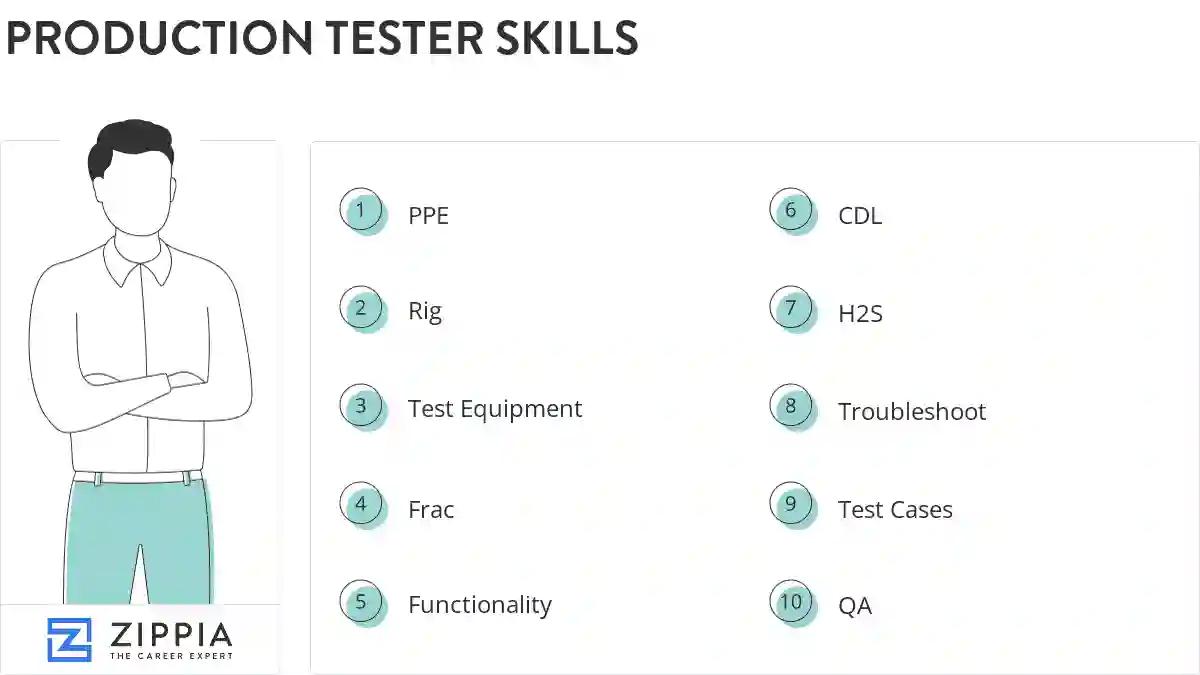
The most important skills for a production tester resume and required skills for a production tester to have include:
- PPE
- Rig
- Test Equipment
- Frac
- Functionality
- CDL
- H2S
- Troubleshoot
- Test Cases
- QA
- API
- JSA
- Circuit Boards
- Assembly Line
- Production Equipment
- HR
- User Acceptance
- Quality Standards
- GUI
- Test Scenarios
- UAT
- Test Specifications
- Lease Equipment
- Load Runner
- QTP
Updated January 8, 2025
