Explore jobs
Find specific jobs
Explore careers
Explore professions
Best companies
Explore companies
Job outlook for program manager interns in the United States
Are program manager internship jobs in demand?
Program manager internship job and salary trends over time
Program manager internship jobs over time
Program manager internship job growth rate over time
| Year | # of jobs | % of population |
|---|---|---|
| 2021 | 529 | 0.00% |
| 2020 | 218 | 0.00% |
| 2019 | 220 | 0.00% |
| 2018 | 492 | 0.00% |
| 2017 | 457 | 0.00% |
Average program manager internship salary over time
Program manager internship salary by year
| Year | Avg. salary | Hourly rate | % Change |
|---|---|---|---|
| 2026 | $45,216 | $21.74 | +4.2% |
| 2025 | $43,373 | $20.85 | +1.3% |
| 2024 | $42,812 | $20.58 | +1.8% |
| 2023 | $42,067 | $20.22 | +0.6% |
| 2022 | $41,813 | $20.10 | +0.1% |
Program manager internship jobs by state
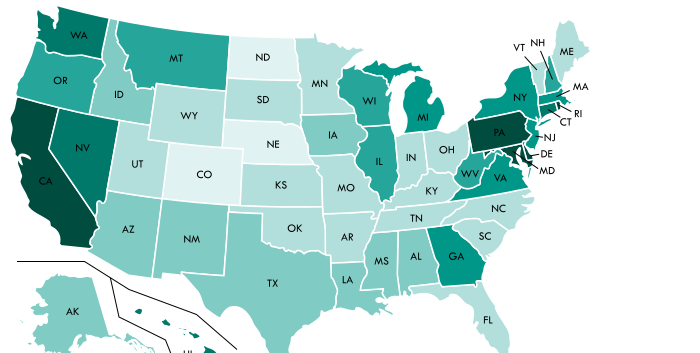
Most common states for program manager interns
| Rank | State | Population | # of jobs | Employment/ 1000ppl |
|---|---|---|---|---|
| 1 | District of Columbia | 693,972 | 618 | 89% |
| 2 | Washington | 7,405,743 | 2,873 | 39% |
| 3 | Delaware | 961,939 | 285 | 30% |
| 4 | North Dakota | 755,393 | 226 | 30% |
| 5 | Wyoming | 579,315 | 169 | 29% |
| 6 | Vermont | 623,657 | 175 | 28% |
| 7 | Montana | 1,050,493 | 287 | 27% |
| 8 | Massachusetts | 6,859,819 | 1,766 | 26% |
| 9 | New Hampshire | 1,342,795 | 348 | 26% |
| 10 | South Dakota | 869,666 | 210 | 24% |
| 11 | Virginia | 8,470,020 | 1,916 | 23% |
| 12 | Connecticut | 3,588,184 | 745 | 21% |
| 13 | Utah | 3,101,833 | 663 | 21% |
| 14 | Nebraska | 1,920,076 | 399 | 21% |
| 15 | Idaho | 1,716,943 | 366 | 21% |
| 16 | Alaska | 739,795 | 158 | 21% |
| 17 | Maryland | 6,052,177 | 1,227 | 20% |
| 18 | Minnesota | 5,576,606 | 1,138 | 20% |
| 19 | Oregon | 4,142,776 | 823 | 20% |
| 20 | Rhode Island | 1,059,639 | 216 | 20% |
Most common cities for program manager interns
| Rank | City | # of jobs | Employment/ 1000ppl | Avg. salary |
|---|---|---|---|---|
| 1 | Urbandale | 2 | 5% | $41,102 |
| 2 | Palo Alto | 2 | 3% | $64,035 |
| 3 | Annapolis | 1 | 3% | $60,201 |
| 4 | Dearborn | 2 | 2% | $46,930 |
| 5 | Alpharetta | 1 | 2% | $47,238 |
| 6 | Sacramento | 5 | 1% | $62,544 |
| 7 | Atlanta | 4 | 1% | $47,252 |
| 8 | Tampa | 3 | 1% | $37,482 |
| 9 | Des Moines | 2 | 1% | $41,135 |
| 10 | Tallahassee | 2 | 1% | $36,120 |
| 11 | Allen | 1 | 1% | $38,010 |
| 12 | Allentown | 1 | 1% | $58,824 |
| 13 | Phoenix | 4 | 0% | $42,197 |
| 14 | Boston | 3 | 0% | $48,032 |
| 15 | Chicago | 2 | 0% | $44,610 |
| 16 | Dallas | 2 | 0% | $38,406 |
| 17 | Miami | 2 | 0% | $38,401 |
Program Manager Internship job outlook: Expert opinions
Our panel of program manager internship experts
University of Massachusetts Boston

Oklahoma Baptist University
Western Carolina University
Auburn University at Montgomery
Maryville University

Azusa Pacific University
Northern Kentucky University

University of Notre Dame

Seattle University

East Tennessee State University

Committee on the Status of Women in Astronomy - CSWA

The USA Hockey Foundation
Pacific Lutheran University

Hartwick College

Boston University

ASCP - Associated Skin Care Professionals
Muhlenberg College
American University
Pace University

Frostburg State University
Ellen Birchander
Graduate Program Director and Clinical Assistant ProfessorUniversity of Massachusetts Boston
Department of Gerontology
What skills stand out on Program Manager Internship resumes?
Ellen Birchander: The field of aging is very different than other disciplines. It encompasses all aspects of life for an older adult; healthcare, transportation, entertainment, consumerism, marketing, technology, social work, housing, insurance, nutrition, etc. This affords many opportunities for individuals who are passionate about working with older adults and their families. There are many entry-level options and lots of room for growth.
There are several characteristics that are advantageous. The most important characteristic is a love/ passion for working with an aging population. In addition, it helps to be curious and a quick learner, and to be patient.
Skills in the field transcend many disciplines. It is very important to have excellent interpersonal and listening skills. This is essential not only for direct service work but to continue to learn about a dynamic field that is constantly changing as people and environments change. Next, organizational skills are essential for negotiating the many intricate responsibilities that encompass an individual's life. Management skills allow individuals to move within a changing field. An understanding of health and wellness, social aspects of aging, and psychology are also very useful skill sets to have. No one lives in a vacuum, so understanding family dynamics is very useful.
In today's world, every profession requires some degree of proficiency with technology. The field of aging is no different. Attention to detail, analytical skills, and professionalism are key elements to success in the field.
As individuals gain experience and hone skills, the opportunities to develop policy and programs, direct home and community-based services, direct residential long-term care services, work in other fields such as finance, housing, entertainment as experts in aging increases.
Working as a gerontologist allows you to impact other people's lives with the goal of promoting autonomy, independence, and continued quality of life. There is little that is so fulfilling as making a difference.
Dr. Daryl Green
Associate Professor of BusinessOklahoma Baptist University
College of Business
What are the biggest trends we'll see in the Program Manager Internship job market given the pandemic?
Dr. Daryl Green: I have been researching emerging employment trends for several years. While working for the Department of Energy as a senior engineer, I have served as a college recruiter. There were gaps in the students' skill sets compared to employers' needs. I later co-authored a book called Job Strategies for the 21st Century to provide students with the necessary tools for future employment. 2021 will be very difficult due to the pandemic. From my research, here are 2021 employment trends to consider:
-Global Market - We are connected! Since employers can tap into human resources across the world, students will compete against others across the globe.
-Students who understand this employment reality will be better prepared.
-AI and Automation - Artificial intelligence is disruptive technology. Companies can avoid the high expense of labor through automation. According to 2013 Oxford University study, nearly half of American jobs are at risk of being taken over by computers by 2033. Students need to understand AI technologies.
-New Work Model - 2020 brought in the explosion of working from home due to Covid-19. Employees already wanted to have more flexibility in life. They got it from employers. Companies responded by offering 70% of full-time workers the ability to work from home!
-Freelancing - Freelancing is part of the gig economy. It goes much further than Airbnb and Uber. In the gig economy, businesses hire independent contractors to perform individual jobs, called "gigs." The total freelancing income is almost $1 trillion. Therefore, students who have an entrepreneurial mindset will fare better.
-Digital & Ecommerce - Covid-19 ushered the digital economy. If companies did not have a digital platform in 2020 with the lockdowns, they did not exist. According to the Internet World Stats, there are currently 4,208,571, 287 internet users. Therefore, students cannot afford to miss this continuing trend of digital platforms.
Will there be an enduring impact of the coronavirus pandemic on Program Manager Interns?
Angela Sebby Ph.D.: While jobs may be slower to return to the capacity pre-Covid, the industry and tourism employment will rebound as people still want to travel and explore diverse foods, cultures, and experiences. However, the enduring impact will be the rapid onset of technology that allowed for limited contact with employees and others has become the new norm. Although human interaction is an important aspect of service in the tourism industry, employers have found that they can reduce the number of personal interactions but still deliver an acceptable level of quality service. What would have taken years to adopt, COVID created an amplified adoption.
What soft skills should all Program Manager Interns possess?
TeWhan Hahn Ph.D.: Writing skills including email writing, being able to work in teams, and knowing the workplace etiquettes.
Meaghan Goodman Ph.D.
Program Director & Assistant ProfessorMaryville University
Speech-Language Pathology
What's a day at work look like for a Program Manager Internship?
Meaghan Goodman Ph.D.: A bachelor's in communication sciences and disorders can prepare you for three different tracks. First, it can prepare you to become a licensed Speech-Language Pathology Assistant (SLPA). This is someone who works under a fully credential speech-language pathologist. Often times, they carryout intervention plans developed by a fully credentialed speech-language pathologist. If graduate school is on your horizon, a bachelor's degree in communication sciences and disorders will prepare you for acceptance into a Speech-Language Pathology program, or an Audiology program. If you are not accepted into a graduate program right away, working as a speech-language pathology assistant (SLPA) is a great way to get experience in the field!
What are the biggest trends we'll see in the Program Manager Internship job market given the pandemic?
Bala Musa Ph.D.: Remote working and telecommuting will continue to grow proportionately, as part of organizational operations. Self-managed teams, global collaborations and machine-learning will be among the biggest trends in organizations of the future.
What's a good job out of college for Program Manager Interns?
Bala Musa Ph.D.: A good job out of college is one that allows you to apply creative and critical thinking skills. Future work environments will require employees to innovate and adapt. Any job that helps you cultivate, sharpen and apply those skills will serve you and your organization well. It will prepare you to adapt in the face of change and future disruptions.
Yaw Frimpong-Mansoh Ph.D.
Professor of Philosophy and Acting ChairNorthern Kentucky University
Department of Sociology, Anthropology, and Philosophy
What general advice would you give to a Program Manager Internship?
Yaw Frimpong-Mansoh Ph.D.: The current education systems need to aim at equipping students with transdisciplinary transferable competencies (e.g. innovative and creative thinking skills) that prepare them to suitably adapt to, and function effectively and efficiently, in the fast-paced changing world in which we live now. Many people hardly stay on the same job for long time, either through transfer to new fields or further training (and sometimes retraining). Also, students do not necessarily work in the fields that they originally studied or majored in. The trend now is that students use the qualities they learned and apply them anywhere to become highly successful. Having a college degree is less about the degree itself and more about proving to an employer that you not only have the skills necessary to complete the tasks but you also have the ability to adapt and function effectively and efficiently in a constantly changing world. A survey of employers conducted recently by the Hart Research Associates on behalf of the Association of American Colleges and Universities (2013) reveals that "Employers are highly focused on innovation as critical to the success of their companies and they report that the challenges their employees face today are more complex and require a broader skill set than in the past." Notably, the survey indicates that employers prioritize a job candidate's demonstrated capacity for "critical thinking, complex problem-solving, written and oral communication, and applied knowledge in real-world settings" when making hiring decisions. These are some of the highly desirable distinctive core career competencies and benefits that liberal arts students from the disciplines in the humanities, such philosophy, sociology, anthropology, history, English, World Languages and Literature, vitally contribute to the current corporate world. Whereas the knowledge learned in some of the specialized professional fields may be superseded by future discoveries or made obsolete by changes of circumstances, the general transferable skills (e.g. the ability of critical thinking) acquired from the humanities do not become devalued over time. On the contrary, the transdisciplinary skills are invaluable when new situations occur. For example, the study of humanity is what will take technology into the future because it helps to see the social problems that technology is needed to help us to resolve, as well as the ways technology can hinder society's growth. Students and employees who are equipped with innovative and creative minds and skills are those who guide technology to limit these dangers while maximizing its benefits.
What technical skills for a Program Manager Internship stand out to employers?
Yaw Frimpong-Mansoh Ph.D.: Here is a brief description of the top nine transferable skills that student graduates vitally need to succeed effectively and efficiently in this constantly changing world.
Analytical and Critical Thinking. Employees with these competencies recognize there may be more than one valid point of view or one way of doing things. They evaluate an issue or problem based on multiple perspectives, while accounting for personal biases. They are able to identify when information is missing or if there is a problem, prior to coming to conclusions and making decisions.
Applied Problem Solving. People with this skill recognize constraints and can generate a set of alternative courses of action. They are able to evaluate alternatives using a set of criteria in order to select and implement the most effective solution and monitor the actual outcomes of that solution. They are also able to recognize there may be more than one valid point of view or course of action.
Ethical Reasoning and Decision Making. Workers trained with these competencies can assess their own moral values and perspectives as well as those of others. They are able to integrate those values and perspectives into an ethical framework for decision making. They consider intentions and anticipate the consequences of actions, both at the personal and social levels, and understand the ethical principles that apply to a situation before making decisions.
Innovation and Creativity. People with these competencies challenge existing paradigms and propose alternatives without being constrained by established approaches or anticipated responses of others. They bring their knowledge, skills, abilities, and sense of originality to the work that they do. They are willing to take risks and overcome internal struggle to expose their creative self in order to bring forward new work or ideas.
Digital Literacy. People with this competency have expertise in evaluating sources of information for accuracy, relevance, purpose, and bias. They respond quickly and creatively to emerging communication technologies and to the changing uses of existing technologies. They recognize how the basics of effective communication persist as the technological landscape evolves and changes while also recognizing the opportunities created for new and innovative approaches to get a message across.
Engaging Diversity. This competency makes employees understand that diversity provides a broader perspective, giving an organization a wider range of options toward resolving challenges. Such employees have the ability to see others points of view and recognize that only seeing things through one’s own culture and experiences is an impediment to achieving goals. They possess the cultural humility to acknowledge their own biases and to manage the conflicts that are inevitable in an increasingly diverse world.
Active Citizenship and Community Engagement. Employees with this competency understand that creating change and opening paths to new futures starts with the active participation of citizens in their local communities and even spans globally. They actively engage with their communities, because they know that their contributions impact the community and that their engagement with the community in turn shapes them. Through coursework, participation in service-learning projects, and volunteering, they have developed and fine-tuned their awareness of social and cultural differences, of the dynamics and needs of the local as well as global communities and are active citizens who engage with their communities to find new futures.
Teamwork and Leadership. Employees who possess this ability are able to both lead and be a part of a cohesive group. They understand their roles and responsibilities within a group, and how they may change in differing situations. They are able to influence others as leaders or as contributing members and have the willingness to take action. They leverage the strengths of the group to achieve a shared vision or objective. They effectively acknowledge and manage conflict toward solutions.
Oral and Written Communication. Employees with these vital skills have the ability to intentionally engage with various audiences to inform, persuade, and entertain. They are able to demonstrate their proficiency and expertise in various means of oral and written communication. They can create effective relationships with an audience as they keep in mind the needs, goals, and motivations of all involved. They are able to ensure that the communication they create is functional and clear to achieve a desired outcome.
Warren von Eschenbach Ph.D.
Associate Vice President and Assistant Provost for Academic Affairs (ND International) and Associate Teaching ProfessorUniversity of Notre Dame
ND International and Philosophy
What type of skills will young Program Manager Interns need?
Warren von Eschenbach Ph.D.: Critical thinking and communication skills, information and quantitative literacy, teamwork and problem-solving abilities, ethical reasoning, and intercultural competency-all hallmarks of a liberal arts education-will continue to be essential skills for the future. But because of the rapid pace of technological, economic, and social change, graduates will need to possess an ability to continually learn anew, to be comfortable with ambiguity and uncertainty, and to anticipate future trends or issues.
The pandemic has also shown that many of the big issues we are facing are complex, multi-faceted, and interdisciplinary in nature. Graduates who can integrate various paradigms into a larger framework will have a distinct advantage.
Theresa Earenfight Ph.D.
Professor of History, Director, Women, Gender, and Sexuality Studies ProgramSeattle University
History Department
Will there be an enduring impact of the coronavirus pandemic on Program Manager Interns?
Theresa Earenfight Ph.D.: As a historian of the European Middle Ages, I'm struck by how students this past year have acquired something scarce: historical empathy. The past can seem so remote, so very different from our lived experiences today, and this can make history seem irrelevant. But this fall, I was teaching a section on the bubonic plague, which historians of medicine now know was a global pandemic, not just an epidemic in Europe. Usually, students are fascinated by the gruesome medical details, but not this group.
They did not need or want to look death in the eyes. They wanted to know how did people react? How did they get back to normal? When we ticked off the list of reactions--fear, distrust of science (such as it was in 1348), xenophobia, scapegoating, economic collapse, hoarding supplies, turn to religion, gallows humor about worms crawling about corpses--they got it. When we talked about the aftermath--eat, drink, be merry, and protest the inequality--they got it. That is historical empathy, and I'm sad that this was how it had to be learned, but it will give them broader compassion that can encompass people alive today.
Will there be an enduring impact of the coronavirus pandemic on Program Manager Interns?
Dr. Frederick Gordon Ph.D.: Graduate students will need to refocus on the changing institutional role, being both remote and in-person, and impacting agency goals and performance.
What experience really stands out on Program Manager Internship resumes?
Dr. Frederick Gordon Ph.D.: Program concentration and meaningful internship experience.
Nicolle Zellner (on behalf of members of the CSWA)
ChairCommittee on the Status of Women in Astronomy - CSWA
What type of skills will young Program Manager Interns need?
Nicolle Zellner (on behalf of members of the CSWA): I believe (hope) that the effects of the pandemic will be short-lived and that there will be a surge in job opportunities once a vaccine is available. Nevertheless, greater flexibility and versatility in skills are always useful. For example, astronomers who have analyzed large data sets or worked with machine learning algorithms will be in significant demand.
Interdisciplinary studies are also on the rise. New fields like astrobiology are rapidly growing, and there are ripe potentials for researchers with unique combinations of expertise or who can work with broad collaborations spanning disciplines.
With the growth of data, especially from large astronomical surveys, technical skills like computer programming and experience with data science tools and machine learning is increasingly useful. The ability to communicate complex ideas to a range of audiences is a necessity in most fields, and astronomers generally have great relevant experience with community outreach.
Are there any particularly good places in the United States for Program Manager Interns to find work opportunities?
Nicolle Zellner (on behalf of members of the CSWA): I think that permanent and what might be considered more "traditional" astronomy research positions like tenured professorships are more difficult to attain, primarily because of a short supply in the availability of those positions compared to the number of qualified candidates. Looking more broadly, there's a wide range of relevant positions for which many astronomers have very useful and increasingly more recognized skillsets - outreach/education positions for a variety of age groups in STEM, technical program/project management, scientific writing, and data science in industry, as examples.
How do you envision technology impacting Program Manager Interns in the next 5 years?
Nicolle Zellner (on behalf of members of the CSWA): Advances in optics technology (laser frequency combs, for example) have already impacted high precision radial velocity measurements that the exoplanet community has been using to search for Earth-sized exoplanets. In the next five years, this technology will continue to be developed and used by other sub-fields in astronomy, including cosmology and Galactic dynamicists.
In planetary science, there are a number of advances that are rapidly changing how we do an exploration of our solar system. For example, NASA is strongly pushing for commercial partnerships that may facilitate delivering scientific payloads to the Moon, and small satellites (e.g., CubeSats) are opening up a lot of new options for both scientists, technologists, and engineers to get more involved in solar system missions.
Computational and algorithmic advances make it easier to aggregate and analyze large datasets, especially with the increasing prevalence of astronomical sky surveys. The increasing popularity of open-source tools and cloud usage for sharing data, I think, is and will be pushing reproducibility of research to be a more heavily emphasized expectation of the standard research process and evaluation metric of a researcher's work.
What are the biggest trends we'll see in the Program Manager Internship job market given the pandemic?
Tamara Tranter: Remote, remote, remote. I also believe we will see more people trying to enter different fields than the fields they were in pre-pandemic. Our norms have shifted, and almost everyone has had to pivot in some way to show their value. People with experience in different areas will be able to add more value to a company that has had to downsize.
What general advice would you give to a Program Manager Internship?
Tamara Tranter: Take risks, go outside of your comfort zone, and don't go into interviews with big expectations. Many qualified people have been impacted and are going to get many of the jobs because they have past experience. So be realistic, be positive, and be a team player.
Jordan Levy Ph.D.
Associate Professor of AnthropologyPacific Lutheran University
Anthropology Department
What experience really stands out on Program Manager Internship resumes?
Jordan Levy Ph.D.: Any research project where students develop independent research skills. This can be part of the coursework, or part of an internship, or through a summer research assistantship. Anthropology is known for its holistic and comparative perspective and our ability to communicate effectively with people from diverse cultural backgrounds. Our qualitative research methods, in particular, have a range of applications. If students can develop interview skills and their capacity to make sense of human behavior, while also pursuing their undergraduate degrees, this knowledge and skill set will be attractive to a range of employers. As the U.S. becomes more diverse, our society will demand a workforce to better understand and interact with people from a range of cultural backgrounds.
What technology do you think will become more important and prevalent for Program Manager Interns in the next 3-5 years?
Jordan Levy Ph.D.: Most of the students I work with are, fortunately, very quick to learn new communication technologies. This is so important because, as the COVID pandemic has shown us, the ability to work remotely is crucial. Communicating in a range of formats (writing emails, recording videos, participating in group discussions via Zoom, etc.) while also making your arguments and content clear to a range of audiences is essential, now more than ever.
Namita Sugandhi Ph.D.
Assistant Professor of AnthropologyHartwick College
Anthropology Department
Will there be an increase or decrease in demand for Program Manager Interns in the next 5 years?
Namita Sugandhi Ph.D.: There is an absolute need for employees who can think anthropologically, but this is probably not where most jobs will lie in the next five years. There is no perceived "demand" for Anthropology graduates in most circumstances; this is not new, but it is to our detriment as a society when most people no longer have the capacity to critically understand the social and historical circumstances of the labor market. This will continue to erode at safe and fair conditions for many working people in America and worldwide. That being said, new candidates will have to be adept at doing new things in new ways - not just replicating the same old things in new ways. I do not think the training for this will come from the professional fields of medicine, law, or business, which are traditionally more conservative. I suspect there will continue to be a declining demand for professional Anthropologists but increasing demand for skilled graduates with an anthropology background. They can apply the social and historical insights of these subjects to whatever field they practice.
What are the biggest trends we'll see in the Program Manager Internship job market given the pandemic?
Namita Sugandhi Ph.D.: Historically, pandemics have created significant shifts in both the social and economic conditions of life, and this one is no different. The most influential trends that I expect in the job market are tighter hiring practices that will require candidates to have multiple skillsets, pushing many workers into increasingly unsafe and unfair positions. An unfortunate mantra of gratitude developed amongst the employed, early in the pandemic, was, "At least I still have a job." I think that sentiment still exists for people. Many employers know this and will continue to use it to their advantage. They pressure their employees to work under conditions that are increasingly unhealthy and untenable for themselves and their families. This will exacerbate many of the existing inequalities that this pandemic has already highlighted. In addition to becoming more ruthless and exploitative, I think future hiring patterns will highly value a candidates' ability to demonstrate resilience and innovation during the pandemic. A candidate's technological prowess - even for a non-technical job - will also be much more visible and impact standards and expectations of professionalism in the job market.
Are there any particularly good places in the United States for Program Manager Interns to find work opportunities?
John Marston: Private contractor companies are operating in the consulting space, termed "Cultural Resource Management."
How do you envision technology impacting Program Manager Interns in the next 5 years?
John Marston: More opportunities for remote work as organizations become more comfortable with small platforms.
Emily Morgan
Associated Skin Care Professionals (ASCP)ASCP - Associated Skin Care Professionals
Will there be an enduring impact of the coronavirus pandemic on Program Manager Interns?
Emily Morgan: The skincare industry is not slowing down. Our world may have been put on pause for a moment, but this industry and the professionals who work within it are resilient and won't be taken down quickly. But that doesn't mean things are going to go back to how they were... Not only will newly licensed estheticians have to demonstrate their overall professionalism and knowledge of skincare techniques and sanitation protocols but, likely, they will also need to display a keen understanding and ability to adhere to individual health and safety procedures that are a direct result of COVID-19
What type of skills will young Program Manager Interns need?
Emily Morgan: Standards are elevating in the skincare industry, and this is a good thing! However, esthetic graduates may find that the basics needed to pass their state board exams may not cut it for gainful employment. Estheticians looking for a new job should be prepared to show that they have a strong knowledge of sanitation and safety protocols, treatment techniques, and ingredients. Certifications in more advanced esthetic services will improve the chances of gainful employment. This demonstrates to potential employers that the esthetician is eager to learn, grow, and offer a new means of income. Belonging to an association such as Associated Skin Care Professionals (ASCP) also shows an impressive level of professionalism and maturity, and shows that the esthetician is serious about protecting and flourishing in their new career, which will be very attractive to employers.
Dr. Steven Coutinho
ProfessorMuhlenberg College
Department of Philosophy
Will there be an increase or decrease in demand for Program Manager Interns in the next 5 years?
Dr. Steven Coutinho: This depends on how the field responds to current changes. If Philosophy Departments focus on training graduates for successful careers outside of academia, especially training in applied ethics, politics, and other areas of contemporary concern, I would predict an increase in demand for graduates, given the reasons stated in 1. above.
What technology do you think will become more important and prevalent for Program Manager Interns in the next 3-5 years?
Dr. Steven Coutinho: Since Philosophy majors get jobs in any and every sector, the technologies they will need will depend on their specific employment area.
However, anyone considering a career as a Philosophy professor will have to develop online and distance teaching expertise. This has changed the teaching experience dramatically, as the technologies and skills are vastly different from those required for in-person instruction.
How do you envision technology impacting Program Manager Interns in the next 5 years?
Dr. Adelaide Kelly-Massoud: Well, every teacher and teacher candidate was thrust into distance learning. Misguided attempts to foster understanding often leaned our adult distant learning pedagogy. Teachers, and those who prepare teachers, found their job to research, define, design, and implement meaningful teaching and learning using a virtual platform. Words such as synchronous and asynchronous are now a part of our everyday vernacular. But there is a much more optimistic change on the horizon that we can thank coronavirus for.
Communication and collaboration have been forced to change. Parents and Teachers are more connected and have been put in a position to leverage technology to build networks of support and consistent dialog. I urge teachers to leverage this in their future as we work to reopening schools; we should learn from this experience to leverage technology to keep us connected.
Dr. Sheying Chen Ph.D.
Professor of Public Administration/Social PolicyPace University
Department of Public Administration
What technology do you think will become more important and prevalent for Program Manager Interns in the next 3-5 years?
Dr. Sheying Chen Ph.D.: The economy will eventually recover, though its structure and job composition may be quite different. Public administration has to adapt to those fundamental changes with retraining, renovation, etc. with more muscular accountability control, particularly for new entrants to the labor force. Experts suggest that the pandemic's primary consequence is to accelerate the timeline of automation and artificial intelligence (AI) we had already anticipated. Policymakers should push for investments in institutions that closely tie worker skills to employers' needs, as the economy recovers after COVID-19.
Will there be an increase or decrease in demand for Program Manager Interns in the next 5 years?
Dr. Sheying Chen Ph.D.: State and local governments re-evaluate their current capacities and plan for reduced revenues in the coming fiscal years. This will result in a shift in hiring in the public sector that may last for some time; thus, graduates should be better prepared for finding job opportunities, networking, etc. There is likely a decrease in demand for graduates in the next couple of years, although the trend is not unique to this field. It's an excellent time to go back to school and get a degree in active pursuit of new skills for the changing work environment. Active learners may demand more creative programming and increased networking that may also help to advance the field of public administration.
Jamelyn Tobery-Nystrom
Coordinator of M.Ed. Special EducationFrostburg State University
Educational Professions
What type of skills will young Program Manager Interns need?
Jamelyn Tobery-Nystrom: Special education needs are wide and varying, depending on position and state/jurisdiction needs. In general, knowledge and experience in the Autism Spectrum is a high need area. Knowledge and skills in behavioral/mental health are also in demand. Indeed, due to the COVID-19 pandemic, the ability to adapt instruction online is a new skill area for special education teachers.
Are there any particularly good places in the United States for Program Manager Interns to find work opportunities?
Jamelyn Tobery-Nystrom: Special education teachers are needed everywhere. Urban areas have more openings; however, rural areas struggle to find qualified candidates because their number is limited. We are not producing enough teachers in the United States, and we have a real crisis in special education.