Explore jobs
Find specific jobs
Explore careers
Explore professions
Best companies
Explore companies
What is a project scientist and how to become one
A project scientist is someone assigned to work on a specific project for some time. The project depends on the scientist's specialization and experience. Also, depending on the project's scope, there may be two or twenty scientists on any given project.
Once assigned, the scientist's duties are to conduct experiments, gather data, and report findings. The job of a scientist is based on hard facts gathered through findings. Scientists often begin with a question in mind, and they proceed to answer it through experiments. The ultimate goal is to add to the current body of knowledge and, hopefully, fuel drive advancements.
The educational requirements for being a project scientist depends on your desired specialization. You'll need a bachelor's and advanced degrees. As a scientist, you'll also need to publish several papers on your research findings.
What general advice would you give to a project scientist?
Dr. Betsy Smith
Assistant Professor of Chemistry, Elmira College
Avg. Salary $79,073
Avg. Salary $59,228
Growth rate 17%
Growth rate 0.3%
American Indian and Alaska Native 0.15%
Asian 26.22%
Black or African American 6.49%
Hispanic or Latino 9.75%
Unknown 4.14%
White 53.25%
Genderfemale 31.98%
male 68.02%
Age - 39American Indian and Alaska Native 3.00%
Asian 7.00%
Black or African American 14.00%
Hispanic or Latino 19.00%
White 57.00%
Genderfemale 47.00%
male 53.00%
Age - 39Stress level is manageable
7.1 - high
Complexity level is advanced
7 - challenging
Work life balance is fair
6.4 - fair
Project scientist career paths
Key steps to become a project scientist
Explore project scientist education requirements
Start to develop specific project scientist skills
Skills Percentages Data Analysis 10.45% Research Projects 9.44% Oversight 7.05% Data Management 5.87% Technical Reports 4.09% Complete relevant project scientist training and internships
Accountants spend an average of 1-2 years on post-employment, on-the-job training. New project scientists learn the skills and techniques required for their job and employer during this time. The chart below shows how long it takes to gain competency as a project scientist based on U.S. Bureau of Labor Statistics data and data from real project scientist resumes.Research project scientist duties and responsibilities
- Manage clearance sampling and responsible for final clearance readings and other duties as directed by EPA.
- Manage the GIS data set and develop maps to support interim actions, the risk assessment, and the RI/FS.
- Develop and manage company asbestos inspection program.
- Develop and manage company EHS compliance processes in accordance with current and upcoming regulatory mandates.
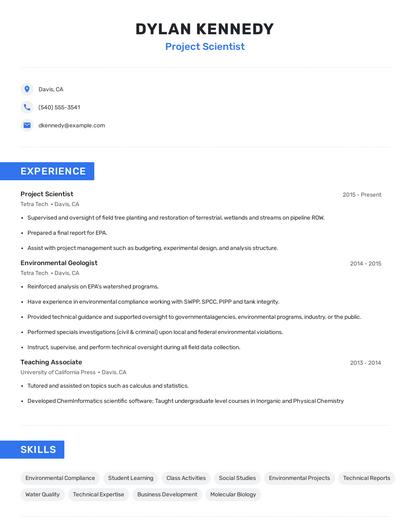
Prepare your project scientist resume
When your background is strong enough, you can start writing your project scientist resume.
You can use Zippia's AI resume builder to make the resume writing process easier while also making sure that you include key information that hiring managers expect to see on a project scientist resume. You'll find resume tips and examples of skills, responsibilities, and summaries, all provided by Zippi, your career sidekick.
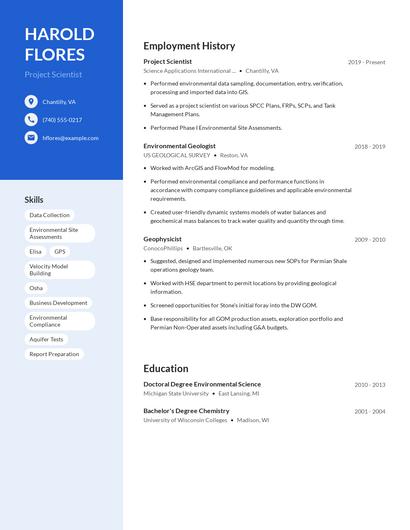
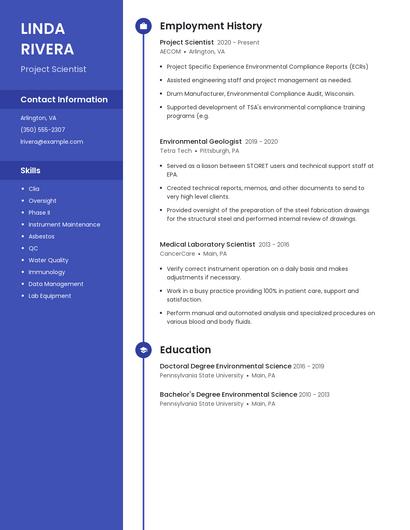
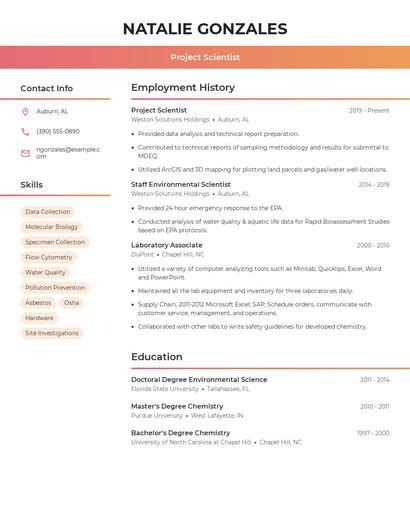
Choose from 10+ customizable project scientist resume templates
Build a professional project scientist resume in minutes. Browse through our resume examples to identify the best way to word your resume. Then choose from 10+ resume templates to create your project scientist resume.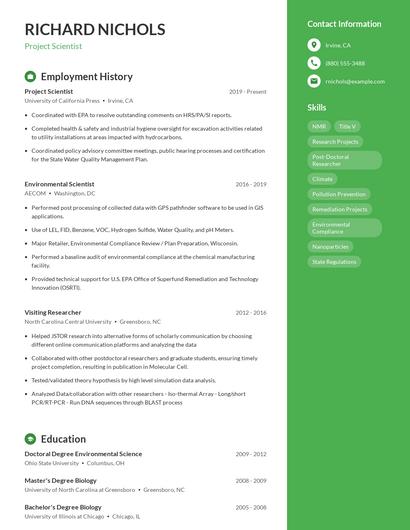
Apply for project scientist jobs
Now it's time to start searching for a project scientist job. Consider the tips below for a successful job search:
- Browse job boards for relevant postings
- Consult your professional network
- Reach out to companies you're interested in working for directly
- Watch out for job scams
How did you land your first project scientist job

Are you a project scientist?
Share your story for a free salary report.
Average project scientist salary
The average project scientist salary in the United States is $79,073 per year or $38 per hour. Project scientist salaries range between $56,000 and $110,000 per year.
What am I worth?

How do project scientists rate their job?
Project scientist reviews

I do the same job every day but I never get the same results twice. each minute, hour, day everything changes. we drill thru different formations all the time. But we drill the same stuff from well to well.
There is a constant chance of someone making a big mistake and causing a blow out that hurts or kills others.
Firstly, the most important is to protect our planet for us and the future generations. Secondly our planet is not going to support the pressure and negative impacts because of the big Increased human population . Finally our planet needs more and more environmental specialists to regulate and control all human activities, especially the ilegal ones.
I don’t like when big companies they know what’s wrong and what’s right, but still the destroy, like cutting trees in Brazil and the other side big companies even knowing those trees are ilegal, but still they continuing to porches. There for I can’t understand and I don’t like.
Science of observation
Updated January 8, 2025
