
Automatically apply for jobs with Zippia
Upload your resume to get started.
Project scientist skills for your resume and career
15 project scientist skills for your resume and career
1. Data Analysis
- Provided customers with reports and effectiveness/efficiency assessments of company technology performance, based upon data analysis results.
- Provided all levels of GIS support including data management, data analysis, project coordination, and cartography.
2. Research Projects
- Fostered relationships with area experts and established collaborative research projects with key opinion leaders.
- Monitored and inspected EPA-granted research projects conducted at universities.
3. Oversight
Having oversight of someone means to monitor a process or a situation. If someone has oversight of something, they are responsible for the completion of the project. Oversight is usually given to experts as they monitor their juniors or newbies as they go through a project.
- Completed health & safety and industrial hygiene oversight for excavation activities related to utility installations at areas impacted with hydrocarbons.
- Provided oversight and certification for sites to be decommissioned.
4. Data Management
The administrative process that involves collecting and keeping the data safely and cost-effectively is called data management. Data management is a growing field as companies rely on it to store their intangible assets securely to create value. Efficient data management helps a company use the data to make better business decisions.
- Supported data management and validation activities for environmental chemistry data.
- Lead field, analysis, and data management teams for subsequent damage assessments and technical reports.
5. Technical Reports
Technical reports are a type of document that is used to indicate either the progress, result, or process of scientific research or the state of problems occurring within such research. A technical report may also showcase the report's overall conclusion and may also include recommendations. This kind of report does not require a peer review and isn't published officially but distributed within the organizations where it was formed.
- Standardized and implemented a company-specific standard format for geologic logging documents incorporated into technical reports submitted to state and government agencies.
- Authored multiple patent applications, research publications, protocols and technical reports.
6. EPA
The Environmental Protection Agency (EPA) is a US-based organization established to sustain and improve the environmental and human health standards across the United States. EPA was established by US President Richard Nixon by executive order in December 1970. The EPA formulates laws and releases guidelines to promote the health of individuals and the ecosystem.
- Followed EPA and Florida Department of Environmental Protection sample procurement procedures.
- Perform EPA air emissions testing of various methods to determine if client facilities are in Compliance with local and federal regulations.
Choose from 10+ customizable project scientist resume templates
Build a professional project scientist resume in minutes. Our AI resume writing assistant will guide you through every step of the process, and you can choose from 10+ resume templates to create your project scientist resume.7. Regulatory Agencies
A regulatory agency is a Public Benefit Corporation (PBC) that is responsible for supervising certain human activities and controlling them to some extent. They are set up in some areas such as hospitals, law firms, and governmental setup to regulate safety standards. They prevent undue and unjust abuse of power in these setups.
- Acted as liaison to state and federal regulatory agencies, and performed regulatory interpretation and application to facility processes.
- Conducted wetland and stream delineations and met with the appropriate regulatory agencies to verify jurisdictional boundaries.
8. OSHA
- Certified asbestos air monitor for the state of New York and 40-Hour OSHA Certified.
- Ensured contractor compliance with applicable L&I, OSHA and AHERA regulations.
9. FDA
The Food and Drug Administration (FDA) is a division of the US Department of Health and Human Services that regulates the production and sale of food, pharmaceutical products, medical equipment, and other consumer goods, as well as veterinary medicine. The FDA is now in charge of overseeing the manufacture of products like vaccines, allergy treatments, and beauty products.
- Supervised and coached chemists in method validations and provided technical consultations for method troubleshooting and FDA recalls for global manufacture sites.
- Co-authored publications on collaborative research with Food and Drug Administration (FDA), food industry members, and suppliers.
10. Laboratory Analysis
- Collect samples using proper protective equipment during surveys for laboratory analysis.
- Reviewed all laboratory analysis on impacted material to insure all material was handled correctly and crews were in proper PPE.
11. PCR
PCR stands for Polymerase Chain Reaction, a tool to make millions of copies of a target part of DNA. Polymerase chain reaction involves the process of heating and cooling. The process takes place using a machine, which helps in heating and cooling off the substances. The purpose of heating exists to separate the DNA into two single strands.
- Analyzed and designed primer sets for PCR validation studies.
- Achieved first milestone ahead of schedule, demonstrating the feasibility of single tube RT- PCR for the detection of FMD virus.
12. R
R is a free software environment and a language used by programmers for statistical computing. The R programming language is famously used for data analysis by data scientists.
- Conducted Robust Statistical Analysis using SPSS, JMP, R and STATISTICA packages.
13. GPS
GPS stands from Global Positioning System. It is a navigation system comprising of satellites that helps in determining the location, velocity, and synchronize time data for different modes of travel like air, sea, or land.
- Accumulated GPS points for soil monitoring and contamination prevention.
- Performed underground utility locating and GPS mapping.
14. Field Testing
- Performed site clean-up, remediation and field testing of soil and water.
- Provided training to field crews on proper usage of Trimble GPS units, field testing kits, and safety procedures.
15. Hazardous Materials
Any substance or good that is harmful to human health as well as the environment are called hazardous materials. Such materials must be handled carefully to avoid any mishaps. Harmful gases. chemicals, strong medicines or drugs, radioactive elements required for radiation purposes, a human blood sample that carries germs, all of these are considered hazardous materials.
- Inventoried various buildings for hazardous materials.
- Conducted DOT Hazardous Materials Commodity Studies.
5 Project Scientist resume examples
Build a professional project scientist resume in minutes. Browse through our resume examples to identify the best way to word your resume. Then choose from 5+ resume templates to create your project scientist resume.

What skills help Project Scientists find jobs?
Tell us what job you are looking for, we’ll show you what skills employers want.
What skills stand out on project scientist resumes?
Dr. Becky A. Ball
Associate Professor, School of Mathematical and Natural Sciences Senior Sustainability Scientist, Global Institute of Sustainability, Arizona State University
What soft skills should all project scientists possess?
Dr. Pascale Biron Ph.D.
Professor, Concordia University
- understand the underlying processes relevant to environmental and sustainability sciences
- acquire and interpret analytical data
- understand physical processes of our planet and interpret data related to climate change and sustainable environmental management
- assess the situation within a given ecosystem in an integrated fashion
What hard/technical skills are most important for project scientists?
Dr. Pascale Biron Ph.D.
Professor, Concordia University
- Statistics
- Computer programming
What project scientist skills would you recommend for someone trying to advance their career?
Joel Burken Ph.D.
Curators’ Distinguished Professor & Chair, Missouri University of Science and Technology
What type of skills will young project scientists need?
David Cool Ph.D.
Professor, Pharmacology & Toxicology; Professor, Obstetrics & Gynecology, Wright State University
Some were even given a test to see if they understood the concept. This then leads to mass spectrometry, LCMS, MALDI-TOF, and even GCMS, and everything that has been developed around those basic techniques is now commonplace in most core facilities and Pharma. New methods for flow cytometry, FACS, are necessary for the higher throughput drug discovery types of labs. Molecular biology has evolved from simple PCR machines that could run 24 samples, just 25 years ago, to digital PCR machines that can run 384 pieces today and email the final data to you at home, while you sleep. Knowing how to calculate the PCR data is extremely critical, as it isn't intuitive, and people tend to take short cuts. Knowing how to do that will be vital. Cell culture and working with animals are still common ways to generate data in any lab, and people who have those skills will always have a job. What do all these techniques have in common? They all have evolved to the point that no one is an expert in every one of them. Labs focus and concentrate on the ones they need the most and make use of them over a long period. What a student should develop is what I call a big toolbox. Learn as many of these techniques as you can, and then use them. Understanding that these are all cyclic and that you may get rusty, or the technology will change. It doesn't matter. By being trained in any of these, it will mean that you can be prepared for other things, that you can catch up and learn and update your techniques in your toolbox. This is what any PI running a lab will be looking for, someone who can be trained, and can evolve and adapt to different technologies, know how they work and how they can be used, what the data looks like when it is working well, and what it looks like when it isn't. The people who have these skills will always be employable.
There is a greater need than ever for workers to analyze data and synthesize a reasonable idea about what it means. This means that they must understand their experiments at a deeper level than just pipetting buffers and timing reactions. They must know what is happening, and if there is a problem, first, they have a problem and then how to solve it. Bioinformatics has become one of the fastest-growing fields. The increased amount of data, whether from standard assays run in an ordinary lab or high throughput data, needs more crunching. The future researcher will not be able to get by just knowing how to use a computer stats program but will be required to understand how to run data in R or Python or whatever new data analysis package is coming next. This becomes even more critical as the data becomes more complex, i.e., 27 cytokines analyzed in 3 different tissues over three other times, from 14 different groups, 6 of which are controls, with the rest being toxin and then treatment groups and authorities. A simple two way ANOVA just doesn't cut it. For this, machine learning tools, pattern recognition, neural networks, topological data analysis (TDA), Deep Learning, etc., are becoming the norm and are being advanced and changed to give more and more substance to what the data means. Students who can operate instruments to generate data and run more complex types of analysis on this 'big data' are in great demand. Likewise, learning the computer-generated design of drugs 'in silico' is a growing field that is now required to screen tens of thousands of compounds before generating them in the lab. This will need someone who can think three-dimensionally; even though the software and advanced computers can do that, it helps if your brain is wired that way, at least a little.
Aside from instruments and complex data analysis, consider where the clinical research is headed. With COVID19, the need to quickly advance drugs from potential use to clinical application has undergone an exponential increase. Lives are being lost daily to the lack of a vaccine or medication that can attenuate to any level the impact the virus has on the human body. The future clinical researcher will need to understand how the instruments work and how tests are run, how a vaccine works, how the virus or disease manifests itself, and how to get it under control. This will only be possible if the researcher is familiar with much of what I wrote above. You won't need to be an expert on virtually everything, but you'll need to understand it so you can use it to synthesize new ideas that may be applicable in the clinical environment. COVID19 is a perfect example. One of the early struggles with this virus was how to test for it. Antibodies weren't developed for it in the very beginning, so an ELISA was out.
In contrast, PCR is one of the most sensitive methods to identify genetic material, such as viruses. So, early on, PCR primers were created that could be used to run a PCR to determine if a person had a live virus. However, the first such PCRs had high false negatives and positives. Further refinement led to the creation of PCR primer sets and protocols that allowed for a more accurate and faster test. An advantage that anyone who has been trained in biotechnology will know the basics of developing a test. If it is a PCR, then what goes into that. Suppose it is an ELISA, how it works, and what you need to set it up. Imagine a test strip similar to the one used for at-home pregnancy tests. This came about in much the same way, through experimentation and developing a way to lower the false negatives and positives, to allow a quick, 5-minute test that could determine if a particular hormone was in your urine at a stage of pregnancy when many women may not have realized there was a possibility they could be pregnant. The person entering the workforce that can think in these ways will be employable and will be able to move between jobs and continue with a very successful and enriching career.
What technical skills for a project scientist stand out to employers?
Daniel Greenwood Ph.D.
Research Assistant Professor, Director, Human Performance Center, The University of Memphis
List of project scientist skills to add to your resume
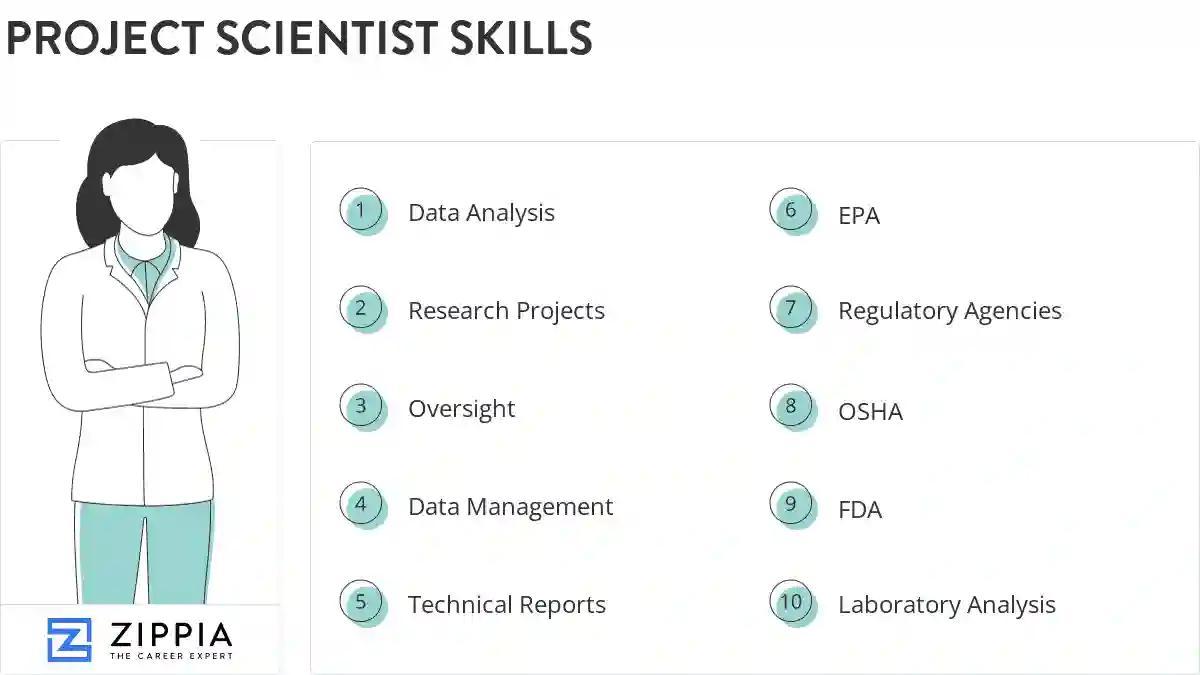
The most important skills for a project scientist resume and required skills for a project scientist to have include:
- Data Analysis
- Research Projects
- Oversight
- Data Management
- Technical Reports
- EPA
- Regulatory Agencies
- OSHA
- FDA
- Laboratory Analysis
- PCR
- R
- GPS
- Field Testing
- Hazardous Materials
- Remote Sensing
- Statistical Analysis
- Immunotherapy
- Environmental Site Assessments
- Hazardous Waste
- Remediation Projects
- Asbestos
- Elisa
- Groundwater Samples
- Environmental Projects
- GIS
- Water Samples
- Stem Cells
- Pharmacokinetics
- Surface Water
- Phase II
- Air Quality
- SPCC
- RCRA
- PCB
- Analytical Data
- Risk Assessments
- ASTM
- Regulatory Compliance
- Environmental Compliance
- ISO
- Geotechnical
- Site Investigations
- DNA
- UST
- Next-Generation Sequencing
- Sample Collection
- Water Quality
Updated January 8, 2025
