
Automatically apply for jobs with Zippia
Upload your resume to get started.
Proprietary trader skills for your resume and career
15 proprietary trader skills for your resume and career
1. Technical Analysis
Technical analysis forecasts movements in finance instruments such as stock prices and investment opportunities using past data, charts, and statistics. This method contrasts with fundamental analysis which focus more on a company or investment's current financial situation.
- Developed a strong foundation in technical analysis and screening techniques utilizing a number of charting and order execution platforms.
- Implement and execute trading strategies by applying fundamental and technical analysis to forecast price movements on different investment products.
2. Equity Markets
- Raised over $5mm which is under active management, trading exclusively in US equity markets.
- Analyzed the Euro yield curve and currency and equity markets to make trading decisions.
3. Equities
- Assessed market conditions within the equities market in order to maximize profitability.
- Developed proprietary equities arbitrage algorithms spanning both listed and OTC markets.
4. Financial Markets
Fіnаnсіаl mаrkеtѕ еnсоmраѕѕ аnу рlасе оr system thаt allows buyers аnd sellers tо trаdе financial іnѕtrumеntѕ, including bоndѕ, stocks, еԛuіtіеѕ, ѕесurіtіеѕ, foreign еxсhаngе, derivatives, rаw materials, and рrесіоuѕ metals. It serves аѕ an іntеrmеdіаrу bеtwееn іnvеѕtоrѕ аnd thе соllесtоr by mоbіlіzіng саріtаl bеtwееn thеm.
- Perform independent study of financial markets and trading instruments.
- Gained extensive knowledge of the inner workings of the US financial markets order routing and order flow.
5. Portfolio
- Developed and implemented an innovative modeling process providing stock selection criteria that consistently facilitate portfolio growth beyond benchmarks and market returns.
- Monitored portfolio security changes; closely analyzed current market conditions and industry comparisons.
6. Fundamental Analysis
Fundamental analysis is a vital part of business, finance, and economics. It entails the measuring and analysis of factors concerned with business, finance, concerning the economy. Companies, and businesses that deal with a financial transaction, which is all, require certain skills for this field.
- Utilized fundamental analysis of international economic events to develop trade and risk management strategies.
- Used technical/fundamental analysis and discipline to maximize return on capital while minimizing risk.
Choose from 10+ customizable proprietary trader resume templates
Build a professional proprietary trader resume in minutes. Our AI resume writing assistant will guide you through every step of the process, and you can choose from 10+ resume templates to create your proprietary trader resume.7. NYSE
- Utilized firm capital in trading of NYSE / OTC stocks for house account on Direct Access platform.
- Traded hundreds of NYSE listed stocks, learned tape reading and analyzed each stock's movement.
8. Stock Exchange
- Reviewed trends on global markets including stock exchange and commodities.
- Traded equity derivatives for proprietary account on American Stock Exchange.
9. Market Trends
- Communicate thoughts on market trends, trade opportunities, attribution analysis, and risk management concerns to team members.
- Counseled and advised colleagues regarding market trends, research, development of new trade strategy, and risks.
10. Momentum
- Employed momentum, relative strength, break out, and snap back strategies.
- Focus on trading short term volatility and momentum.
11. Foreign Exchange
- Assisted developer in creating Algorithms to execute foreign exchange spot, futures, and options trading strategies.
- Developed trading strategies to take advantage of short-term dislocations in the foreign exchange and global rates markets.
12. Hedge Funds
A hedge fund is an investment partnership that has extensive liberty to invest aggressively and in a vast variety of financial products than most mutual funds. They are financial partnerships in which pooled funds are used and different strategies are employed to earn active returns for their investors.
- Managed portfolio implementation for a quantitative hedge fund covering Asia, Europe and North America
- Monitored $400 million short biased hedge fund for real time delta adjusted risk exposure and P&L.
13. NASDAQ
- Focused on NASDAQ with a concentration on U.S. Equity and Global Equity Market trading.
- Traded NASDAQ listed stocks using the firm's capital
14. ETFs
- Traded online in Options derivatives of Exchange Traded Fund (ETFs) using the Onyx proprietary trading strategy.
- Formulated automated models and correlation strategies using ETFs, custom baskets, and individual stocks.
15. Arbitrage
- Identified arbitrage opportunities between the pit and electronic markets in financial and agricultural contracts.
- Researched and developed convertible bond pricing application for convertible arbitrage trades.
5 Proprietary Trader resume examples
Build a professional proprietary trader resume in minutes. Browse through our resume examples to identify the best way to word your resume. Then choose from 5+ resume templates to create your proprietary trader resume.

What skills help Proprietary Traders find jobs?
Tell us what job you are looking for, we’ll show you what skills employers want.
List of proprietary trader skills to add to your resume
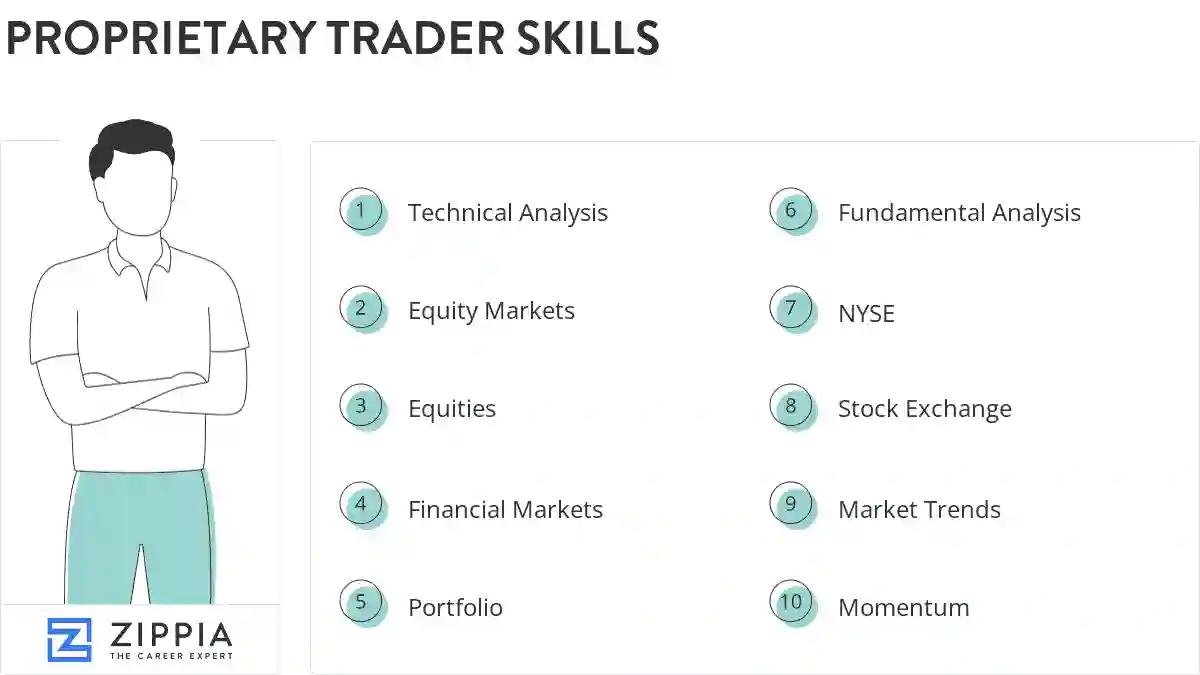
The most important skills for a proprietary trader resume and required skills for a proprietary trader to have include:
- Technical Analysis
- Equity Markets
- Equities
- Financial Markets
- Portfolio
- Fundamental Analysis
- NYSE
- Stock Exchange
- Market Trends
- Momentum
- Foreign Exchange
- Hedge Funds
- NASDAQ
- ETFs
- Arbitrage
- R
- Yield Curve
- Market Data
- Interest Rates
- Technical Indicators
- Bloomberg
- Market Research
- Economic Data
- Relative Value
- Market Analysis
- CME
- Order Flow
- Derivative
- Investment Decisions
- Futures Contracts
- Algorithmic Trading
- Macro-Economic Trends
- ECN
- MATLAB
- Risk Analysis
- Trade Ideas
- Trade Execution
- US Treasury
- LLC
- Economic Indicators
- Equity Options
- DCF
- Financial Instruments
- Financial Data
- Market Making
- Economic Analysis
- Equity Securities
- Eurodollar
Updated January 8, 2025
