What does a propulsion systems engineer do?
Propulsion systems engineer responsibilities
Here are examples of responsibilities from real propulsion systems engineer resumes:
- Develop Perl scripts to automate object model and functional mapping into the application metadata and database.
- Monitor OS optimization; test, evaluate product processing and accuracy performance within environment before operational implementation are performed with SCCM.
- Introduce a new change process and documentation to improve speed and efficiency of problem identification during a rapid prototyping to manufacturing.
Propulsion systems engineer skills and personality traits
We calculated that 33% of Propulsion Systems Engineers are proficient in MATLAB, Engine Performance, and DOD. They’re also known for soft skills such as Business skills, Writing skills, and Analytical skills.
We break down the percentage of Propulsion Systems Engineers that have these skills listed on their resume here:
- MATLAB, 33%
Developed component fatigue analysis program in MATLAB Delivered superior performance in assisting the Military C-130 Propeller Control Modification
- Engine Performance, 11%
Performed analyses and authored the Engine Performance Interface Document for propulsion and supplier reference.
- DOD, 9%
Served as Information Systems Security Officer for closed area lab network comprised of several DOD classified information systems.
- Technical Support, 7%
Provided technical support on liquid propulsion systems of major space launch vehicle programs to the Air Force Space Division.
- NASA, 6%
Applied NASA System Engineering practices to develop algorithms for incorporation into the M&FM SysML Model.
- FAA, 6%
Coordinate results of safety analysis with Federal Aviation Administration (FAA).
Common skills that a propulsion systems engineer uses to do their job include "matlab," "engine performance," and "dod." You can find details on the most important propulsion systems engineer responsibilities below.
Business skills. One of the key soft skills for a propulsion systems engineer to have is business skills. You can see how this relates to what propulsion systems engineers do because "meeting federal standards in aerospace engineering requires business knowledge, including commercial law." Additionally, a propulsion systems engineer resume shows how propulsion systems engineers use business skills: "collaborated with company heads to restructure manufacturing and integration business practices to conform to quality management system goals. "
Analytical skills. Another skill that relates to the job responsibilities of propulsion systems engineers is analytical skills. This skill is critical to many everyday propulsion systems engineer duties, as "aerospace engineers must be able to evaluate project design elements and propose improvements, if necessary." This example from a resume shows how this skill is used: "performed trade studies with engine data and simulation to improve performance and engine operating characteristics; updated simulation. "
Math skills. A big part of what propulsion systems engineers do relies on "math skills." You can see how essential it is to propulsion systems engineer responsibilities because "aerospace engineers use calculus, trigonometry, and other math in their analysis, design, and troubleshooting work." Here's an example of how this skill is used from a resume that represents typical propulsion systems engineer tasks: "used technical documents and subject matter experts to create math models for components on ships. "
Problem-solving skills. Another crucial skill for a propulsion systems engineer to carry out their responsibilities is "problem-solving skills." A big part of what propulsion systems engineers relies on this skill, since "aerospace engineers upgrade designs and troubleshoot problems to improve aircraft, such as for increased fuel efficiency or safety." How this skill relates to propulsion systems engineer duties can be seen in an example from a propulsion systems engineer resume snippet: "researched and tested apu starter/generator failure and provided design support on a tiger team to find a solution. "
The three companies that hire the most propulsion systems engineers are:
- SpaceX7 propulsion systems engineers jobs
- General Dynamics5 propulsion systems engineers jobs
- Allison Transmission4 propulsion systems engineers jobs
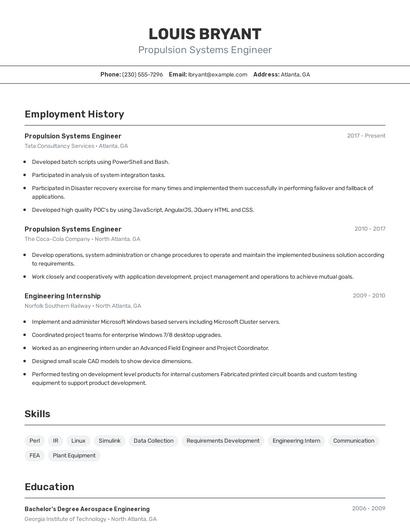
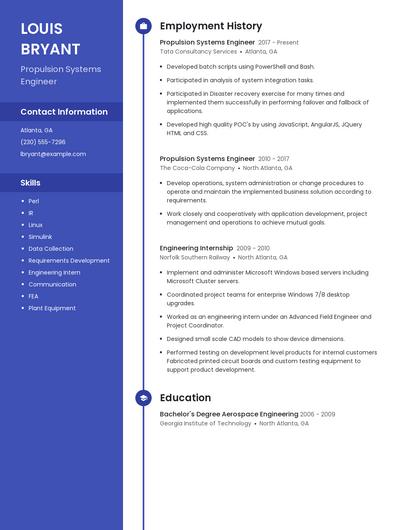
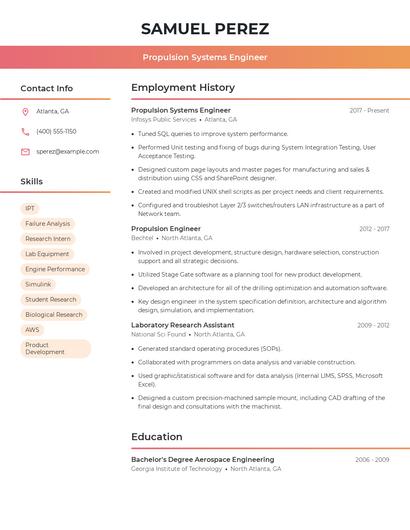
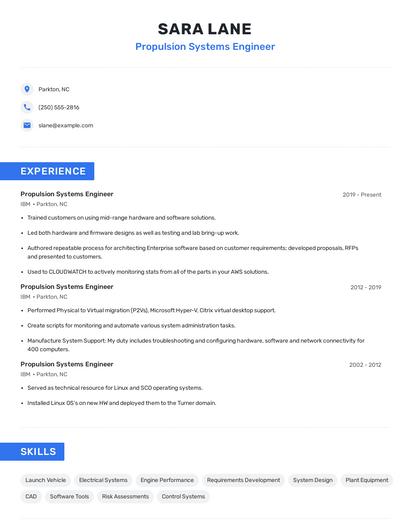
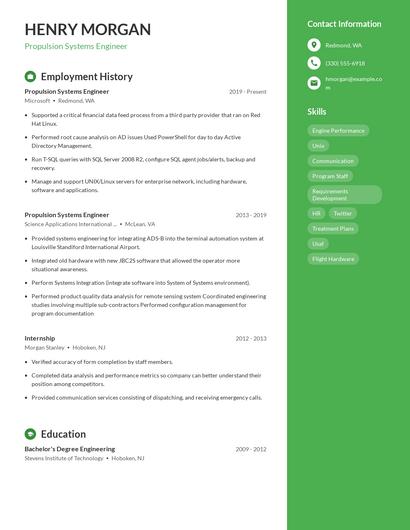
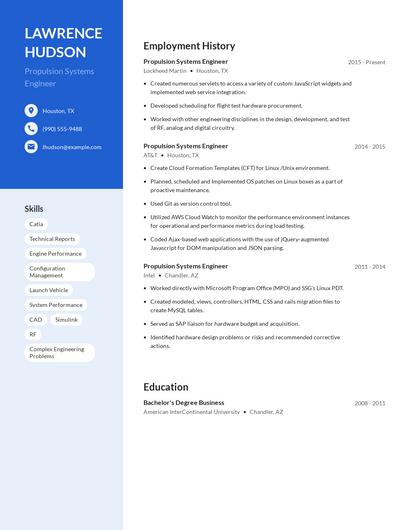
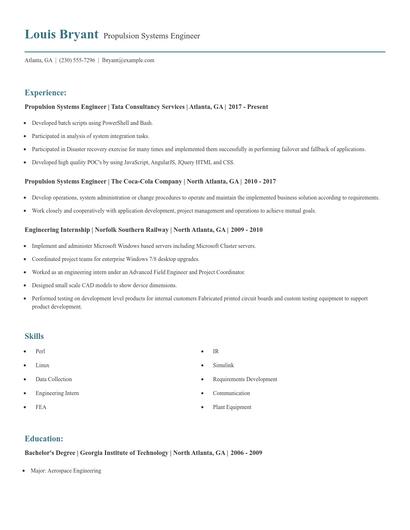
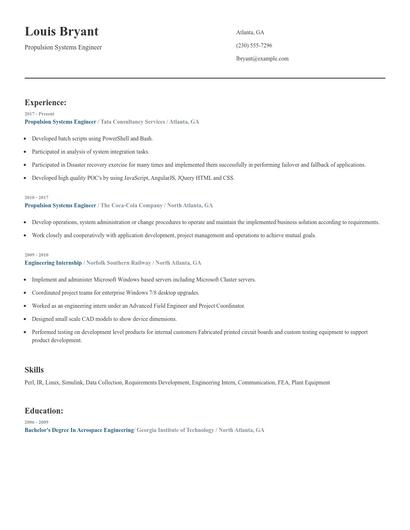
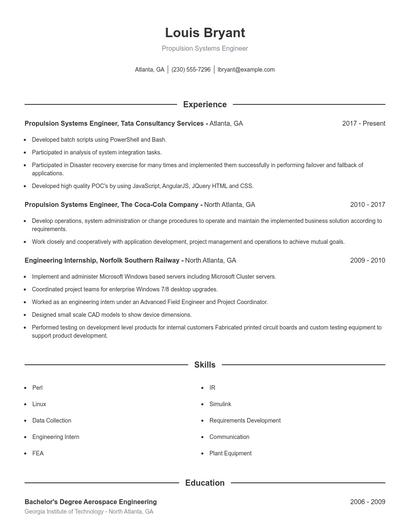
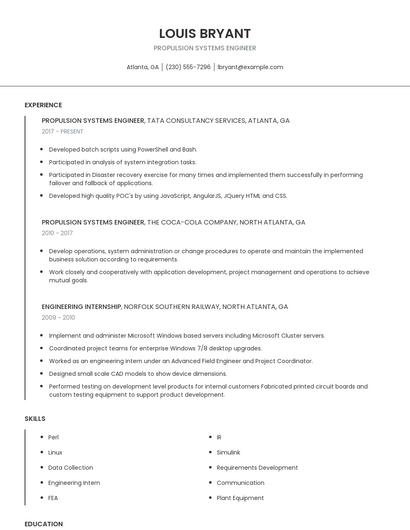
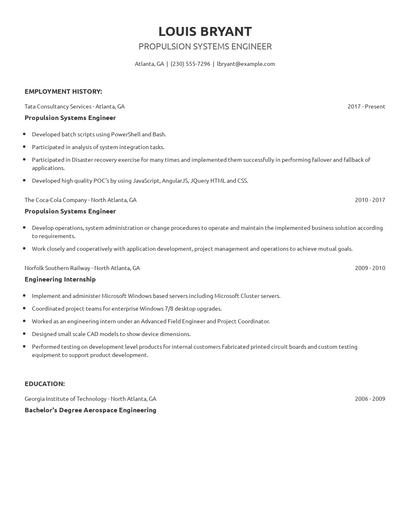
Choose from 10+ customizable propulsion systems engineer resume templates
Build a professional propulsion systems engineer resume in minutes. Our AI resume writing assistant will guide you through every step of the process, and you can choose from 10+ resume templates to create your propulsion systems engineer resume.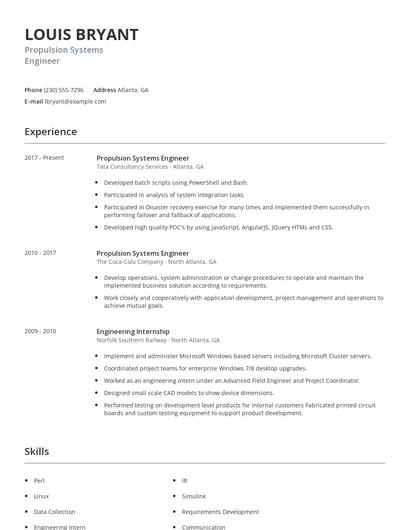
Compare different propulsion systems engineers
Propulsion systems engineer vs. Master lay out specialist
A stress analyst is a type of aerospace engineer; they design, construct, and test aircraft. They may also work on missiles or spacecraft. They primarily study design requirements for the overall strength of a craft. They analyze the stress data of structural components and prepare mathematical models of issues.
There are some key differences in the responsibilities of each position. For example, propulsion systems engineer responsibilities require skills like "matlab," "engine performance," "technical support," and "nasa." Meanwhile a typical master lay out specialist has skills in areas such as "customer service," "cloud," "crm," and "business development." This difference in skills reveals the differences in what each career does.
Master lay out specialists tend to reach higher levels of education than propulsion systems engineers. In fact, master lay out specialists are 7.6% more likely to graduate with a Master's Degree and 2.9% more likely to have a Doctoral Degree.Propulsion systems engineer vs. Stress analyst
An engineering scientist is responsible for designing new technological systems through the evaluation of scientific methods and innovative solutions. Engineering scientists analyze technical parts and components, researching the current engineering trends to meet public demands and interests. They record their observations and discoveries, run multiple diagnostic tests on the outputs to ensure its efficiency and optimal performance to support industrial operations. An engineering scientist also works closely within a group of engineering and designs team to implement procedures that would support findings from its conceptualization to final deliverables.
Each career also uses different skills, according to real propulsion systems engineer resumes. While propulsion systems engineer responsibilities can utilize skills like "engine performance," "dod," "technical support," and "risk assessments," stress analysts use skills like "abaqus," "airframe," "structural integrity," and "ansys."
In general, stress analysts achieve higher levels of education than propulsion systems engineers. They're 7.2% more likely to obtain a Master's Degree while being 2.9% more likely to earn a Doctoral Degree.What technology do you think will become more important and prevalent for propulsion systems engineers in the next 3-5 years?
Edoardo Sarda Ph.D.
Assistant Professor, Robotics Engineering, Lake Superior State University
Propulsion systems engineer vs. Aviation consultant
There are many key differences between these two careers, including some of the skills required to perform responsibilities within each role. For example, a propulsion systems engineer is likely to be skilled in "matlab," "engine performance," "dod," and "technical support," while a typical aviation consultant is skilled in "client relationships," "federal aviation administration," "icao," and "airspace."
Aviation consultants typically earn similar educational levels compared to propulsion systems engineers. Specifically, they're 4.2% less likely to graduate with a Master's Degree, and 1.6% less likely to earn a Doctoral Degree.Propulsion systems engineer vs. Engineering scientist
Types of propulsion systems engineer
Updated January 8, 2025
