
Automatically apply for jobs with Zippia
Upload your resume to get started.
Prototype engineer manager skills for your resume and career
15 prototype engineer manager skills for your resume and career
1. Prototyping
- Provided prototyping and testing for various Carrier departments and product development projects.
- Attend national rapid prototyping conferences.
2. C++
C++ is a general-purpose programming language that is used to create high-performing applications. It was invented as an extension to the C language. C++ lets the programmer have a high level of domination over memory and system resources. C++ is an object-oriented language that helps you implement real-time issues based on different data functions
- Assisted with C++ coding to integrate a powerful proprietary eraser engine, improving virus removal ability.
- Used C++, STL, and Python for deployment, CTC++ for Unit test framework for Performance Modules in Nokia Products.
3. BOM
BOM stands for a bill of materials in design drafting. This list outlines the raw materials, instructions, and components required to manufacture or construct a product or service.
- Created a bill of material(BOM) to control the cost and improve material management for easier fabrication.
- Designed new products, re-designed existing products, constructed accurate BOM's based on legacy and new designs.
4. RP
- Provided material recommendations based on the customers end use for the RP parts.
- Trained employees in CAD (SolidWorks) and multiple RP software packages.
5. Product Development
Product development is the complete procedure of creating a product from concept until release of the final product. Product development has many stages after which a product is released into the market. Identifying the need, creating the opportunity, conceptualizing a product, and providing a solution, all are different stages of product development.
- Managed product development expense account.
- Review necessary drawings, specifications, and test plans to ensure proper documentation throughout product development cycle.
6. Solidworks
- Supported development and refinement of design using Solidworks CAD modeling.
- Produced models & drawings in SolidWorks to develop designs for analysis of product form, fit, function and tolerance stacking.
7. Additive Manufacturing
- Conducted immersive multi-day lectures and seminars designed to provide robust fundamental knowledge and know-how in Additive Manufacturing and other related tech.
8. CNC
CNC stands for Computer Numerical Control. It is a subtractive manufacturing technique that usually uses computerized controls and machine tools to strip layers of material from a stock piece.
- Program CNC Pipe benders for new products during the prototype phase.
- Oversee the use of CNC grinding, machining, lathe and other operations by in-house personnel.
9. Design Changes
- Implemented design changes for material cost savings totaling $700k per year, which met customer score card requirements.
- Perform research for increasing the efficiency of existing evaporator units and propose design changes to the management team.
10. ISO
- Managed implementation of ISO 9000 procedures for a manufacturing environment.
- Maintained ISO 9001:2000 compliance through departmental documentation and participation in requisite audits.
11. Jigs
- Design all tools required to manufacture a prototype: Bonding Jigs, molds for wet layups, & shop aids.
- Design tooling components, assembly jigs and fixtures and compression molds and created detail drawings for the aerospace Industry.
12. Design Concepts
- Transferred design concepts to manufacturer.
- Achieved 1st optical gain within company (micro-optic coupled fiber amplifier), with many design concepts developed still in use.
13. R
R is a free software environment and a language used by programmers for statistical computing. The R programming language is famously used for data analysis by data scientists.
- Developed R software to analyze tuning curves over PVT.
- Awarded the Edward R Murrow award for best newscast.
14. JavaScript
- Offered support for JAVA Applet, JAVAScript, and JMS Publish/Subscribe capability as well as intra NGC team coordination.
- Designed and constructed numerous web pages utilizing ASP, HTML, Javascript, and ADO connections to SQL Server databases.
15. Field Testing
- Develop models or prototypes for field testing.

What skills help Prototype Engineer Managers find jobs?
Tell us what job you are looking for, we’ll show you what skills employers want.
What skills stand out on prototype engineer manager resumes?
Donald Yeung
Professor and Associate Chair for Undergraduate Education, Affiliate Professor, Computer Science Department, University of Maryland - College Park
What prototype engineer manager skills would you recommend for someone trying to advance their career?
Yi Yang PhD
Associate Professor, Pennsylvania State University - Abington
What technical skills for a prototype engineer manager stand out to employers?
Patrick Atkinson
Professor, Kettering University
List of prototype engineer manager skills to add to your resume
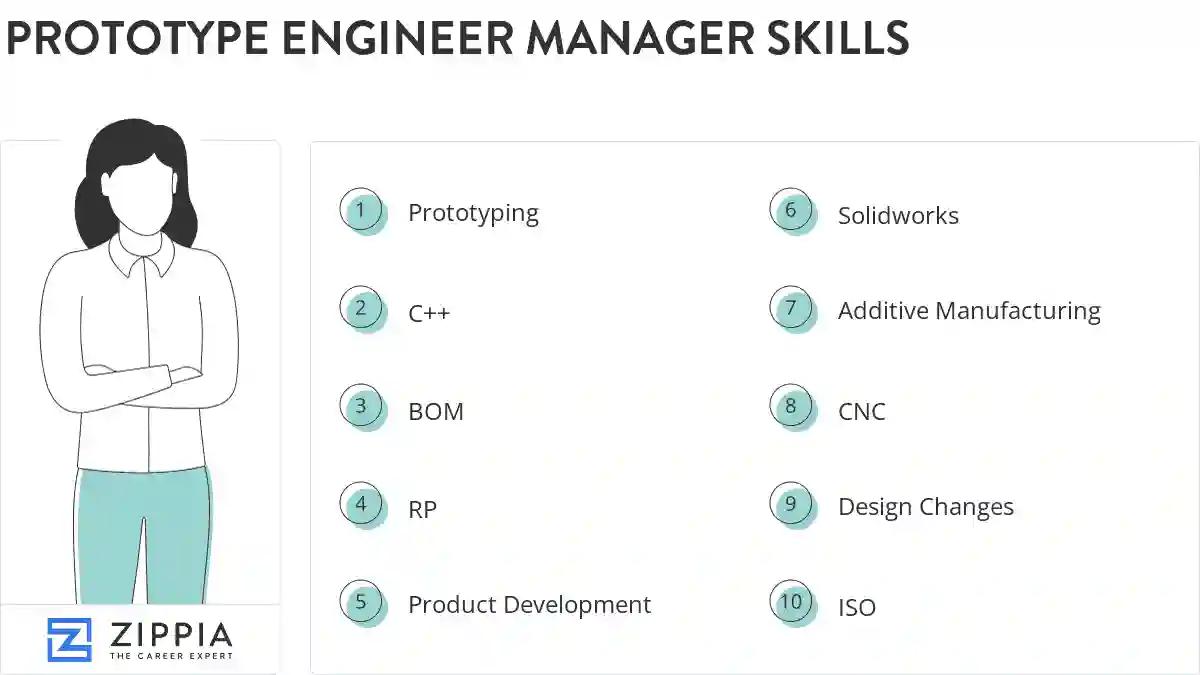
The most important skills for a prototype engineer manager resume and required skills for a prototype engineer manager to have include:
- Prototyping
- C++
- BOM
- RP
- Product Development
- Solidworks
- Additive Manufacturing
- CNC
- Design Changes
- ISO
- Jigs
- Design Concepts
- R
- JavaScript
- Field Testing
- Supplier Sourcing
- Toyota
- Design Validation
- Production Process
Updated January 8, 2025
