
Automatically apply for jobs with Zippia
Upload your resume to get started.
Provisioning analyst skills for your resume and career
15 provisioning analyst skills for your resume and career
1. Provisioning
- Trained coworkers on implementation of all legacy Provisioning Systems needed to design high-speed Internet circuits.
- Maintained databases of logistics information while tracking provisioning flow from origin to final delivery.
2. Engineering Drawings
Engineering drawings are technical drawings that tell about the requirements for engineering components or equipment. Such drawings have standardized languages and symbols. There are multiple types of engineering drawings such as isometric drawing, orthographic or multiview drawing, schematic drawings, one view, and two view drawings, etc.
- Reviewed and utilized engineering drawings developed from CAD.
- Performed verification and quality checks on Illustration content by comparing Engineering Drawings, Bill of Materials with newly created Illustration.
3. Logistics
Logistics is a complete organization and implementation of a problem. Logistics are often considered in a complex business operation, as some works need detailed plannings. Logistics are also used in military action.
- Coordinate materials shipping/receiving with headquarters Field Activity logistics mangers and others.
- Managed logistics to ensure smoothly run plan of action (POA) sales meetings held twice a year.
4. Technical Data
Technical data refers to both scientific and technical nature and information recorded and presented in any form other than financial and management information but includes manuals and instructional materials, as well as technical data formatted as a computer database.
- Interfaced with System Engineering/Design Engineering and customer to gain insight to technical data required.
5. Technical Documentation
Technical documentation means any documentation that gives a functional, architectural, and handling description of a technical product or a product in use or development.
- Prepare and produce technical documentation in accordance with corporate, military, and commercialspecifications and standards.
- Prepared all technical documentation according to current standards and policies.
6. Customer Support
- Improved customer support and process flow.
- Web based configuration and customer support for Printer rollout project.
Choose from 10+ customizable provisioning analyst resume templates
Build a professional provisioning analyst resume in minutes. Our AI resume writing assistant will guide you through every step of the process, and you can choose from 10+ resume templates to create your provisioning analyst resume.7. SLA
SLA refers to Service-level Agreement. It is an agreement between a customer and the service provider on the quality of service and what standards they must meet.
- Monitored and repaired Prudential's highly technical enterprise network emphasizing customer focus and meeting customer SLA's.
- Provided quick response and maintenance through the use of SMS and TCP/IP while maintaining SLA's.
8. Support Equipment
- Reviewed site survey results and letters of offer and acceptance to formulate specific recommendations for spare/repair parts and support equipment.
9. Epic
Epic is a private healthcare company which developed and continues to provide a software intended for healthcare professionals and the organization and management of medical records. It is by far one of the largest in its field, with over 50% of patients having a medical record present in their system. Patients, as well as clinics and various medical professionals and facilities are all able to use this system to keep medical history and information safe and easy to reach, alter, and share with the necessary people.
- Work with Epic Security team; assist with validating and troubleshooting employee access and demographics.
10. User Accounts
A user account is a relationship established between a user and a computer, network, or information service that includes a user name, password, and all information related to the user. A user account may or may not allow a user to connect to a network, another computer, or other shared resources.
- Create, Modify, Disable, and Permission Network Active Directory User accounts, groups, and shares.
- Remove User accounts or access as employees or contractors leave Boeing or needs change.
11. Data Circuits
- Provisioned and designed data circuits for different product configurations.
- Initiated and monitored engineering orders for data circuits (installs, changes, and disconnects) and CPE.
12. Trouble Tickets
A trouble ticket is another term for a support/help ticket. At the point when a client or worker has an issue, they present a record, or ticket, to the IT group depicting their issue. The group records significant data on the ticket and uses it for correspondence between the client and the group.
- Escalated Trouble Tickets to the appropriate internal and external organizations.
- Maintained and tracked all accepted/rejected orders, trouble tickets, and other OSS (Operational Support Systems) roles as needed.
13. Customer Orders
- Designed layout templates for customer orders.
- Processed customer orders by ensuring that coding is correct and accurate Used customer data to make changes and updates in company system
14. Unix
UNIX is a computer operating system that was first created in the 1960s and has been constantly updated since then. The operating system refers to the set of programs that enable a machine to function. It is a multi-user, multi-tasking device that works on computers, laptops, and servers. UNIX systems also have a graphical user interface (GUI), similar to Microsoft Windows, that makes it simple to use.
- Investigated and identified any fiber breaks within the network through SmartGrid and UNIX system tools.
- Demonstrated competency in software configuration and application's build process using PVCS configuration manager and UNIX make utilities.
15. Parts List
- Provide Repair Parts List and Special Tools (RPSTL) for the ITV Interactive Electronic Technical Manual (IETM)
- Created parts list and utilized customer drawings to develop technical manuals.
5 Provisioning Analyst resume examples
Build a professional provisioning analyst resume in minutes. Browse through our resume examples to identify the best way to word your resume. Then choose from 5+ resume templates to create your provisioning analyst resume.

What skills help Provisioning Analysts find jobs?
Tell us what job you are looking for, we’ll show you what skills employers want.
What technical skills for a provisioning analyst stand out to employers?
Everett Wiles
Assistant Professor, Andrews University
Another thing to consider that employers will seek, outside of the technical areas is someone who is teachable, someone who has the right work ethic and attitude. You can always train someone to improve on their technical skills, but it is difficult to change someones poor attitude and work ethic.
What soft skills should all provisioning analysts possess?
Kevin Trowbridge Ph.D.
Department Chair, Associate Professor of Public Relations, Belmont University
What hard/technical skills are most important for provisioning analysts?
Kevin Trowbridge Ph.D.
Department Chair, Associate Professor of Public Relations, Belmont University
Aspiring communication professionals must be able to use applications for word processing, create presentations, organize data, communicate digitally (e.g., email), and manage tasks and projects. You can do a lot of simple tasks using web-based apps, and that's what many students have used through school. However, you'll stand out if you're a superuser who really knows how to work applications like Microsoft Word, PowerPoint, Excel, and Outlook. These applications are powerhouses-if you know how to use them. If you can work magic with them and do it efficiently, you're already ahead of the game, and it will make your life so much easier. Of course, other specialized applications may be required by your organization or your position, e.g., design, photography, audio, and video editing software. Be prepared to learn the ones you need. There is plenty of online tutorials that are free or inexpensive.
Another way to set yourself apart is by earning and showcasing you are invested in your own professional development. There are increasing numbers of industry-recognized courses and exams to earn certificates showing your competencies in the profession. For example, seniors or recent graduates could earn the Principles of Public Relations Certificate offered by the Universal Accreditation Board, Public Relations Society of America (PRSA), and its student organization, PRSSA. Google, HubSpot, and Muck Rack are among industry service providers who have developed training programs where students can earn certificates to make them marketable.
List of provisioning analyst skills to add to your resume
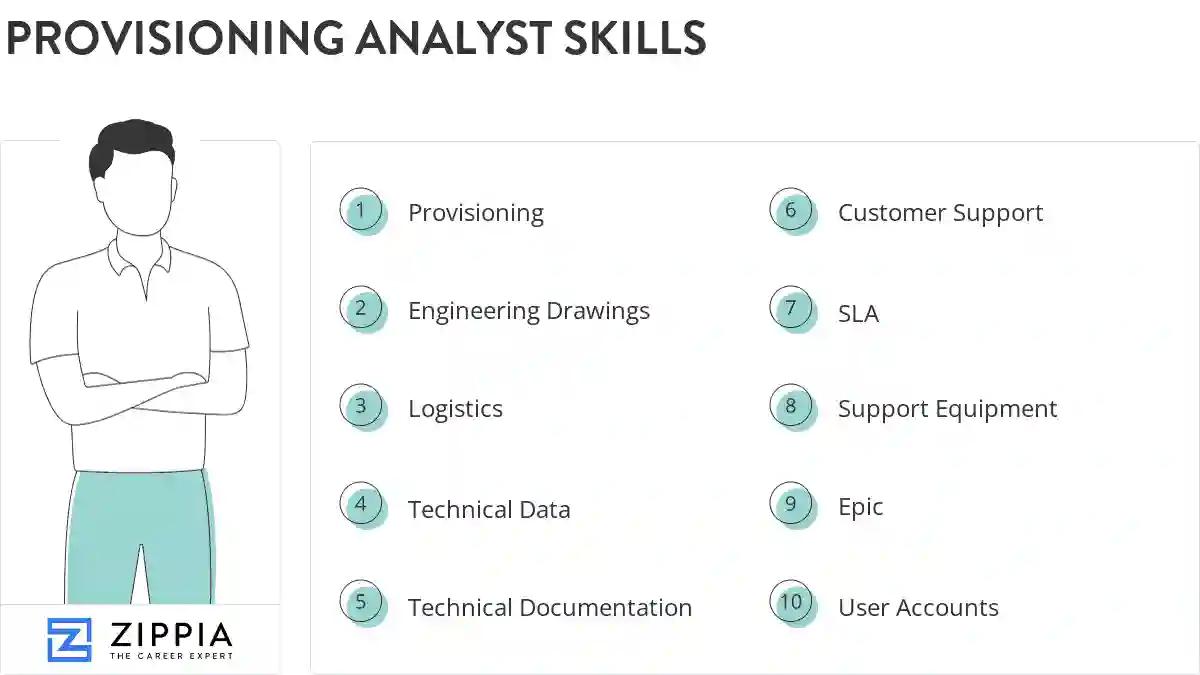
The most important skills for a provisioning analyst resume and required skills for a provisioning analyst to have include:
- Provisioning
- Engineering Drawings
- Logistics
- Technical Data
- Technical Documentation
- Customer Support
- SLA
- Support Equipment
- Epic
- User Accounts
- Data Circuits
- Trouble Tickets
- Customer Orders
- Unix
- Parts List
- VoIP
- Configuration Management
- Windows
- T1
- Telecom
- SQL
- DSL
- LEC
- Technical Manuals
- Inbound Calls
- Sprint
- SharePoint
- Local Exchange
- Circuit Design
- BOM
- Mac
- Lotus Notes
- GUI
- Clec
- Data Integrity
- Ethernet
- Data Analysis
- E911
- Critical Dates
- Cost Savings
- PC
- ISDN
- Conference Calls
- CSR
Updated January 8, 2025
