Explore jobs
Find specific jobs
Explore careers
Explore professions
Best companies
Explore companies
Job outlook for public relations representatives in the United States
Public relations representative job growth summary. After extensive research, interviews, and analysis, Zippia's data science team found that:
The projected public relations representative job growth rate is 8% from 2018-2028.
About 22,300 new jobs for public relations representatives are projected over the next decade.
Public relations representative salaries have increased 8% for public relations representatives in the last 5 years.
There are over 44,325 public relations representatives currently employed in the United States.
There are 23,506 active public relations representative job openings in the US.
The average public relations representative salary is $57,476.
Are public relations representative jobs in demand?
Public relations representative job and salary trends over time
Public relations representative jobs over time
Public relations representative job growth rate over time
| Year | # of jobs | % of population |
|---|---|---|
| 2021 | 44,325 | 0.01% |
| 2020 | 44,661 | 0.01% |
| 2019 | 44,694 | 0.01% |
| 2018 | 43,653 | 0.01% |
| 2017 | 42,685 | 0.01% |
Average public relations representative salary over time
Public relations representative salary by year
| Year | Avg. salary | Hourly rate | % Change |
|---|---|---|---|
| 2025 | $57,476 | $27.63 | +2.7% |
| 2024 | $55,957 | $26.90 | +1.9% |
| 2023 | $54,904 | $26.40 | +1.2% |
| 2022 | $54,264 | $26.09 | +2.2% |
| 2021 | $53,092 | $25.53 | +2.2% |
Public relations representative jobs by state
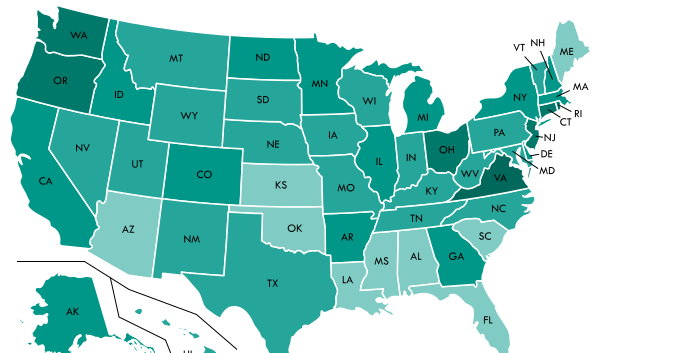
Most common states for public relations representatives
| Rank | State | Population | # of jobs | Employment/ 1000ppl |
|---|---|---|---|---|
| 1 | District of Columbia | 693,972 | 241 | 35% |
| 2 | Delaware | 961,939 | 96 | 10% |
| 3 | Vermont | 623,657 | 65 | 10% |
| 4 | Rhode Island | 1,059,639 | 87 | 8% |
| 5 | Wyoming | 579,315 | 44 | 8% |
| 6 | Maine | 1,335,907 | 99 | 7% |
| 7 | Montana | 1,050,493 | 74 | 7% |
| 8 | South Dakota | 869,666 | 61 | 7% |
| 9 | Massachusetts | 6,859,819 | 420 | 6% |
| 10 | Idaho | 1,716,943 | 102 | 6% |
| 11 | New Hampshire | 1,342,795 | 78 | 6% |
| 12 | Alaska | 739,795 | 48 | 6% |
| 13 | Georgia | 10,429,379 | 489 | 5% |
| 14 | Virginia | 8,470,020 | 419 | 5% |
| 15 | Minnesota | 5,576,606 | 284 | 5% |
| 16 | Maryland | 6,052,177 | 276 | 5% |
| 17 | Oregon | 4,142,776 | 218 | 5% |
| 18 | Utah | 3,101,833 | 163 | 5% |
| 19 | North Dakota | 755,393 | 38 | 5% |
| 20 | Connecticut | 3,588,184 | 145 | 4% |
Most common cities for public relations representatives
| Rank | City | # of jobs | Employment/ 1000ppl | Avg. salary |
|---|---|---|---|---|
| 1 | Corvallis | 1 | 2% | $75,297 |
| 2 | New Orleans | 2 | 1% | $50,764 |
Public Relations Representative job outlook: Expert opinions
Our panel of public relations representative experts
New Jersey Institute of Technology
Coastal Carolina University
Grand Valley State University
Saint Mary's College
University of San Francisco
University of Connecticut
Elon University
Winthrop University
Denison University
Texas A&M University - Corpus Christi
What general advice would you give to a Public Relations Representative?
Matthew Turner Ph.D., M.B.A.: People like the flexibility and excitement that can come with being a communication specialist. You can often meet interesting and important people and travel to new places. You can get new challenges frequently so you don’t fall into a rut. One of the things that people dislike about being a communication specialist is that it can sometimes feel amorphous. They might wonder what are the most important things to learn, what skills, tools, software, etc. are most valuable and how will changing technology make that knowledge obsolete? It often involves retraining and evolving job responsibilities and positions.
What Public Relations Representative skills would you recommend for someone trying to advance their career?
Matthew Turner Ph.D., M.B.A.: It would impossible to say what an average Communication Specialist does since Communication is such a diverse field. The tasks that a professional would do would depend largely on the type of specialist they are and may well depend on seasonal factors or specific events. That person could work in HR, Corporate Communication, Sales, Public Relations, Media, Advertising, or a host of other fields. As someone entering the field you may well be learning from someone else the specifics of your job. You may also be asked to jump right in and create new communication campaigns or continue old ones with little training particularly in smaller businesses.
What will help Public Relations Representatives increase their earning potential?
Matthew Turner Ph.D., M.B.A.: Communication is central to pretty much every business and organization so someone with good communication skills will always be employable. The skills acquired in getting a degree in communication are transferable to many different career paths.
What general advice would you give to a Public Relations Representative?
Laura Willis Calo Ph.D.: A couple of skills that will become all the more important in coming years are editing and critical thinking. With AI being able to produce initial drafts of content, our role as 'writer' is transitioning to that of 'editor.' In reworking AI-generated content, we need to think critically to ensure it is in line with the strategy driving our work.
What Public Relations Representative skills would you recommend for someone trying to advance their career?
Laura Willis Calo Ph.D.: Highlight your relevant experiences from internships and/or courses focused on experiential learning. Complete certifications, such as those offered through PRSA, Hubspot, and Google, that further develop your skills and demonstrate your mastery.
What will help Public Relations Representatives increase their earning potential?
Laura Willis Calo Ph.D.: Stay up-to-date with the news! Being able to speak about current events will help you stand out in an interview and once you land the job. Get involved in your local PRSA chapter/district - this will help you grow your professional network and build your reputation.
What general advice would you give to a Public Relations Representative?
Kimberly Lauffer: Public relations practitioners work in many different types of organizations, so it's hard to generalize a typical day. However, some activities include clipping (physically or electronically) mentions of their organization and its employees, coordinating interviews between media outlets and experts, identifying good internal stories and writing them, collecting B-roll for video news releases, identifying good external stories and pitching them to media outlets, monitoring social media, heading off or dealing with crises, etc. At the entry level in large academic, corporate, or agency-based organizations, a PR practitioner might have a very specialized role but in small or non-profit organizations, she might be a Jill-of-all-trades. Crucial public relations skills include writing, oral communication, critical thinking, and time management.
What Public Relations Representative skills would you recommend for someone trying to advance their career?
Kimberly Lauffer: Some of the drawbacks in public relations include the 24-7 nature of some roles (media relations, crisis communication, social media). It can be difficult for new practitioners to prioritize daily activities when they have multiple demands for attention. However, it can also be a rewarding career, both intrinsically and financially.
What will help Public Relations Representatives increase their earning potential?
Kimberly Lauffer: PR is a good profession for a number of reasons. Depending on one's role, it often has a set, regular schedule. This is one reason why many journalists move into public relations after several years. Public relations can also be advocacy- or issue-focused, so when people have a strong interest in a particular topic (energy, animal welfare, health), it allows them to take an active role in promoting that issue.
What general advice would you give to a Public Relations Representative?
Dr. Joy Daggs: I think making yourself the most well-rounded candidate you can be is the best way to maximize your salary potential. Try lots of things in your undergraduate experience. What you think you want to do as a freshman may not be as appealing after you try it. Most jobs do not require only one skill, so having a variety of skills where you can plug in several places in an organization is helpful. Even if you want to go into something like event planning, you still need writing skills, design skills, interpersonal skills, etc. to do that job effectively.
Don't be afraid to negotiate your salary. There are workshops from organizations such as AAUW (American Association of University Women) to help you build those skills.
What Public Relations Representative skills would you recommend for someone trying to advance their career?
Dr. Joy Daggs: 1. Knowing how to use AI responsibly. It can be used to make work more efficient. It's important to understand how to use it appropriately at a tool.
2. Understanding social media and how to interpret data to create and change messages.
3. 'Soft skills' such as public speaking, conflict management, and relationship building are not going away. You may need to learn to adapt those skills to a digital platform, such as Zoom or Teams. I am seeing current articles from publications such as Forbes about current graduates struggling in these areas, so sharpening these skills and your writing skills will set you apart.
What will help Public Relations Representatives increase their earning potential?
Dr. Joy Daggs: I have quite a bit of advice:
1. Get as much experience as an undergraduate as possible. Many programs require internships, but even if they don't, seek opportunities to get experience. Take leadership roles in student organizations. Even if it's not specifically a 'public relations' entitled position, anything where you practice your skills is helpful. Even if you need to work a job in retail or service, those jobs still provide important benefits other than a paycheck. Don't discount your experiences!
2. Don't pass up opportunities to meet professionals. Many schools and departments bring their alumni on campus or do virtual events so that you can meet and chat with professionals. Even if it's not required for class, GO. You never know when a casual conversation may lead to an internship or an important professional connection.
3. Use your LinkedIn profile to your advantage. Make sure you have a professional picture that shows you in your best light. Follow organizations that you want to work for and other professional organizations related to your interests. I know of people getting interviews based off of LinkedIn interactions. Check your other social media accounts to make sure that you are not presenting yourself poorly. Most likely, organizations will Google you or look up your personal social media. There are reports of students losing opportunities because of poor social media choices.
What general advice would you give to a Public Relations Representative?
Erica Haugtvedt Ph.D.: The skills I think that will become more prevalent and important in the next 3-5 years are critical thinking skills. By critical thinking, I mean looking at the big picture and thinking about values, ethics, and thinking ahead to implications and consequences. AI will be able to produce a lot of words, but whether those words are appropriate to the situation, purpose, and context--whether those words are the words that we need--that will be something that only a conscientious and intelligent person can bring to the situation. People who are able to do that should be leaders in any field.
What Public Relations Representative skills would you recommend for someone trying to advance their career?
Dr. Holly Sullenger PhD: Soft skills such as communication, active listening, giving and receiving feedback, writing, and presenting well are crucial and will become more important.
What will help Public Relations Representatives increase their earning potential?
Dr. Holly Sullenger PhD: Don't bring up salary in the first interview, look for published salary ranges, connect with current employees on LinkedIn, ask about workplace, teams, leadership, and address salary expectations at the end of the second interview or in response to the job offer.
What general advice would you give to a Public Relations Representative?
Mr. Daniel Routh: More and more companies want to expand their presence on social media, and someone with good video, photography, writing, and spoken communication skills is in demand. Someone who communicates well also has potential for leadership and promotion, especially in HR and PR fields.
What Public Relations Representative skills would you recommend for someone trying to advance their career?
Mr. Daniel Routh: Most communication specialists enjoy new challenges and projects that require some creativity, interacting with people, and getting a message out. Some communication specialist work is more project based, which can mean late nights before an event or video project deadline.
What will help Public Relations Representatives increase their earning potential?
Mr. Daniel Routh: On a day-to-day basis, a communication specialist is likely to be interviewing or networking, planning an event, taking photos or videos, posting and managing social media on Facebook, Instagram, TikTok, X, and YouTube, meeting with teams or clients about branding and marketing, editing videos, or writing news updates.
What Public Relations Representative skills would you recommend for someone trying to advance their career?
David Painter Ph.D.: Many Communication Specialists appreciate the variety in their work as well as their ability to decide which industry they want to promote. From crafting compelling brand narratives for tourist or hospitality organizations to managing digital platforms for financial or legal organizations to strategizing communication plans for sports, fashion, or automotive companies, the possibilities are nearly infinite. Moreover, communication specialists enjoy the creativity, strategic thinking, and collaboration their role demands. However, the job can also be stressful, particularly during crises or when managing conflicting narratives. Long hours and balancing multiple projects can be challenging, but for many, the fast-paced nature and the ability to shape public perception make it worth it.
What Public Relations Representative skills would you recommend for someone trying to advance their career?
Dr. Alice Veksler Ph.D., BCPA: Practice your interpersonal skills and think about how what you have learned in your coursework translates to your chosen field of work. Teamwork, conflict resolution, social media savvy, and professionalism can make or break a career. Being able to articulate and demonstrate mastery of these skills with concrete examples during an interview can help land the job and then embodying the skillset of an excellent communicator will lead to professional success. Networking is also key so making sure that you do internships and engage with others in your chosen field helps with securing a job. Forging connections early in one's career can pay massive dividends down the road. We say that 'you get jobs by talking to people' and this maxim is especially true for a broad field like communication studies. Finally, I always encourage a healthy work-life balance to avoid burnout and maximize productivity.
What will help Public Relations Representatives increase their earning potential?
Dr. Alice Veksler Ph.D., BCPA: The single most important thing you can do is learn effective negotiation skills so that you negotiate a good salary and benefits package. Starting salaries will often set the baseline for future earning potential so being able to ensure that you are paid your worth early on is very important. New hires are often hesitant to negotiate salary to their detriment. Effective salary negotiation requires knowing how to do some basic market research to know what is reasonable and requires an understanding of the basics of principled negotiation. For example, it is important to know about positions vs. interests and what a BATNA/WATNA are. Beyond that, you need to stay proactive to ensure you are getting regular salary increases commensurate with norms in the field. Those increases are largely contingent on performance so excelling at the job then becomes the key to ongoing financial success. Making yourself an indispensable and irreplaceable asset to the employer is also very important.
What general advice would you give to a Public Relations Representative?
Yao Sun: The world has never been so eager for enhanced communication. Individuals, parties, organizations, etc. all need conversations and dialogues to improve the understanding toward each other as well as toward the new challenges that we are facing. Being a Communication Specialist can play an important role in this regard.
What Public Relations Representative skills would you recommend for someone trying to advance their career?
Yao Sun: On a day-to-day basis, a Communication Specialist takes care of any work relevant to human interaction. This area of knowledge can be applied to a wide variety of jobs. For example, in an IT company, you can find a Communication Specialist in the marketing department for promoting the product, or in the product management department responsible for team building and knowledge integration.
What will help Public Relations Representatives increase their earning potential?
Yao Sun: People like being a Communication Specialist because of its dynamic and vibrant working environment. However, sometimes people dislike being a Communication Specialist due to the fact that this job demands high energy in dealing with various relationships, and this is a capability that not everybody can have.
Wendy Weinhold Ph.D.
Associate Professor of JournalismCoastal Carolina University
Communication And Media Studies
What Public Relations Representative skills would you recommend for someone trying to advance their career?
Wendy Weinhold Ph.D.: Curiosity is the most importantly thing when it comes to skill building. Your college classes have you a solid foundation, but there is always more to learn. Seek out mentors who will help you understand your strengths and weaknesses, and be open to opportunities that help you grow.
What will help Public Relations Representatives increase their earning potential?
Wendy Weinhold Ph.D.: Communication is a major that offers you tremendous flexibility as you start your career, so use that to your advantage. Apply for jobs that interest you and build your portfolio. Your first job is highly unlikely to be your final job, so seek a job that will help you gain skills and prepare you for what’s next.
What Public Relations Representative skills would you recommend for someone trying to advance their career?
Dr. Mikhila Wildey PhD: I think the ability to engage and connect with people will be very important in the field as we shift more and more to a culture that is driven by AI. Although AI can be a useful tool, it likely won’t ever fully replace the value of human interaction and connection. In addition, employers often comment that they want to see employees with strong work ethic, and I think this will continue to be the case in 3-5 years. Having a strong work ethic can separate the people that move forward in their careers to those who remain stagnant.
What will help Public Relations Representatives increase their earning potential?
Dr. Mikhila Wildey PhD: My general advice for a graduate beginning their career in the field is to work hard, stay open-minded, and network! Most employees won’t stay in the same position for their entire career, and so I often tell graduates to not get too hung up on the first job needing to be the 'perfect' job for them. Often, the first job will be a place where they learn how to navigate the workplace, learn about their own strengths/weaknesses, and figure out what they like and don’t like. I encourage graduates to use this information to help them make decisions about the next steps in their career. And, if they are working hard and networking with people at their job, then opportunities will often times present themselves or be more available to them as they navigate their future career path.
What Public Relations Representative skills would you recommend for someone trying to advance their career?
Dr. Veronica Hefner: Knowing how to brand yourself, both in person and online, is becoming increasingly important. If you're networking at an event, do you have short stories or anecdotes that you can share that help you come across as interesting? A story can tell a listener about your values, work ethics, drive, and competencies much better than you sharing a laundry list of your achievements. The same thing is true when branding yourself online. Another skill is the ability to communicate, even if that sounds simple. Are you able to write a professional email? Can you carry on an intelligent conversation with a potential client? Do you know when to stop talking and actively listen? Are you able to get your message across to diverse audiences? These skills are applicable no matter what job you do.
What general advice would you give to a Public Relations Representative?
Tika Lamsal PhD: Since communication graduates approach the workplaces equipped with effective interpersonal and cross-cultural communication skills, they can vouch for aspirational positions that become both professionally competitive and individually fulfilling.
What Public Relations Representative skills would you recommend for someone trying to advance their career?
Tika Lamsal PhD: You may want to look for career opportunities that provide a platform for your professional growth through deeply engaging and responsive communication practices across languages and cultures.
What will help Public Relations Representatives increase their earning potential?
Tika Lamsal PhD: In the time when students and professionals need to cater to the increasing demands of rapidly growing globalized and digitized workplaces, cross-cultural and multilingual communication skills have become essential for a meaningful and transformative dialogue with one another.
What general advice would you give to a Public Relations Representative?
Tianxu Chen: But if you could kindly send me the questions you have, I'll coordinate with the career center to gather relevant information.
What will help Public Relations Representatives increase their earning potential?
Tianxu Chen: I may be able to help, because starting later this month, I'll be becoming one of the faculty fellows at UConn's Center for Career Development.
What will help Public Relations Representatives increase their earning potential?
Kenn Gaither Ph.D.: Focus on your skills honed by coursework, internships or involvement in student media organizations. Although you might not have significant full-time experience yet, offer your skill set as salary negotiation lever. Also, know your worth. If you receive an offer, consult with a mentor or career advisor to discuss strategies to maximize your salary potential and know a good starting point. Finally, ask about opportunities for promotion and timelines. Sometimes it can pay off to take slightly less than anticipated if there is a clear path toward salary increases or the company has a track-record of rapidly advancing entry-level employees.
Bonnye Stuart
Internship Coordinator, Speech Communication Coordinator, Study Abroad Adviser, Integrated Marketing Communication InstructorWinthrop University
Public Relations, Advertising, And Applied Communication
What general advice would you give to a Public Relations Representative?
Bonnye Stuart: First of all – have an e-portfolio of your work to show what you can do! Share that during the interview. Build trust with your employer during the interview stage that you have the skills and can-do attitude necessary to be an asset to his/her company! Be willing to go the extra mile, take on extra tasks, work long and hard on projects – all without asking if you will be paid extra for doing this!
What general advice would you give to a Public Relations Representative?
Zack Stiegler Ph.D.: Students who have competency across multiple media technologies will become more valuable. Having a broader skill set offers flexibility to employers and is attractive in terms of efficiency.
What Public Relations Representative skills would you recommend for someone trying to advance their career?
Zack Stiegler Ph.D.: Shooting for a big time programming gig in a major urban market might be alluring, but those jobs are highly competitive. It's better to take a longer path to dream jobs by gaining experience in smaller markets. Additionally, media jobs are not limited to traditional media organizations, and skills acquired in media and communication programs are highly applicable in various industries.
What will help Public Relations Representatives increase their earning potential?
Zack Stiegler Ph.D.: Having flexibility, willingness to learn new skills, and dedication to the organization can enhance one's value as an employee. Preserving work-life balance is also important to avoid exploitation.
What general advice would you give to a Public Relations Representative?
Dr. Charles St-Georges Ph.D.: Be sure to communicate to potential employers all the skills you've acquired besides just 'speaking the language.' For example, your study of language and culture has helped you develop strong communication skills in both speaking and writing, and your intercultural competence has enabled you to engage with and learn from diverse populations in positive, productive ways. Your analytical skills are well developed after several years interpreting texts and cultural production across a variety of contexts and in comparison with your own language and culture. You already have significant experience adapting to new systems and learning to function and communicate quickly and effectively within them. Language majors are also uniquely aware of how cross-cultural communication needs to work if it is to happen successfully in an increasingly globalized world, regardless of the language of communication. Take the time to reflect on all the skills you've developed as a language major so you're ready to articulate them and advocate for yourself in a job interview.
What Public Relations Representative skills would you recommend for someone trying to advance their career?
Dr. Charles St-Georges Ph.D.: With American K-12 education continuing to gut the humanities and stress the importance of a STEM-only education (which is a false either/or choice, by the way), and with each new generation of college students having fewer and fewer social skills and poorer mental health due in part to an increasingly unhealthy relationship with technology, the workforce will increasingly be looking for college graduates who have people skills: effective communicators who are emotionally intelligent, culturally aware, and adept at encountering difference and navigating human complexity. A.I. is not going to provide these skills—especially when it comes to the cross-cultural communication that this increasingly globalized world will require. A quick A.I. translation from language A to language B is not going to facilitate the kind of contextually-savvy, culturally and historically-aware communication needed to combat climate change, deal with the next pandemic, or avert a major armed conflict. Or even effectively sell products, for that matter.
Sheryl McMillan
Senior Research and Outreach Development OfficerTexas A&M University - Corpus Christi
Registered Nursing, Nursing Administration, Nursing Research And Clinical Nursing
What Public Relations Representative skills would you recommend for someone trying to advance their career?
Sheryl McMillan: Attached you will find the answers to your questions provided by Christina Murphey, Ph.D., RN, and Renae Schumann, PhD, RN, CNE. I have included their full titles in the attached document.