Explore jobs
Find specific jobs
Explore careers
Explore professions
Best companies
Explore companies
Job outlook for publications managers in the United States
Are publications manager jobs in demand?
Publications manager job and salary trends over time
Publications manager jobs over time
Publications manager job growth rate over time
| Year | # of jobs | % of population |
|---|---|---|
| 2021 | 841 | 0.00% |
| 2020 | 822 | 0.00% |
| 2019 | 802 | 0.00% |
| 2018 | 734 | 0.00% |
| 2017 | 682 | 0.00% |
Average publications manager salary over time
Publications manager salary by year
| Year | Avg. salary | Hourly rate | % Change |
|---|---|---|---|
| 2026 | $94,155 | $45.27 | +4.1% |
| 2025 | $90,469 | $43.49 | +2.1% |
| 2024 | $88,630 | $42.61 | +3.2% |
| 2023 | $85,913 | $41.30 | +3.7% |
| 2022 | $82,855 | $39.83 | +3.1% |
Publications manager jobs by state
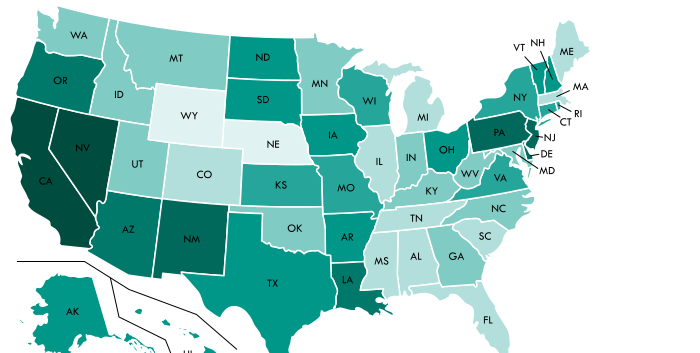
Most common states for publications managers
| Rank | State | Population | # of jobs | Employment/ 1000ppl |
|---|---|---|---|---|
| 1 | District of Columbia | 693,972 | 266 | 38% |
| 2 | Delaware | 961,939 | 80 | 8% |
| 3 | Washington | 7,405,743 | 515 | 7% |
| 4 | Massachusetts | 6,859,819 | 481 | 7% |
| 5 | California | 39,536,653 | 2,348 | 6% |
| 6 | Illinois | 12,802,023 | 808 | 6% |
| 7 | Virginia | 8,470,020 | 519 | 6% |
| 8 | Maryland | 6,052,177 | 372 | 6% |
| 9 | Oregon | 4,142,776 | 233 | 6% |
| 10 | Alaska | 739,795 | 42 | 6% |
| 11 | New York | 19,849,399 | 1,045 | 5% |
| 12 | Georgia | 10,429,379 | 553 | 5% |
| 13 | New Jersey | 9,005,644 | 455 | 5% |
| 14 | Colorado | 5,607,154 | 291 | 5% |
| 15 | Connecticut | 3,588,184 | 193 | 5% |
| 16 | Utah | 3,101,833 | 155 | 5% |
| 17 | Rhode Island | 1,059,639 | 49 | 5% |
| 18 | Texas | 28,304,596 | 1,072 | 4% |
| 19 | Pennsylvania | 12,805,537 | 572 | 4% |
| 20 | Arizona | 7,016,270 | 289 | 4% |
Most common cities for publications managers
| Rank | City | # of jobs | Employment/ 1000ppl | Avg. salary |
|---|---|---|---|---|
| 1 | Frankfort | 1 | 4% | $82,784 |
| 2 | Rockville | 2 | 3% | $84,492 |
| 3 | Annapolis | 1 | 3% | $84,739 |
| 4 | Altamonte Springs | 1 | 2% | $76,174 |
| 5 | Washington | 4 | 1% | $97,125 |
| 6 | Costa Mesa | 1 | 1% | $109,538 |
| 7 | Hartford | 1 | 1% | $87,215 |
| 8 | Los Angeles | 3 | 0% | $111,358 |
| 9 | Phoenix | 3 | 0% | $103,486 |
| 10 | Atlanta | 2 | 0% | $82,342 |
| 11 | Baltimore | 2 | 0% | $84,649 |
| 12 | Boston | 2 | 0% | $77,776 |
| 13 | Chicago | 2 | 0% | $76,450 |
| 14 | Indianapolis | 2 | 0% | $80,504 |
| 15 | San Diego | 2 | 0% | $106,564 |
| 16 | Baton Rouge | 1 | 0% | $104,010 |
| 17 | Denver | 1 | 0% | $76,330 |
| 18 | Des Moines | 1 | 0% | $93,743 |
| 19 | Detroit | 1 | 0% | $77,435 |
| 20 | Durham | 1 | 0% | $79,777 |
Publications Manager job outlook: Expert opinions
Our panel of publications manager experts

University of the Incarnate Word
Northwestern University

Southern Illinois University

University of Colorado at Colorado Springs

Saint John's University

Penn State University, Brandywine
University of Missouri-St. Louis
Luther College

Morehouse College
Indiana University Northwest

Drake University

Montana State University Billings

University of New Haven

Mississippi College
Neumann University

Dixie State University

Evangel University
Eastern Michigan University

University of the Incarnate Word
University of Michigan-Flint
Dr. Trey Guinn
Associate Professor and Program DirectorUniversity of the Incarnate Word
Communication Arts
What skills stand out on Publications Manager resumes?
Dr. Trey Guinn: The field of communication(s) is like an enormous playground. The roles and responsibilities of professional communicators vary as much as playgrounds and the equipment they house. What seems universal is that communications managers work to advance a brand's image by developing and delivering intentional messages that effectively convey meaning with impact. Beyond that, these individuals work in various settings and perform a range of communicative tasks. Some have general oversight of an organization's internal and external communications, while others may have a narrower focus exclusively on liaising with media to gain purposeful exposure or manage crisis communication. Thus, while the role may seem straightforward, the truth is that the job description and responsibilities can vary greatly. This is important to note because the skills that should stand out on your resume must incorporate your knowledge of the industry and the nuance of the specific job to which you are applying. Sticking with our aforementioned metaphor, a hiring manager may need to know that you have a general understanding of all the toys on the playground but may be especially interested in how well you build sandcastles. Thus, it behooves you to make your resume speak to the job description. And moreover, when appropriate to do so, you would be wise to utilize language in the job description. If you are part of a "tiger team," but the job description calls for someone who has been part of a "high-performing team," accommodate your language for the reader, especially if your reader is a machine that may not be programmed to understand your jargon.
What soft skills should all Publications Managers possess?
Dr. Trey Guinn: It goes without saying that a communications manager is expected to demonstrate exceptional verbal, nonverbal, and written communication. They should have in-depth knowledge of best writing and messaging practices for the needs of the particular organization and industry to which they have applied. But more than developing and delivering effective messaging, a savvy communications manager must effectively engage with individuals of all levels, whether internal or external to the organization. They must be able to lead and influence with and without positional authority.
What skills will help Publications Managers earn the most?
Dr. Trey Guinn: Companies large and small, especially those offering impressive salary ranges, seek individuals who can go beyond the traditional definition of the role. Organizations are looking for communications managers who can work cross-functionally, employ quantitative reasoning to extract meaningful insights, and then utilize their emotional intelligence and interpersonal savvy to turn nuggets of data into compelling stories presented to senior leaders. They seek people who can lead projects from ideation and strategy phases through implementation and assessment. Best-in-class communications managers also exhibit tremendous ability to influence internal and external stakeholders, unlock potential, and drive value.
Clarke Caywood
Professor (founder group of IMC and PR in Medill) Joint Doctorate in Business and Journalism - Univ. Wis. MadisonNorthwestern University
Integrated Marketing Communications in Medill School of Journalism, Media and IMC
What Publications Manager skills would you recommend for someone trying to advance their career?
Clarke Caywood: Rapid and changing from competitors who offer advanced textual intelligence systems to track brands, employees, competitors, public figures, customers, and more.
Justin Young
Assistant LecturerSouthern Illinois University
School of Communication Studies
What skills stand out on Publications Manager resumes?
Justin Young: What I hear more and more is a desire for multi-skilled Communication Managers. In other words, it's not simply enough to have a background in PR, but often you'll wear many hats and might be asked to shoot a video with your phone, edit it on your desktop, and then post it across social media. So they're not just looking for video editing, or web content management, or social media, or article writing, or public speaking, but ideally, a little of them all.
What soft skills should all Publications Managers possess?
Justin Young: Two big factors are affecting soft skill needs-diversity and remote work. As companies diversify, they need people who can deftly integrate diverse employees while keeping an open, understanding ear to those employees' needs. A background in intercultural communication and empathy is very useful here.
Along the same lines, COVID has forced many employees into remote work, and the truth is that some will never return to a traditional office schedule. Companies need communicators who can build those team dynamics when the team might be scattered across five states. Again, it's about listening to the needs and understanding that a video chat meeting is less about the tech and more about interpersonal communication and teamwork.
What skills will help Publications Managers earn the most?
Justin Young: Straight out of school, some of those hard skills might give you a leg up on that first job. However, long-term, I think soft skills like teamwork, problem-solving, adaptability, and simply interpersonal skills will advance you further. The most successful people I see tend to be good with people as well as willing to listen and learn. Some people can fake these skills to advance, but the organization usually suffers in the long-term, as do they financially.
Sherry Morreale Ph.D.
ProfessorUniversity of Colorado at Colorado Springs
Department of Communication
What hard/technical skills are most important for Publications Managers?
Sherry Morreale Ph.D.: A very recent analysis of 82 million job postings uncovered a critical demand by employers for what often is referred to as durable skills (America Succeeds, 2021). By contrast to hard skills, durable skills, sometimes referred to as soft skills, comprise important professional capabilities (Leadership, Critical Thinking, Communication, etc.) and personal qualities (Creativity, Mindfulness, Fortitude, etc.) that last throughout a person's entire career. In this analysis, two key findings are:
-In the job postings, the top five durable skills were requested nearly four (3.8) times more than the top five hard skills.
-Also, Communication and Leadership were in the highest demand, requested by 50+% of postings. These two durable (soft) skills sets include the following specific knowledge and skills.
A third durable skill or competency identified in the job postings, closely related to Leadership and Communication, is Collaboration. The Collaboration knowledge and skills connected to Communication and Leadership are interpersonal communications, coordinating, teamwork, team-oriented, team leadership, collaboration, team building, cooperation, and virtual teams.
Nancy DiTunnariello Ph.D.
Assistant ProfessorSaint John's University
Mass Communication
What soft skills should all Publications Managers possess?
Nancy DiTunnariello Ph.D.: Be personable! During the interview process, individuals are so focused on being "professional" that they forget to show potential employers who they really are. YOU are what sets you apart from other applicants. Also, employers want to see if your personality is a good fit with the company culture and the colleagues/clients you would be working with. Plus, would you want to work for an organization where you have to pretend and assume a false persona all day?
What hard/technical skills are most important for Publications Managers?
Nancy DiTunnariello Ph.D.: A hard/technical skill important in communication is to be aware of applications and programs used within your field and at least have some experience working with them. For example, if you are in advertising, be familiar with applications used in the ad and copy creation process. Or, if you are in tv/film, be familiar with editing applications like Adobe Premiere and Final Cut. This is why really jumping into your coursework pre-career is so important; you can take the time to explore and learn to use important software and applications that will tie to your future career.
Hans Schmidt Ph.D.
Associate Professor of Communications, Coordinator, Schreyer and Cooper Honors ProgramsPenn State University, Brandywine
Communications Department
What skills stand out on Publications Manager resumes?
Hans Schmidt Ph.D.: It is important to have a wide range of communication skills -from effectively participating in and leading meetings to write in style appropriate for the setting to media productions skills. When people move into the "manager" role, of course, this entails having developed a broad awareness of the culture at that particular organization and the skills needed to lead a group of people. So, really, skills related to communication touch on a wide range of job functions and responsibilities.
What soft skills should all Publications Managers possess?
Hans Schmidt Ph.D.: I know that "soft skills" is commonly used, but I'm not a fan of the term. I think it implies that some of these skills are "soft" or "easy" or "unimportant." They aren't. In many ways, so-called "soft skills" - things like interpersonal communication skills - can be among the most important skills for any worker. This is especially the case in communication-related fields, where there is an expectation that human interaction - both in-person and mediated - is important. This is true with leadership skills and presentation/speaking skills.
What hard/technical skills are most important for Publications Managers?
Hans Schmidt Ph.D.: Having the ability to write well is important in most knowledge-based fields today. It is especially critical in any communication-related field of job specialization. Otherwise, the specific technical skills are important variations between the particular company and/or job expectations. Some fields use proprietary software that one typically learns about once one starts the job. Some fields require media production competencies - related to basic video production, audio production, imaging or photography, or even web design/management. The important thing is to develop a general competency with technology - and to learn how to learn. That allows you to pivot to develop new skills in different situations and roles.
What skills will help Publications Managers earn the most?
Hans Schmidt Ph.D.: There are so many variables here. For one thing, market needs are constantly changing. Similarly, there is a wide range of salaries between different employers. This is why it is so important to, again, "learn how to learn." That enables you to be adaptable, flexible, and capable of adjusting to different environments. Also, it emphasizes why the development of fundamental communication skills related to spoken communication, written communication, and - today - mediated communication are so important. You can take these skills and specialize them in any number of ways.
Vicki Sauter Ph.D.
Professor of Information Systems and TechnologyUniversity of Missouri-St. Louis
Information Systems Department
What soft skills should all Publications Managers possess?
Vicki Sauter Ph.D.: The major soft skill needed by all graduates is communication, and net etiquette (netiquette), especially by younger workers. These workers are on the computer or the phone at all times. They don't distinguish between professional communication and personal communication. That combined with most communication happening in text, in Zoom, etc. They need to understand that you cannot rely upon emoticons and abbreviations to get your points across to the boss or the customer.
Associated with this is a need for comfort with computers, software, and fast changes in both.
Sarah Wilder Ph.D.
Associate ProfessorLuther College
Communication Studies Department
What certifications/licenses/courses can have the biggest impact for Publications Managers?
Sarah Wilder Ph.D.: That's an interesting question for a degree like Communication Studies that doesn't have a designated career like other fields. Some positions of our recent graduates include anchor, producer, occupational therapist, director of career development, attorney at law, librarian, graduate student, social worker, marketing manager, and director of training, to name a few. So really what certifications or licenses are helpful will be position/career specific. As far as courses, I recommend a breadth of courses that prepare individuals to interact and communicate competently as well as think critically. This could mean taking an interpersonal communication course to better understand the nuances of truly empathic, competent communication with others, particularly in a diverse workforce, to taking a course on argumentation to better understand how to effectively present ideas and critically interact with a larger society's positions on complicated ideologies.
Will there be an enduring impact of the coronavirus pandemic on Publications Managers?
Matthew Lange Ph.D.: During the COVID-19 pandemic international trade was able to continue but tourism, study abroad, and in-person business negotiation all but ceased due to quarantine and lockdown restrictions. When our lives shifted online, certain sectors of the economy were crippled, while others continued remotely with adjustments.
As the pandemic subsides, we will face a different work environment now that many employers and employees have grown accustomed to online working/learning. While most German educators will return to face-to-face instruction, schools and universities now have a greater infrastructure for online education and potentially greater acceptance by learners and teachers.
For those in professional tracts who augment their careers with German language skills (think business students with a second major in German), renewed freedom of movement will allow employees to work in and travel to German-speaking countries once again thus opening up greater employment opportunities. At the same time, new possibilities have emerged due to the shift to remote work.
In addition to the COVID pandemic, graduates of 2021 and beyond will also find a stronger Germany within the European Union due to Brexit. After kicking the proverbial can down the road for years, a hard negotiation deadline forced the British hand at the end of 2020. As a result of the Brexit, the UK has lost its representation in the European Parliament, and we have already seen international corporations moving their operations from London to other cities such as Amsterdam, Dublin (presumably to keep English as the local language), Frankfurt, and Paris. Frankfurt is particularly attractive to the financial sector, because the European Central Bank is there.
What will help Publications Managers increase their earning potential?
Matthew Lange Ph.D.: Several articles over the past few years have noted the salary bump for employees with second-language skills. A 2014 report in The Economist entitled "What is a language worth?" indicated, for example, that German proficiency can add a 3.8% bump to your earnings, as calculated by MIT economist Albert Saiz. This increase can come directly from employers who pay a premium for language skills, or the employee can benefit from a larger pool of opportunities that are simply inaccessible to monolingual speakers.
But while many graduates increasingly like to consider return-on-investment (ROI) of a course of study or set of skills, let us not forget that quality of life is important as well, even if it is difficult to quantify. Learning another language and its culture exposes one to another value system that might prefer, for example, more vacation time over increased salary.
Dorothy Ige Campbell
Professor of Communication Emeritus, Founder & Former ChairIndiana University Northwest
Department of Communication
What are the biggest trends we'll see in the Publications Manager job market given the pandemic?
Dorothy Ige Campbell: The emphases on graphic design and emerging media are in demand more than ever in an increasingly virtual world. New workers who have some Public Relations and persuasive communication backgrounds will have an edge. Those who work or go to school in diverse environments and have cross-cultural training during this time of civil rights demands are also suited for the new era. Jobs in Communication have decreased a bit (see below).
What certifications/licenses/courses can have the biggest impact for Publications Managers?
Dorothy Ige Campbell: A bachelor's degree in Communication is considered ideal for non-academic jobs. For undergraduate degrees, a Communication degree paired with a Minor (such as Business) can be ideal, and that has not changed. Those who wish to teach Communication in secondary schools often complete a four-year degree with a major in Education which stresses teaching methods and childhood development, with an emphasis in Communication. Courses in Drama and English also help secondary teacher preparation in Communication.
For graduate education and academic faculty positions in higher education, a Masters in Communication or a related field for part-time teaching for Junior College teaching of Communication courses is usually required. A Ph. D. is usually required for tenure-track, full-time faculty positions in Communication. Courses in statistical research, theory, then specialty Communication courses (such as Health, Religious or Strategic Communication, and so on) are usually required. At all levels, there is an increased emphasis on diversity in the curriculum.
What certifications/licenses/courses can have the biggest impact for Publications Managers?
Alanah Mitchell Ph.D.: In some cases certifications and licenses can help with possible job prospects. In general, IS education is focused on current technology processes, skills, tools, and technologies that employers are interested in. Additionally, internships during school really help to provide practical experience and increase the chances of job offers.
What soft skills should all Publications Managers possess?
Alanah Mitchell Ph.D.: Along with business and technical skills, IS majors do need to work in developing a broad set of soft, interpersonal skills. Specifically, collaboration and teamwork, critical thinking and problem solving, creativity, communication, negotiation and conflict management, and leadership as well as working under pressure often rank high in the list of soft skills necessary for success in IS. Increasingly, the development of soft skills is emphasized in academic programs as employers are looking for these skills in new graduates.
What soft skills should all Publications Managers possess?
Samuel Isaac Boerboom Ph.D.: Conflict management, the ability to work effectively and efficiently in groups, and active listening skills, especially as these pertain to engaging audiences in virtual settings.
What experience really stands out on Publications Manager resumes?
Matt Caporale: In a nutshell, hands on and applied experiences stand out the most. What employers truly seek is not just what you know and what you did, but how you did it, where you did it, to what outcome, and what do you offer now because of those experiences. This isn't new, but employers are increasingly looking for details and level of specificity to a student's college experience - buzzwords won't suffice any more. The experiences that stand out are ones students can actively quantify and showcase success, hard skills, and soft skills.
These types of experiences include traditional experiences such as internships, research projects, study abroad, and campus leadership. But they more often now include diverse perspectives, interdisciplinary experiences, and roles in which students make a focused impact on the organization in which they served. Employers seek well rounded candidates with hard and soft skills; so, the experiences that stand out will need to be diversified, skill focused, and impactful.
For students in international relations, these experiences will include traditional internships and study abroad, but also Model UN, policy research and development, multi-cultural experiences (local and international), and data-based projects.
What are the biggest trends we'll see in the Publications Manager job market given the pandemic?
Dr. Phyllis Seawright: Based on what our grads this year are doing, it appears that the market needs people with technical and writing skills. Social media is only as good as the writers and thinkers who create it. Our graduates are building web pages and social media platforms, PR and marketing plans. A graduate trained in media and people skills can find a job in this changing marketplace.
What Publications Manager skills would you recommend for someone trying to advance their career?
Dr. Phyllis Seawright: A gap year is only as adventurous as the budget allows. An up-to-date resume, thorough research of job websites in the desired area, and the ability to Zoom or Skype for interviews will help a fledgling fly farther from the nest. Having excellent presentation skills will secure that job over the Zoom universe.
What general advice would you give to a Publications Manager?
Dr. Phyllis Seawright: General advice: Practice professionalism while you are still in classes. When it's time for the BIG interview, you will feel more confident in how you present yourself to a potential employer. Keep a friend handy who can review your resume and other materials. It's too easy to miss an error when you have the INTERVIEW on your mind. And keep your interview suit READY to wear.
Dr. Alfred Mueller Ph.D.
Dean, School of Arts and Sciences, Professor of Communication ad Digital mediaNeumann University
School of Arts and Sciences
What experience really stands out on Publications Manager resumes?
Dr. Alfred Mueller Ph.D.: As someone who reads resumes regularly, I don't spend much time on the resume. I expect a resume to convey to me basic information about degrees held. If the applicant played in a sport or held a leadership position in a club while attending college, I want to know that because it shows me that the applicant managed time reasonably well and led a group of people in some way. I will also look for information about what an applicant accomplished in a previous or current position. I don't want a listing of the job's responsibilities. I want to know what value the applicant brought to the workplace. For example, don't tell me that you oversaw training initiatives at your current employer. Tell me that you trained 85% of the staff to use the new software and that, as a result, quarterly productivity increased 115%. The first tells me nothing; the second tells me what value you brought to the workplace. So it is important to shift away from bland job descriptions to accomplishments.
For me, the cover letter is much more important than the resume. The cover letter is the place where applicants can show me that they have done their research on my organization. Over 99% of the people whom I interview know little to nothing about my organization or its mission and values even though all of that information is a click away. If an applicant did not even take the time to look up that information on the Internet, it sends a clear signal to me about the applicant's lack of priorities. Demonstrate you have done that research by referring to my organization's mission and values in your cover letter. The cover letter is also the place where applicants can tell me about the soft skills they developed. Concrete examples help me see those skills in action.
Dr. James Stein
Assistant Professor and Director of Interpersonal Communication CurriculumDixie State University
Communication Studies Department
What Publications Manager skills would you recommend for someone trying to advance their career?
Dr. James Stein: Well, first, if you have the means/finances to take a full year off, I commend you. My advice would be to immerse yourself in the use of technology and social media. Every company is always looking for good PR and a good "vibe." So, if you're taking a gap year, I would recommend using that time not to figure out what you want to do, but rather to hone the thing(s) that you're already good at and make them work for you.
What general advice would you give to a Publications Manager?
Dr. James Stein: Take the job that best fits your career. I cannot tell you how many people (students, and personal friends alike) chose to turn down a career starter that pays $9 an hour in favor of a job that pays $11 and hour. As the old adage goes: penny smart, dollar foolish. You should always be asking yourself "how does this opportunity advance my larger goal?" Don't embark on an endeavor that doesn't help you, even if it does look shiny at first glance.
What type of skills will young Publications Managers need?
Melinda Booze: Today's communication graduates will need adaptive storytelling skills. In a communication environment that is noisy and insistent, the graduates that will stand out are those who can demonstrate to employers and clients that they can identify an audience's needs, wants and values and craft messages that connects with and engages that audience. This involves all the requisite hard and soft skills, such as technological proficiency, writing, speaking, a love of learning, flexibility, creativity and more. The skill that is perhaps less emphasized or practiced is careful listening. The outcome of careful listening is valid research that informs meaningful stories that communicate. -Melinda Booze, assistant professor of communication, Evangel University.
Dr. Jeannette Kindred Ph.D.
Professor of CommunicationEastern Michigan University
School of Communication, Media & Theatre Arts
What general advice would you give to a Publications Manager?
Dr. Jeannette Kindred Ph.D.: Seek out people in your field who you admire and start building professional relationships (this also builds your network). Ask questions and accept constructive feedback, to show that you are willing to learn and grow. Continually reflect on what you are doing and consider if the work is important and meaningful for you-if it's not, then why are you doing it? Finally, always find ways to give back to your community, through your voice or your actions. Especially in these difficult times in our country, we need people working together to better communities more than ever.
What are the biggest trends we'll see in the Publications Manager job market given the pandemic?
Michael Mercer: I think the job market might continue to be tough going into 2021. Until the vaccine is widespread many of the industries hard hit by Covid will have a slow recovery, and I would not be surprised if there is a tentative approach to hiring. However, many businesses have learned how productive employees can be when working remotely, and they have also discovered the cost savings when people work from home. I would predict that more jobs will be able to offer work-from-home options than before the pandemic.
Jeyoung (Jenny) Oh Ph.D.
Assistant Professor of CommunicationUniversity of Michigan-Flint
Department of Communication Studies
What Publications Manager skills would you recommend for someone trying to advance their career?
Jeyoung (Jenny) Oh Ph.D.: Anyone with internet access can learn many different skills. Many resources are free. The skills you should learn highly depend on the specific field you'd like to work in. For example, if you are interested in market research, then I recommend you take a statistics or data analytics course on online course sites, such as Coursera or Udemy. If you are interested in graphic design, a photography or Illustrator course will be helpful. It is also important to stay updated in your field by following various online sources. For instance, if you are interested in advertising, keep up with publications such as Ad Age, and if you want to work in public relations, I recommend that you keep an eye on the websites of the Public Relations Society of America and the Institute for Public Relations for the latest news.
Graduates can also enhance their skill sets and put them into practice by engaging in different experiences, such as volunteering with organizations in their field. With the ongoing pandemic, many organizations are seeking virtual help from volunteers. For example, if you volunteer in a social media marketing project for a nonprofit organization, you get to create a social media campaign to increase awareness of the initiatives of the organization. This experience can hone your skills in creating and managing online content. To search for these kinds of opportunities, you can use sites such as VolunteerMatch or AllForGood. It would be a great chance for you to apply what you have learned in class to make society better in this novel pandemic. You can also engage in a remote internship for a similar experience.