
Automatically apply for jobs with Zippia
Upload your resume to get started.
Quality control scientist skills for your resume and career
15 quality control scientist skills for your resume and career
1. QC
Quality control is a set of instructions or procedures to ensure a manufactured product or a service is up to the highest quality standards. This set of quality control criteria are either defined by the clients or the company itself.
- Inspected and released incoming QC reagents and materials into the laboratory facility.
- Participated in team projects representing the QC Laboratory to support other departments.
2. HPLC
- Conducted cleaning validations analysis using HPLC, TOC and Conductivity Chemistry laboratory techniques.
- Performed Clotting, SDS PAGE and HPLC assays on stressed samples of the products to evaluate stability of the dosage constituents.
3. Dosage Forms
- Perform testing of in-process and finished pharmaceutical dosage forms, products on stability and cleaning- -verification samples.
- Analyzed manufacture dosage forms intended for market and performed stability testing of marketed dosage forms.
4. Analytical Methods
An analytical method is a method used to determine the chemical or physical property of a substance. It is a procedure to determine the relationship between different variables. This method can be conducted by combining scientific methods with any kind of formal process to solve a problem or prove a fact.
- Executed validation protocols, which include: Instrument Performance Qualification and Analytical Method Transfer for Finished Products and Raw Material.
- Tested in-process and finished products in the quality control chemistry laboratory using validated analytical methods.
5. Test Methods
Test methods are the steps in which thorough testing is conducted in a laboratory setting.
- Authored/revised/approved test methods, specifications, forms, standard operating procedures and other documentation.
- Designed validation protocols and perform validation experiments on the developed test methods.
6. UV/Vis
- Worked with Potentiometer KF, Coulometer KF, Metler Titrator, UV/VIS Spectrophotometer, Atomic Absorption and Dissolution Apparatus.
- Performed the potency studies, dissolution, and uniformity, by using HPLC, GC, and UV/VIS.
Choose from 10+ customizable quality control scientist resume templates
Build a professional quality control scientist resume in minutes. Our AI resume writing assistant will guide you through every step of the process, and you can choose from 10+ resume templates to create your quality control scientist resume.7. GC
- Operated different instrument like Karl Fischer, Gc and MS Approved the lots.
- Tested raw materials and stability testing on pharmaceutical products and participated in validation of GC systems and performed general laboratory procedures.
8. Test Results
- Recognize atypical or out-of-specifications test results, instrument malfunctions and methodology problems and participates in the investigation to resolve and correct.
- Participated in the investigation of atypical or out-of-specifications test results, instrument malfunctions and methodology situations.
9. Microbiology
- Developed a full functioning microbiology laboratory, from design to evaluating and acquiring equipment for the laboratory.
- Performed monthly internal audits of microbiology labs to ensure audit preparedness and share findings with area supervisors.
10. Laboratory Equipment
- Carry out calculations, operation of laboratory equipment and record keeping necessary to complete method transfer activities for new products.
- Assist and conduct laboratory equipment's Performance Qualifications and Installation Qualifications * Conduct laboratory reagents and equipment purchases.
11. Data Analysis
- Trained new personnel in Standard Operating Procedures, QA documentation review procedures, and laboratory data analysis.
- Perform event and laboratory data analysis due for investigation and root cause analysis.
12. Qc Testing
- Established and documented QC testing procedures and specifications.
- Performed QC testing on Raw Materials, Intermediates, and Final Product.
13. FDA
The Food and Drug Administration (FDA) is a division of the US Department of Health and Human Services that regulates the production and sale of food, pharmaceutical products, medical equipment, and other consumer goods, as well as veterinary medicine. The FDA is now in charge of overseeing the manufacture of products like vaccines, allergy treatments, and beauty products.
- Participated in FDA inspection and contributed to successful FDA inspection and approval of the new manufacturing facility.
- Documented test procedures into laboratory notebook per FDA regulations and GMP requirements.
14. EP
An EP also known as "Extended Play" are song recordings that have fewer tracks compared to an Album but more tracks compared to a Single. A Single allows for three tracks maximum with thirty minutes while an EP stands at four to five tracks. Six tracks onwards form an Album.
- Conducted gap analysis and conciliation among USP, JP and EP monographs.
- Experienced in USP/BP/JP and EP pharmacopoeias and the change process.
15. Environmental Monitoring
Environmental monitoring is a method to manage and assess a particular environmental condition or situation. It plays an essential role in society as it affects how people can work and implement regulations and guidelines on protecting and conserving the environment to prevent further impact or damage. Other can assessment, monitoring also needs a support policy for and concrete plan for a long term effect.
- Trained analysts on media preparation, environmental monitoring sampling and plate reading.
- Performed analysis for environmental monitoring samples, process and cleaning validation samples.
5 Quality Control Scientist resume examples
Build a professional quality control scientist resume in minutes. Browse through our resume examples to identify the best way to word your resume. Then choose from 5+ resume templates to create your quality control scientist resume.

What skills help Quality Control Scientists find jobs?
Tell us what job you are looking for, we’ll show you what skills employers want.
What skills stand out on quality control scientist resumes?
Stephanie Hooper Marosek Ph.D.
Chair, Associate Professor, Methodist University
What soft skills should all quality control scientists possess?
Dunwei Wang Ph.D.
Margaret A & Thomas A Vanderslice Chair in Chemistry, Professor of Chemistry, Chairperson of Chemistry Department, Boston College
What hard/technical skills are most important for quality control scientists?
Dunwei Wang Ph.D.
Margaret A & Thomas A Vanderslice Chair in Chemistry, Professor of Chemistry, Chairperson of Chemistry Department, Boston College
What quality control scientist skills would you recommend for someone trying to advance their career?
Peter Rosado
Associate Professor of Chemistry, Georgia College and State University
What type of skills will young quality control scientists need?
Dennis Doverspike Ph.D.
Chief People Scientist, Doverspike Consulting/HR LItehouse
What technical skills for a quality control scientist stand out to employers?
Dr. Joey Neilsen
Assistant Professor, Villanova University
List of quality control scientist skills to add to your resume
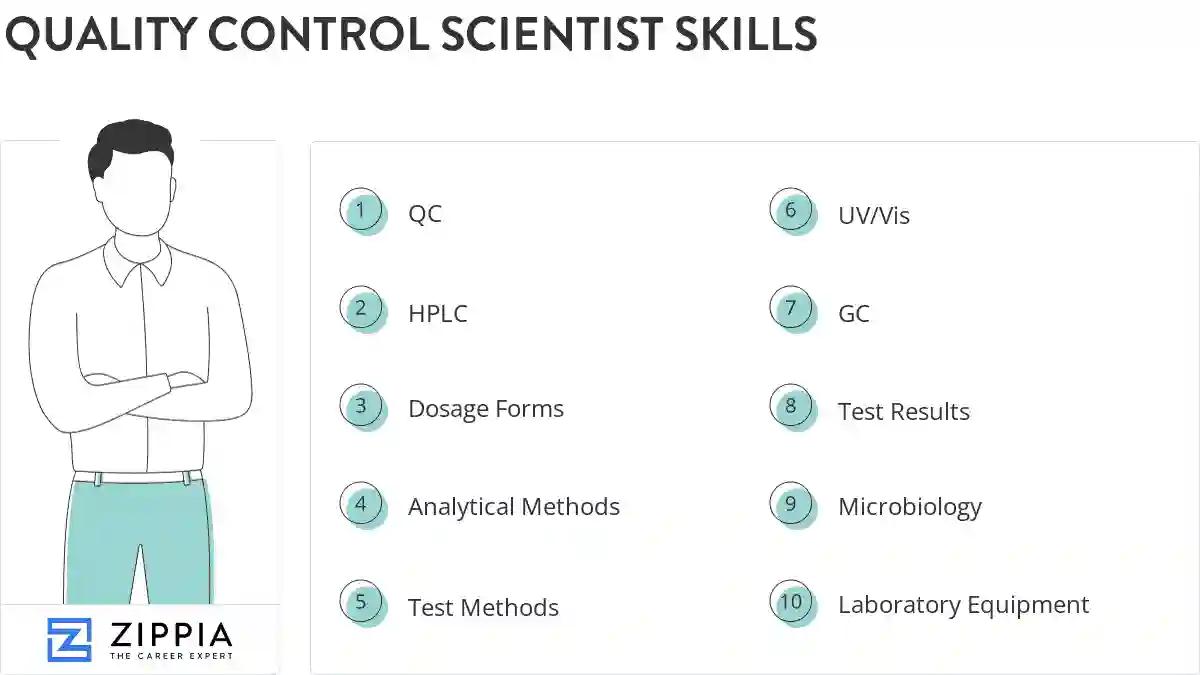
The most important skills for a quality control scientist resume and required skills for a quality control scientist to have include:
- QC
- HPLC
- Dosage Forms
- Analytical Methods
- Test Methods
- UV/Vis
- GC
- Test Results
- Microbiology
- Laboratory Equipment
- Data Analysis
- Qc Testing
- FDA
- EP
- Environmental Monitoring
- Method Validation
- Pharmaceutical Industry
- Method Development
- CAPA
- OSHA
- ICH
- Stability Samples
- PCR
- Elisa
- OOs
- Peer Review
- Laboratory Instruments
- FTIR
- Cell-Based Assays
- Apis
- Karl Fischer
- Drug Products
- Test Procedures
- Data Review
- Analytical Data
- Cgmp Environment
- Cleaning Validation
- Technical Support
- GLP
- Process Validation
- Endotoxin
- UPLC
- Bioburden
- Laboratory Investigations
- Laboratory Notebook
- Drug Substance
Updated January 8, 2025
