
Automatically apply for jobs with Zippia
Upload your resume to get started.
Quality/reliability engineer skills for your resume and career
15 quality/reliability engineer skills for your resume and career
1. Product Quality
Product quality is the basic element of a business. It means to add features in a product or service in such a way that it meets the needs and wants of the customers. Enhancing the product quality also means improve the goods from any existing defects to ensure customer satisfaction.
- Oversee entire Quality Management and Document Control Systems ensuring top product quality and reliability for high speed IC manufacturing.
- Challenged with increasing product quality and process capacity in a chemical production facility with batch and continuous processes.
2. Statistical Analysis
- Inspected piece parts to ensure tight tolerances through statistical analysis and implemented this process as a continuous improvement procedure.
- Provided corporation cost/statistical analysis with estimates to meet contractual requirements for connectors, indicators, and components.
3. Corrective Action
- Conducted Material Review Analysis (MRA) - reviewed discrepant hardware, reviewed engineering dispositions, analyzed and followed-up corrective actions.
- Performed root cause analysis and proactively drove corrective action of reliability and customer field failures through a cross-functional Failure Review Board.
4. Failure Analysis
Failure Analysis is a step-by-step process of determining the reason for a particular machine or equipment failure by way of checking, identification, and examination. It means conducting a test within the system and perform a maintenance check that leads you to a conclusion. A failure analysis takes place to prevent further damages.
- Saved two key accounts with focused failure analysis investigations and detailed summary reports which customers were very pleased with.
- Consolidated test capacity and failure analysis planning processes at Intel's environmental labs in Oregon and Washington.
5. Quality Standards
Quality standards are a specific level of standards of products that are set by the companies for the customers that have to be met and maintained throughout the process until the time of delivery. Quality standards are information that includes the customer's requirements, guidelines, and characteristics for the needed final product or service.
- Applied best practices and coordinated operation of QC Laboratories compliance to ISO 9001/ TS 16949 quality standards.
- Establish Quality processes and quality standards using ISO 9001and Six Sigma methods.
6. Data Analysis
- Monitored warranty data, ran data analysis, prepared reliability reports & made recommendations to improve design.
- Created Best Known Method document for data analysis methodology on Flash Memory products.
Choose from 10+ customizable quality/reliability engineer resume templates
Build a professional quality/reliability engineer resume in minutes. Our AI resume writing assistant will guide you through every step of the process, and you can choose from 10+ resume templates to create your quality/reliability engineer resume.7. Product Reliability
- Lead Engineering Investigations, participate in quality audits while performing drawing and design reviews to improve product reliability / maintainability.
- Performed post-market risk assessments and product reliability estimates using the data from prospective registries and complaints data.
8. Sigma
In Greek alphabets, sigma is the 18th letter that means "to sum up". In statistics, the lower case symbol of sigma is the unit of measurement for standard deviation which is used to assess the variability in a given set of data. While the upper case symbol is for summation notation means to add up all the given numbers in the data set.
- Improved quality 50%, safety 70% and downtime 42% by coaching teams in Six Sigma methodologies.
- Used 6 SIGMA (DMAIC) methodologies for problem solving and conducted FMEA with cross-functional engineering team.
9. Product Development
Product development is the complete procedure of creating a product from concept until release of the final product. Product development has many stages after which a product is released into the market. Identifying the need, creating the opportunity, conceptualizing a product, and providing a solution, all are different stages of product development.
- Integrated quality and reliability into new product development cycle.
- Analyzed design requirements & developed reliability plan with suppliers for new product development programs Constructed design verification/validation test plans.
10. JMP
- Designed experiments and analyzed data using modeling and statistical tools (such as JMP and Minitab).
11. Process Control
Process control is a method pertaining to continuous production processes that uses the aid of ICS (Industrial Control Systems) for production. This method enables production to be done with a level of consistency and safety in an economically friendly manner that is impossible to achieve solely through manual control.
- Consolidated and analyzed Daily to Weekly Statistical Process Control of Intel Flash memory chips.
- Established a Cooling Unit Baseline and Implemented In-Production Statistical Process Control.
12. ISO
- Maintained budget control with an outside certification body and organized external certification audits for North America in all ISO certifications.
- Completed reorganization of Quality Management System including TS16949 compliance elements, and full ISO 9001:2008 re-certification.
13. Continuous Improvement
Continuous improvement is an ongoing process of improvement of products, services, and processes with the help of innovative ideas. It is an organized approach that helps an organization to find its weaknesses and improve them.
- Chaired and directed continuous improvement team meetings for internal interfacing as well as for manufacturing assembly processes and suppliers' improvement.
- Utilized Value Stream Mapping to identify process bottlenecks and bring about continuous improvement.
14. FMEA
- Assist Body Engineers with the application of FMEA Methodology and participate in the development of the new FMEA Handbook.
- Led Failure Mode and Effects Analyses (FMEA / PFMEA) and Reliability analyses efforts on new products.
15. Risk Assessments
The process of analyzing and identifying the acts or events that have the potential to negatively affect an individual, asset, or business is called risk assessment. Risk assessments are important because they form an integral part of an organization as well as occupational safety plans
- Performed risk assessments based on historical trends of potential failures and advise management on course of action.
- Developed risk assessments to determine testing required.
5 Quality/Reliability Engineer resume examples
Build a professional quality/reliability engineer resume in minutes. Browse through our resume examples to identify the best way to word your resume. Then choose from 5+ resume templates to create your quality/reliability engineer resume.

What skills help Quality/Reliability Engineers find jobs?
Tell us what job you are looking for, we’ll show you what skills employers want.
What quality/reliability engineer skills would you recommend for someone trying to advance their career?
Ana Wooley Ph.D.
Assistant Professor, University of Alabama at Huntsville
What technical skills for a quality/reliability engineer stand out to employers?
Tracy Farrell
Adjunct Instructor, Clarkson University
Respectfully, today's graduates do not understand that being able to text and use social media does not prepare them for "real" computer skills. Many students that I have in high school and in college do not have proper writing skills, document formatting skills, or document management skills to know how to save documents properly and where to save to.
What hard/technical skills are most important for quality/reliability engineers?
Dr. David Grewell Ph.D.
Department Chair and Professor, North Dakota State University
List of quality/reliability engineer skills to add to your resume
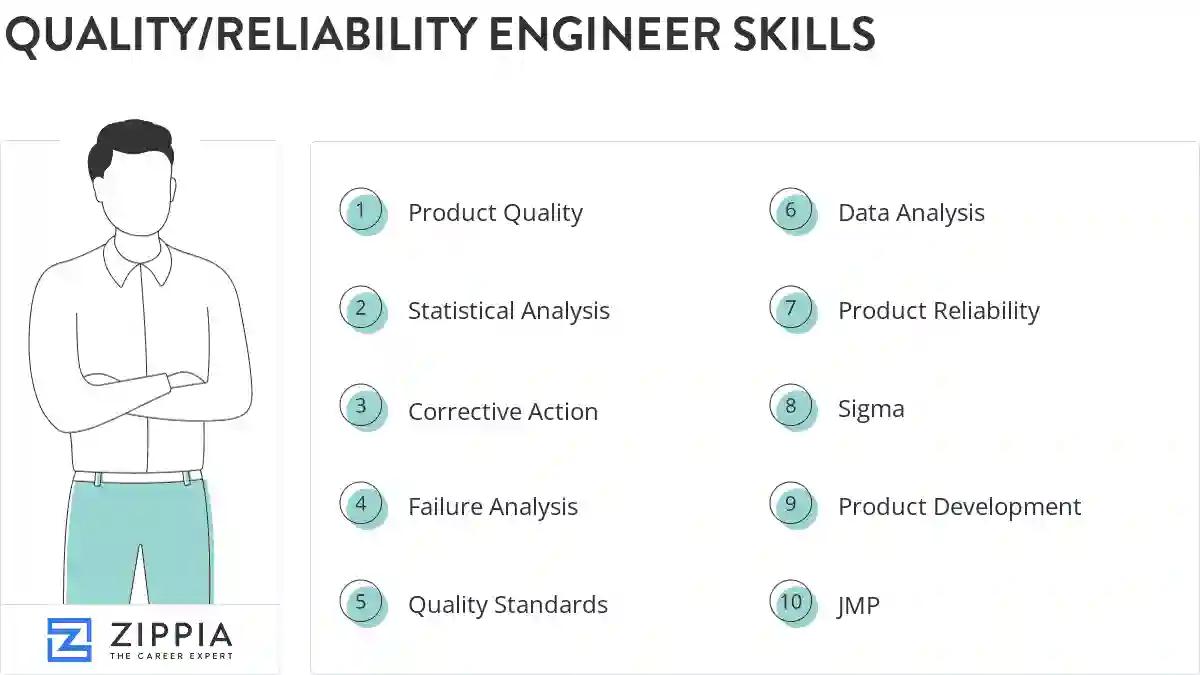
The most important skills for a quality/reliability engineer resume and required skills for a quality/reliability engineer to have include:
- Product Quality
- Statistical Analysis
- Corrective Action
- Failure Analysis
- Quality Standards
- Data Analysis
- Product Reliability
- Sigma
- Product Development
- JMP
- Process Control
- ISO
- Continuous Improvement
- FMEA
- Risk Assessments
- Quality Issues
- Failure Modes
- Minitab
- Test Data
- SPC
- R
- PFMEA
- Reliability Issues
- Quality System
- DOE
- Statistical Methods
- FMECA
- Test Equipment
- Supplier Quality
- Product Design
- PPAP
- Reliability Analysis
- Lean Manufacturing
- Management System
- APQP
- Design Verification
- RMA
- DFMEA
- FDA
- QMS
- MTBF
- Design Engineering
- Regression
- HASS
- Customer Issues
- Commodities
- Test Results
- Customer Returns
- Quality Metrics
Updated January 8, 2025
