
Automatically apply for jobs with Zippia
Upload your resume to get started.
Radio interference supervisor skills for your resume and career
13 radio interference supervisor skills for your resume and career
1. Communications Equipment
Communication equipment is an installation or a facility that consists of the physical plants and equipment solely to disseminate information. Communication equipment includes mobile and/or portable radios, based and/or fixed station radios, and repeaters.
- Executed the establishment and maintenance of detachment tactical and communications equipment valued more than $3 million without violation or loss.
- Instructed a class of 16 individuals on 8 different pieces of communications equipment with a 100% pass rate.
2. RF
- Supervised RF design, system performance and optimization for 150 + sites in AL, MS and Kansas.
- Diagnosed 400 faulty radios using RF instrumentation devices and measurements including Signal Generators and Power Meters.
3. Radio Communications
- Coordinated personnel engaged in installing and maintaining radio communications with higher headquarters.
- Performed trouble-shooting on various satellite and single channel radio communication systems.
4. VHF
- Supervised the installation, operation, and maintenance of tactical HF, VHF, UHF, and satellite communications circuits.
- Provided multiple spectrum (HF, VHF, UHF, SHF, and EHF) communications in fixed and tactical environments.
5. Combat Operations
- Supervised communication staff in a complex and dynamic battalion combat operations center.
- Initiated and anchored numerous communication innovations to ensure the success of the battalion during combat operations in Iraq and Afghanistan.
6. UHF
- Keep track via UHF radios, HF radios or cell phones of all displacements of personnel for security matter.
- Prepared messages for transmission and reception on HF, UHF and satellite radio equipment.
7. KPIs
- Recognized as the region with the best KPIs nationwide during 3 consecutive years.
- Performed trending KPIs and monitor cell site performance before and after site upgrade.
8. Radio Equipment
Radio equipment is an electrical product which is designed to emit and receive radio waves so that it can search the function of radio communication and radio determination. Radios modulate and radiate electromagnetic waves in space to communicate over a distance. This equipment is installed operated and managed by skilled and educated professionals.
- Managed the procurement and inventory management of all radio equipment.
- Maintained and repaired radio equipment and computers.
9. Radio Operators
- Attended Incidental Radio Operators Course.
10. SATCOM
- Performed troubleshooting and training on units SatCom Radios and associated sub systems to correct deficiencies prior to a combat deployment.
- Provide 24 hour operations for air craft through HF and SATCOM communications.
11. Antenna
The antenna is a lengthy pole-like tool used in radio engineering to receive radio wave signals sent into space from transmitting stations. The waves are gotten by the antenna and transmitted using a transmitter into audible and clear sounds on the radio being used. Antennas have over the years grown beyond radios and now into cable TV's and in the use of ordinary televisions.
- Designed and built an antenna capable of talking over 300 miles away using the high frequency band.
12. Communication Assets
- Maintained accountability for more than 100 electronic key management systems and over 500 pieces of communication assets across ten different units.
- Protected Cryptographic Communication assets and information, planning and monitoring physical security measures to safeguard people and electronic infrastructure.
13. Satellite Communications
- Provided as-needed technical assistance to satellite communications work-centerwhen deployed.
- Inspected wireless radio/satellite communications activities and determined equipment operational status.

What skills help Radio Interference Supervisors find jobs?
Tell us what job you are looking for, we’ll show you what skills employers want.
List of radio interference supervisor skills to add to your resume
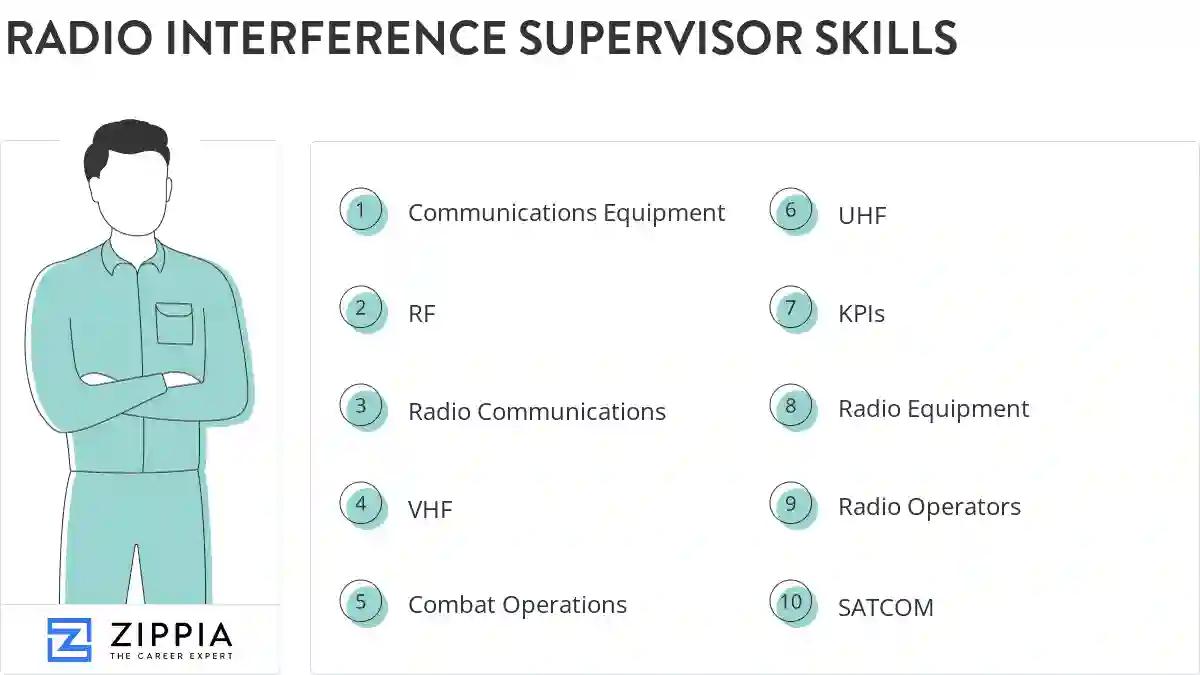
The most important skills for a radio interference supervisor resume and required skills for a radio interference supervisor to have include:
- Communications Equipment
- RF
- Radio Communications
- VHF
- Combat Operations
- UHF
- KPIs
- Radio Equipment
- Radio Operators
- SATCOM
- Antenna
- Communication Assets
- Satellite Communications
Updated January 8, 2025
