
Automatically apply for jobs with Zippia
Upload your resume to get started.
Radiologic technologist assistant skills for your resume and career

15 radiologic technologist assistant skills for your resume and career
1. Patients
- Provided customer service concerning outpatient care while keeping an accurate tally of patients receiving treatment.
- Performed administrative duties and quality assurance to facilitate patients and ensure record accuracy.
2. Patient Care
Patient care entails the diagnosis, recovery, and control of sickness as well as the maintenance of physical and emotional well-being through the use of healthcare providers' services. Patient care is described as services provided to patients by health practitioners or non-professionals under guidance.
- Transported patients to various departments within radiology Provided basic patient care
- Earned recognition for delivering exemplary patient care and customer service.
3. Vital Signs
Vital signs are a set of values indicating different body systems' performance. They are measurements of the body's most basic functions. The four major vital signs used in medicine to assess a patient are body temperature, pulse rate, respiration rate, and blood pressure.
- Retrieve and document patient's history and physical records, current medications, allergies, and vital signs.
- Verify patient and obtain vital signs such as BP, Pulse, O2 Sat, and temperature.
4. CPR
Cardiopulmonary resuscitation or CPR is a medical procedure that involves chest compression to help a patient breathe. This artificial ventilation helps in keeping the brain function in place and regulates blood throughout the body. CPR is a lifesaving procedure that is used in emergencies.
- Maintained HIPAA regulations and was up to date on all certifications (i.e CPR, ARRT, and clinical mandatories)
- Handled inventory and ordering supplies, and materials, Hands on training,CPR Certification
5. Radiologic Technologist
- Assisted Radiologic Technologist and Radiologist with diagnostic procedures.
- Developed X-rays for Radiologic Technologist.
6. Exam Rooms
An exam room in a hospital is a place where patients are examined by medical representatives. In several cases, the exam room distinguishes the doctor-patient relationship and is a critical component of the overall care process.
- Escort patients to exam rooms and explain the remainder of their appointments.
- Worked and communicated well with Physicians, assisting in exam rooms.
Choose from 10+ customizable radiologic technologist assistant resume templates
Build a professional radiologic technologist assistant resume in minutes. Our AI resume writing assistant will guide you through every step of the process, and you can choose from 10+ resume templates to create your radiologic technologist assistant resume.7. Radiologic Procedures
- Perform radiologic procedures in an outpatient orthopedic setting, using digital radiography.
- Completed radiologic procedures for interpretation.
8. EKG
- Perform drug screens, EKG, CBC, urinalysis, and other in-house lab tests.
- Staff Technologist, RADS Mobile Radiology and EKG Services, Inc., Columbia, SC.
9. MRI
Magnetic Resonance Imaging (MRI) is a non-invasive and painless procedure that uses strong magnetic fields, radio waves, and computers to create detailed and cross images of the body's inner parts. MRI scanner can detect anomalies inside the brain and spinal cord, find tumors or cysts, detect heart, liver, and other abdominal organ problems, and many more. MRIs are very useful in studying soft tissues and the nervous system. Aside from diagnosing diseases, doctors also use MRI to check how well you have recovered from a particular treatment.
- Report to patient flow coordinator for transport of patients and provide radiology tech support in X-ray, MRI and CT procedures.
- Mixed Contrast drinks for the patients receiving Cat Scans, MRI's and Sonograms.
10. Phlebotomy
- Performed X-ray imaging, waived lab procedures phlebotomy and medical assistant procedures.
- Performed Phlebotomy and ran minor in office laboratory results.
11. Pacs
Picture archiving and communication system or, as is more commonly shortened, PACS, is a type of imaging scan used in medical treatment and other such work which provides effective storing and access to images and scans created by a large variety of machinery and medical tools. This might include scans such as CTs and MRIs and even basic X-rays and the system can also potentially be used to store digitised versions of originally physical paper documents.
- Used PACS system on computer to complete the requisition to alert the doctor that the x-ray was completed.
- Assisted with ICU portable exams and completed exam paperwork with traditional and digital (PACS) systems.
12. EMR
- Obtain medical histories and enter patient data into EMR.
- Document procedures and interactions in EMR.
13. HIPAA
- Verified at least two patient identification items before transporting patient and maintained patient and family confidentiality (HIPAA).
- Maintain comprehensive records in compliance with regulations, including HIPAA.
14. Ultrasound
Ultrasound refers to an imaging method that uses high-frequency sound waves to produce images of structures within your body.
- Perform C-ARM and Ultrasound duties during injection procedures.
- Completed diagnostic-quality ultrasound exams under the direction of the radiologist.Developed and maintained effective relationships through effective and timely communication.
15. Patient Transport
- Input of patient studies to system for Radiologists to review Patient Transport - Clinical Care Operations Duties: 1.
- Assist radiology and nuclear technologist in areas such as patient transportation, paperwork, filing, etc.
5 Radiologic Technologist Assistant resume examples
Build a professional radiologic technologist assistant resume in minutes. Browse through our resume examples to identify the best way to word your resume. Then choose from 5+ resume templates to create your radiologic technologist assistant resume.

What skills help Radiologic Technologist Assistants find jobs?
Tell us what job you are looking for, we’ll show you what skills employers want.
What radiologic technologist assistant skills would you recommend for someone trying to advance their career?
Karen Bubb
Department Head, Assistant Professor, Diagnostic Medical Imaging, Oklahoma State University - Oklahoma City
List of radiologic technologist assistant skills to add to your resume
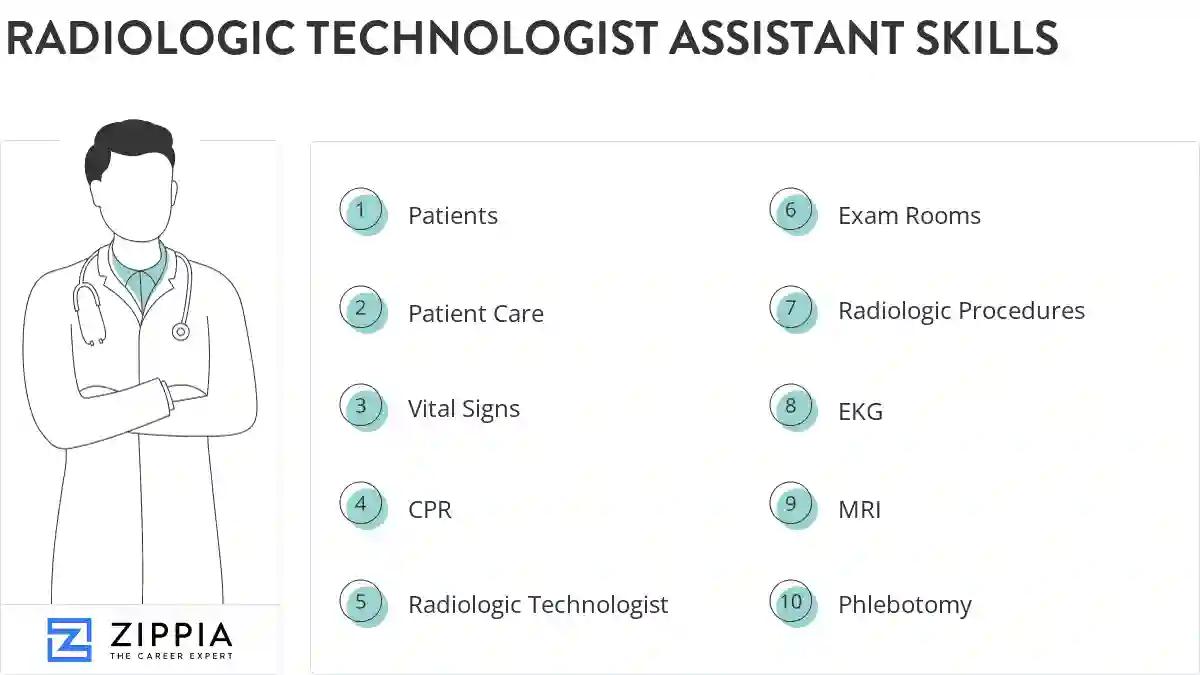
The most important skills for a radiologic technologist assistant resume and required skills for a radiologic technologist assistant to have include:
- Patients
- Patient Care
- Vital Signs
- CPR
- Radiologic Technologist
- Exam Rooms
- Radiologic Procedures
- EKG
- MRI
- Phlebotomy
- Pacs
- EMR
- HIPAA
- Ultrasound
- Patient Transport
- Patient Safety
- Patient History
- Front Desk
- Patient Flow
- Medical History
- Ct Scan
- IV
- Drug Screens
- Urinalysis
- ALARA
- DR
- Lab Tests
- Blood Pressure
- Nuclear Medicine
- Stretchers
- Strep
- CR
- Test Results
- X-Ray Equipment
- Medical Procedures
- Radiologic Exams
- Patient Charts
- Diagnostic Radiographic Procedures
- Splints
- Computer System
- C-Arm
- Diagnostic Images
- Surgical Procedures
- Scheduling Appointments
- Breath Alcohol
- Patient Exams
- Hippa
Updated January 8, 2025
