
Automatically apply for jobs with Zippia
Upload your resume to get started.
Receiving operator skills for your resume and career
15 receiving operator skills for your resume and career
1. Pallets
- Unloaded trucks, sorted and tagged merchandise.- Stack and wrap pallets.- Pick order and other duties, as needed.
- Used RF Scanner to insure proper location movement of pallets, clamp product, and bulk movement of furniture
2. OSHA
- Demonstrated high compliance with OSHA regulations relating to maintaining tools and equipment operations.
- Received OSHA Certification on all equipment.
3. GMP
GMP stands for Good Manufacturing Practice. It is a system that ensures that all products like food, beverages, and medicinal drugs that are produced comply with the quality standards. It helps in minimizing the risks and hazards that cannot be eliminated after the testing of final products.
- Manufacture active pharmaceutical ingredients using GMP format and aseptic techniques.
- Observed plant safety work procedures, rules, environmental practices, and GMP guidelines by serving as a Plant Safety Observer.
4. Inventory Control
- Helped with inventory control using RF gun.
- Instituted inventory control procedures resulting in a reduction of overpayment to suppliers.
5. CIP
A Capital Improvement Plan (CIP) is a planning tool used to coordinate the timing and financing of capital improvements over a period of several years. It helps organizations make good budget decisions for large projects and purchases based on objectives and resources. The purpose of a CIP is to identify capital improvement projects, identify and forecast funding sources, prioritize improvements based on available funds, and estimate a timeline for completing the improvements.
- Learned and controlled computer operations for raw receiving bays and CIP systems.
- Connected together Milk tank and whey tanks for CIP and assembly.
6. Cleanliness
- Maintained cleanliness of the receiving bay, in accordance with the set rules and regulations.
- Coordinated other employees to maintain cleanliness of department.
Choose from 10+ customizable receiving operator resume templates
Build a professional receiving operator resume in minutes. Our AI resume writing assistant will guide you through every step of the process, and you can choose from 10+ resume templates to create your receiving operator resume.7. RF
- Replenished and put away products for specific locations according to RF selection.
- Used RF equipment to receive and replenish warehouse inventories.
8. Rail Cars
Rail Cars, also called railroad cars, are large containers set on a railway and pulled by a locomotive. Rail cars are frequently used for shipping large quantities of product or material, such as metal, chemicals, or livestock; however, a rail car may also transport people such as a subway system. A locomotive often pulls numerous cars that attach to each other, which then form a train.
- Constructed and managed orders and request-Responsible for keeping inventory-Loaded/Unloaded trucks and rail cars-Transported products and materials to and from site locations
- Packaged/labeled/sealed hazardous materials for shipping, monitored consoles, loaded/unloaded rail cars, made blends
9. Shipping Receiving
- General Warehouse/Light Industrial Shipping Receiving.
- Loaded and unloaded trucks with forklift in the shipping receiving department.
10. Quality Customer Service
- Provided quality customer service to all resort staff, vendors/contractors, and customers.
- Provide quality customer service to all callers.
11. Customer Orders
- Retrieve and confirm sales, aids and stripe cards to accommodate customer orders.
- Received/maintained stock in warehouse and picked/shipped customer orders utilizing bar code gun in a packaging distribution warehouse.
12. Unload Trucks
Unload trucks is an activity that is undertaken to remove items that have been carried on a truck. It could be raw materials, work-in-stock or finished products. Unloading a truck may require people and some equipment that may help unload items that are too heavy or dangerous for humans to handle.
- Load and unload trucks, Delivered and put away materials in designated areas.
- Unload trucks, check for damage, stage load on dock inventory loads.
13. PPE
Personal protective equipment is an item of protective clothing such as goggles, helmets, or other garments meant to protect the body from injury.
- Shift safety auditor- safety audits, incident investigations, PPE verification
- Familiarized with company PPE policies and operating procedures.
14. Cycle Counts
Cycle counts are the procedures used in inventory auditing and enable organizations or businesses to count items in various areas within the organization's warehouse without counting the entire inventory.
- Perform raw materials transfers, enter accepted materials into inventory system and cycle counts as necessary.
- Receive and sample a raw material for test also monthly cycle counts and warehouse inspections.
15. Antibiotics
- Sample raw milk tankers and test the milk to make sure it was free of antibiotics.
5 Receiving Operator resume examples
Build a professional receiving operator resume in minutes. Browse through our resume examples to identify the best way to word your resume. Then choose from 5+ resume templates to create your receiving operator resume.

What skills help Receiving Operators find jobs?
Tell us what job you are looking for, we’ll show you what skills employers want.
List of receiving operator skills to add to your resume
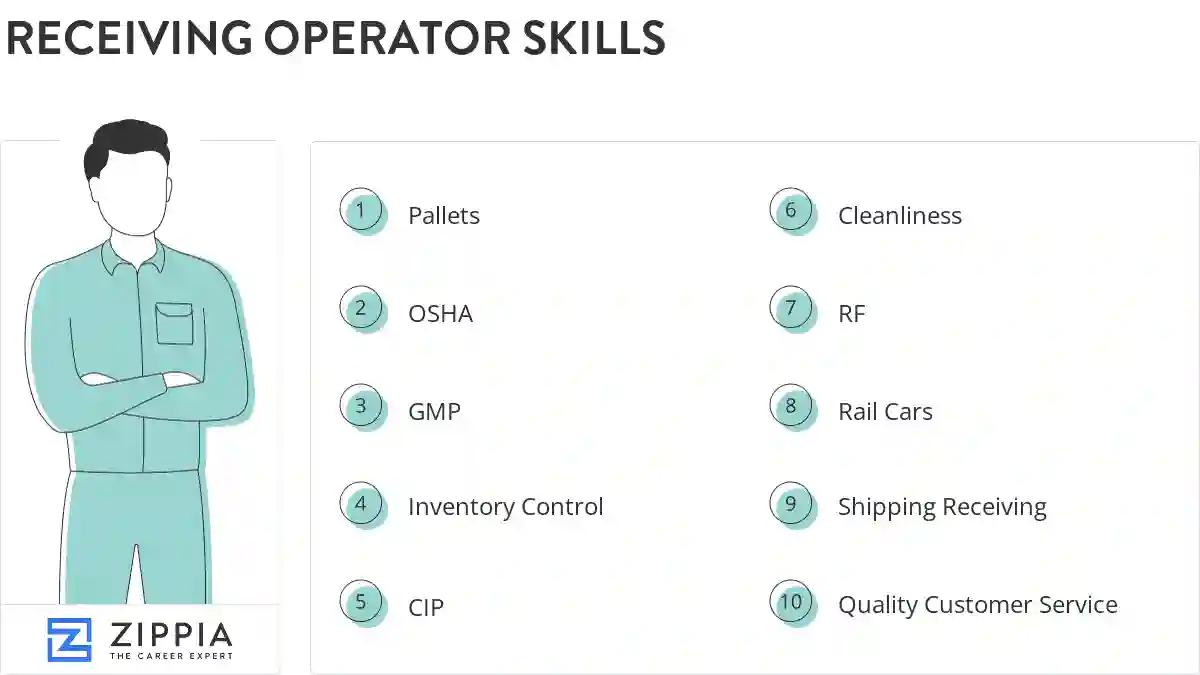
The most important skills for a receiving operator resume and required skills for a receiving operator to have include:
- Pallets
- OSHA
- GMP
- Inventory Control
- CIP
- Cleanliness
- RF
- Rail Cars
- Shipping Receiving
- Quality Customer Service
- Customer Orders
- Unload Trucks
- PPE
- Cycle Counts
- Antibiotics
- Computer System
- Purchase Orders
- CAD
- Medicaid
- Outbound Calls
- Telephone Calls
- Ambulances
- Hazardous Waste
- EX
Updated January 8, 2025
