
Automatically apply for jobs with Zippia
Upload your resume to get started.
Record systems analyst skills for your resume and career
10 record systems analyst skills for your resume and career
1. On-Call Rotation
- Update support and maintenance documentation * Provides production support on as part of an on-call rotation that provides 24x7 support.
2. EHR
Electronic Health Records, or simply EHR, contains all the information about a patient whether they are new or old. It includes the record of diagnosis, medication, progress note, medical history, radiology, and laboratory results. A health facility or hospital has this kind of document to track a patient's record electronically.
- Participate in coding audits and demonstrating coder information and advice in the EHR to remedy procedural errors.
- Champion enhancement requests from current EHR users and advise technical teams on such requests.
3. Epic
Epic is a private healthcare company which developed and continues to provide a software intended for healthcare professionals and the organization and management of medical records. It is by far one of the largest in its field, with over 50% of patients having a medical record present in their system. Patients, as well as clinics and various medical professionals and facilities are all able to use this system to keep medical history and information safe and easy to reach, alter, and share with the necessary people.
- Position requires working with Epic and PacMed representatives from multiple departments to tailor the system to fit the organization's needs.
- Presented programs success story and program design at Epic's national conference 2013.
4. SQL Server
- Defined and documented data record characteristics for data modeling transition to SQL Server database load files under Web architecture.
- Developed complex SQL queries to support reporting requirements and SQL Server stored procedures/functions and verified data accuracy.
5. HL7
(HL7) Health Level Seven International is a non-profit ANSI-accredited standards development organization dedicated to providing benchmarks and solutions that empower overall health data unification. This framework enables sharing, integration, and recovery of electronic health information. This information strengthens clinical practices along with the evaluation, management, and deliver health services.
- Conducted volume, functional, integration, and HL7 testing to validate application performed in accordance with organizational requirements.
- Coordinated the development of GE ConnectR HL7 interface specifications with various hospital applications.
6. Troubleshoot
Troubleshooting is the process of analyzing and fixing any kind of problem in a system or a machine. Troubleshooting is the detailed yet quick search in the system for the main source of an issue and solving it.
- Advised personnel in the use of technical data to troubleshoot, replace, or repair malfunctioning parts.
- Build facility specific master files, test all areas of the application including participation in integrated testing and troubleshoot issue resolution.
7. User Support
- Provided first and second level troubleshooting of a client-server three tiered mission-critical business application and user support.
- Provided end-user support with application and the business processes relating to Earned Value Management.
8. User Training
- Spearheaded and formalized an instructional design methodology used to standardize and streamline the end user training curriculum and training materials.
- Provided installations of proprietary software applications and on-site user training and support for customers at government facilities.
10. Go-Live
The term ‘Go-live' is used to define a period when a product/service becomes ready to use. Going live is commonly used in the software industry to indicate that the software or the program has entered the production stage, where it is ready for the users.
- Act as first point of contact for EMR software support questions following the ambulatory EMR application go-live at assigned sites.
- Trained clinical staff both during go-live period and within a classroom setting prior to the new implementation.

What skills help Record Systems Analysts find jobs?
Tell us what job you are looking for, we’ll show you what skills employers want.
List of record systems analyst skills to add to your resume
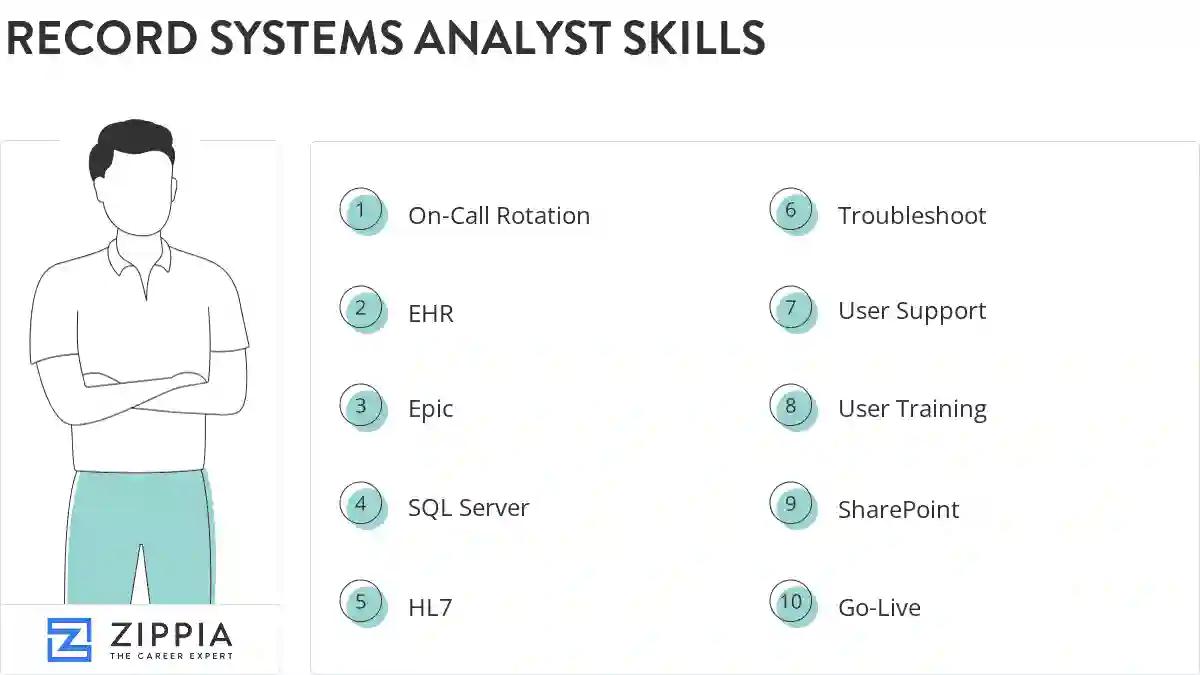
The most important skills for a record systems analyst resume and required skills for a record systems analyst to have include:
- On-Call Rotation
- EHR
- Epic
- SQL Server
- HL7
- Troubleshoot
- User Support
- User Training
- SharePoint
- Go-Live
Updated January 8, 2025
