
Automatically apply for jobs with Zippia
Upload your resume to get started.
Reimbursement analyst skills for your resume and career
15 reimbursement analyst skills for your resume and career
1. Patients
- Analyzed hospital operating costs pertaining to Medicare patients in order to properly prepare and submit Medicare/Medicaid Cost Report to government agencies.
- Reviewed historical patient records and gained drug replacement approval for patients who were not previously identified as eligible for programs.
2. Medicare
Medicare is a federal government insurance program that offers health care coverage to people who are 65 and above. In some cases, younger people with disabilities whose status is identified by the SSA can also avail the insurance program. Medicare covers the health expenses of people who are not able to afford it plus it protects the payee from rising health care costs.
- Facilitated and coordinated department revenue cycle meetings to discuss monthly financial impact of Medicare and South Carolina Medicaid program denials.
- Coordinated third party audits, defended preferential reporting practices and maintained current knowledge of Medicare and Medicaid reimbursement regulations.
3. Medicaid
- Gather required information for internal and external auditors for company audits and for state Medicaid audits.
- Secure and submit Medicaid and/or drug company Patient Assistance Program applications according to all relative policies.
4. Home Health
- Partnered with hospital and home health chains to discuss changes impacting organizational reimbursements.
- Evaluated home health and hospital billing reimbursement interruptions.
5. Appeals
- Assist consultant in preparation of appeals relating to Graduate Medical Education, Disproportionate Share and other reimbursement issues.
- Obtained prior authorization, coverage exceptions and appeals assistance to secure coverage and reimbursement.
6. Revenue Cycle
Revenue cycle stands for a method to define and maintain the processes utilized for completing an accounting process to record the revenue generated from products/services provided by the company.
- Develop and implement processes and procedures to support business office and revenue cycle operation and improve cash collections
- Utilize revenue cycle management tools and techniques to ensure optimal operational and financial performance of contracts.
Choose from 10+ customizable reimbursement analyst resume templates
Build a professional reimbursement analyst resume in minutes. Our AI resume writing assistant will guide you through every step of the process, and you can choose from 10+ resume templates to create your reimbursement analyst resume.7. Strong Analytical
- Demonstrated strong analytical and business problem solving skills; able to understand complex business system functionality and develop strategies.
- Applied strong analytical and organizational skills including thoroughness and attention to detail to accommodate changing priorities and work assignments.
8. CPT
CPT is a medical term that stands for Current Procedural Terminology. Whenever a procedure like surgery or diagnosis occurs or some other medical service is rendered to a patient, it is reported to the concerned physician, insurance company, or organization. The aforementioned practice is widely referred to as CPT.
- Updated the patient accounting system with nationally issued releases for the CPT codes, UB Revenue codes and APC's.
- Review and validate all CPT and ICD-10 coding for accuracy before posting charges to bill to Insurance carriers.
9. Financial Statements
A financial statement is a report of an individual or a company that includes all the information about the declared assets, the use of money, income, and also the contribution of shareholders over a certain period.
- Prepared monthly and yearly financial statements to present to management and senior executives.
- Reviewed financial statements and supporting documentation for accuracy and regulatory compliance.
10. CMS
A Content Management System or CMS is computer software that works as a framework where content can be assembled and managed by using a database. CMS is an important asset in web development. This platform enables users to create, edit, collaborate on, publish and store digital content. It helps users to manage their content and modify it from a single system.
- Cultivated relationships with key contacts at insurance companies and managed care organizations, CMS and medical professional societies.
- Provided feedback to department managers/employees regarding reimbursement questions and CMS regulation concerns.
11. Financial Analysis
- Support and assist operational leadership at TIRR hospital in training and consultation of financial analysis and interpretation at the departmental level.
- Performed financial analysis used in the monthly preparation of financial reporting.
12. Calculation
- Analyzed interim rate calculations for appropriate documentation of organizational costs and charges, as well as compliance with federal regulations.
- Monitored and analyzed funding calculations and utilization to ensure accurate contract implementation, settlement payments, and accounting accruals.
13. Rehabilitation
- Created comprehensive reimbursement methodology for rehabilitation centers.
- Negotiated fee structure for managed care contracts on acute and rehabilitation facilities.
14. Contract Terms
Contract terms refer to the rules, conditions, and standards that both parties in a contract agreement have to honor.
- Analyzed contract terms, prepared fee schedules and system load files for making changes in the claims processing system.
- Interpret and provide system logic needed to build payer contract terms into the patient accounting system.
15. Contractual Allowances
- Prepared contractual allowances and compiled reports for auditors in timely manner.
- Prepare monthly contractual allowances, analysis and journal entries.
5 Reimbursement Analyst resume examples
Build a professional reimbursement analyst resume in minutes. Browse through our resume examples to identify the best way to word your resume. Then choose from 5+ resume templates to create your reimbursement analyst resume.

What skills help Reimbursement Analysts find jobs?
Tell us what job you are looking for, we’ll show you what skills employers want.
What reimbursement analyst skills would you recommend for someone trying to advance their career?
Dr. Mark Evans
Area Chair and Dale K. Cline Associate Dean for Accountancy, Wake Forest University
List of reimbursement analyst skills to add to your resume
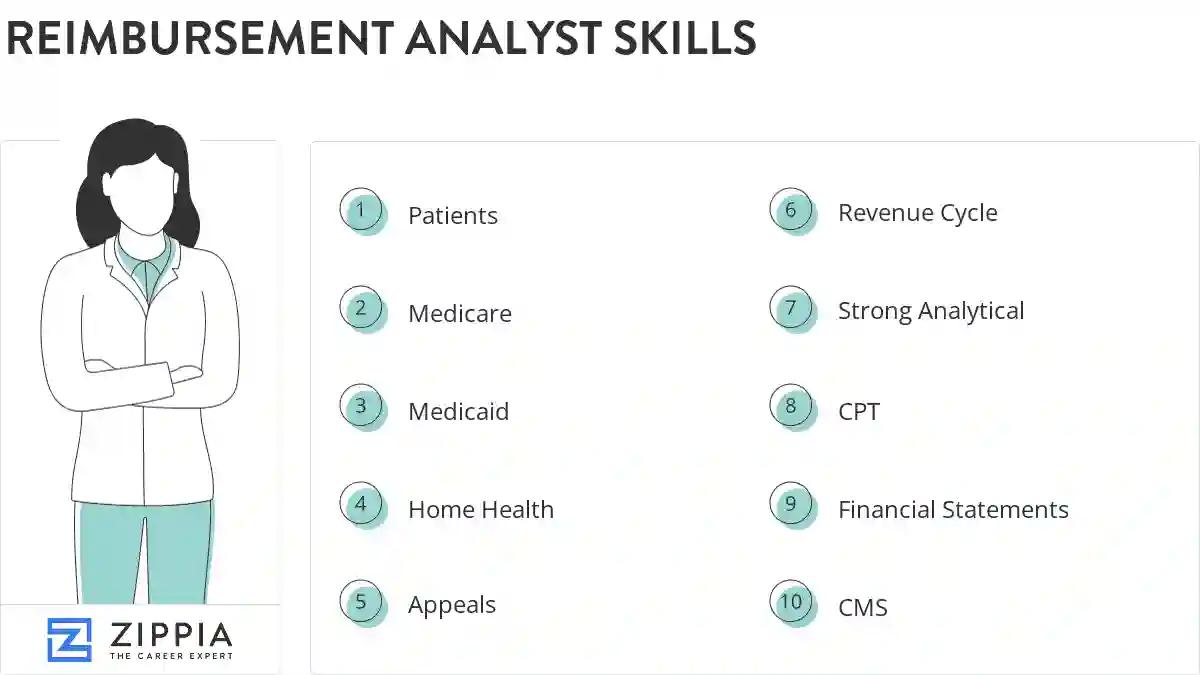
The most important skills for a reimbursement analyst resume and required skills for a reimbursement analyst to have include:
- Patients
- Medicare
- Medicaid
- Home Health
- Appeals
- Revenue Cycle
- Strong Analytical
- CPT
- Financial Statements
- CMS
- Financial Analysis
- Calculation
- Rehabilitation
- Contract Terms
- Contractual Allowances
- Fee Schedules
- Medical Terminology
- Data Entry
- Government Regulations
- Patient Accounts
- Reimbursement Issues
- NET Revenue
- Party Cost Reports
- HCPCS
- Reconciliations
- Medical Billing
- Management System
- DRG
- Journal Entries
- Billing System
- Healthcare Professionals
- Tricare
- Analyze Data
- Statistical Data
- Financial Data
- ICD-10
- Account Balances
- Claims Processing
- Care Contracts
- Insurance Claims
- Analytical Support
- Impact Analysis
- Billing Issues
- ICD-9
- Medical Claims
- A/R
- Financial Reports
- SQL
- HIPAA
Updated January 8, 2025
