Explore jobs
Find specific jobs
Explore careers
Explore professions
Best companies
Explore companies
Job outlook for reports analysis managers in the United States
Are reports analysis manager jobs in demand?
Reports analysis manager job and salary trends over time
Reports analysis manager jobs over time
Reports analysis manager job growth rate over time
| Year | # of jobs | % of population |
|---|---|---|
| 2021 | 381 | 0.00% |
| 2020 | 365 | 0.00% |
| 2019 | 366 | 0.00% |
| 2018 | 340 | 0.00% |
| 2017 | 319 | 0.00% |
Average reports analysis manager salary over time
Reports analysis manager salary by year
| Year | Avg. salary | Hourly rate | % Change |
|---|---|---|---|
| 2026 | $96,576 | $46.43 | +3.3% |
| 2025 | $93,488 | $44.95 | +1.5% |
| 2024 | $92,120 | $44.29 | +2.3% |
| 2023 | $90,026 | $43.28 | +2.7% |
| 2022 | $87,629 | $42.13 | +3.2% |
Reports analysis manager jobs by state
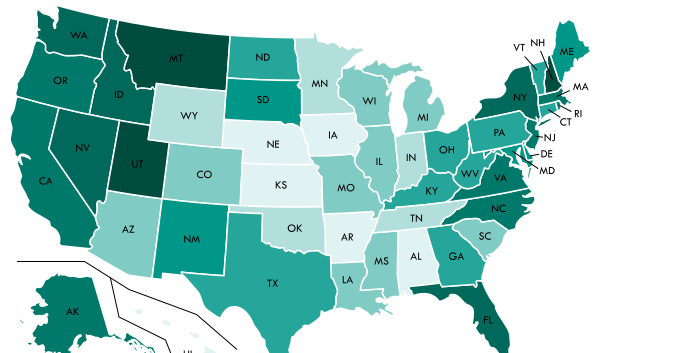
Most common states for reports analysis managers
| Rank | State | Population | # of jobs | Employment/ 1000ppl |
|---|---|---|---|---|
| 1 | District of Columbia | 693,972 | 157 | 23% |
| 2 | Washington | 7,405,743 | 524 | 7% |
| 3 | Massachusetts | 6,859,819 | 499 | 7% |
| 4 | Delaware | 961,939 | 65 | 7% |
| 5 | Illinois | 12,802,023 | 736 | 6% |
| 6 | Virginia | 8,470,020 | 516 | 6% |
| 7 | Maryland | 6,052,177 | 343 | 6% |
| 8 | Connecticut | 3,588,184 | 204 | 6% |
| 9 | California | 39,536,653 | 1,988 | 5% |
| 10 | New York | 19,849,399 | 917 | 5% |
| 11 | North Carolina | 10,273,419 | 478 | 5% |
| 12 | Arizona | 7,016,270 | 319 | 5% |
| 13 | Minnesota | 5,576,606 | 262 | 5% |
| 14 | Colorado | 5,607,154 | 259 | 5% |
| 15 | Oregon | 4,142,776 | 190 | 5% |
| 16 | Utah | 3,101,833 | 144 | 5% |
| 17 | Rhode Island | 1,059,639 | 52 | 5% |
| 18 | Nevada | 2,998,039 | 109 | 4% |
| 19 | New Hampshire | 1,342,795 | 49 | 4% |
| 20 | Montana | 1,050,493 | 39 | 4% |
Most common cities for reports analysis managers
| Rank | City | # of jobs | Employment/ 1000ppl | Avg. salary |
|---|---|---|---|---|
| 1 | Farmington | 1 | 4% | $88,915 |
| 2 | Peachtree City | 1 | 3% | $91,523 |
| 3 | Silver Spring | 1 | 1% | $96,789 |
| 4 | Jersey City | 1 | 0% | $99,096 |
Reports Analysis Manager job outlook: Expert opinions
Our panel of reports analysis manager experts

University of Arkansas

The University of Scranton

Case Western Reserve University

DePaul University

California State University San Marcos

Loyola University Maryland

University of Maine at Augusta
South College

Rhode Island College

University of Pittsburgh - Johnstown
Baruch College, City University New York

Red Rocks Community College
Kris Allee Ph.D.
Associate Professor, Doyle Z. Williams Chair in Professional AccountingUniversity of Arkansas
Accounting Department
What skills will help Reports Analysis Managers earn the most?
Kris Allee Ph.D.: Certainly, passing the CPA exam is a must, as it is considered a necessary condition for advancement. Passing the exam also helps certify the minimum level of skills the person may possess. Financial analysis skills are also highly valued and hard to find in the average staff accountant. These skills traditionally would include computing, quantitative analysis, and understanding forecasting techniques and limitations. Finally, communication skills and the ability to effectively manage expectations and projects are what make an accountant indispensable and valuable to a firm.
Dr. Douglas Boyle
Chair & Professor, Director, Doctorate in Business Administration Program , Director, Nonprofit Leadership ProgramThe University of Scranton
Accounting Department
What skills stand out on Reports Analysis Manager resumes?
Dr. Douglas Boyle: Accounting is a very technical profession, so any credential that shows you have an advanced level of knowledge makes a candidate stand out. Accountants have many opportunities to pursue credentials. A Certified Public Accountant (CPA) is the only accounting credential that is a license from the state. If you hold a CPA, the AICPA offers six specialty credentials to consider pursuing, including Certified Information Technology Professional (CITP), Chartered Global Management Accountant (CGMA), Accredited in Business Valuation (ABV), Certified in Financial Forensics (CFF), Personal Financial Specialist (PFS), and Certified in Entity and Intangible Valuations (CEIV). Three other organizations to consider that do not require a CPA to pursue are the Institute of Management Accountants (IMA), Institute of Internal Auditors (IIA), and the Association of Certified Fraud Examiners (ACFE). The IMA offers two credentials, the Certified Management Accountant (CMA) and Certified in Strategy and Competitive Analysis (CSCA). The IIA offers six credentialling opportunities, the Certified Internal Auditor (CIA), Certification in Risk Management Assurance (CRMA), Qualification in Internal Audit Leadership (QIAL), Certified Process Safety Auditor (CPSA), and Certified Professional Environmental Auditor (CPEA). Last, the ACFE offers the Certified Fraud Examiner (CFE). These opportunities enable accountants to specialize in several areas and provide opportunities to stand out. Our research shows that in addition to technical skills, soft skills are very important as you move to higher levels of a firm or organization.
What hard/technical skills are most important for Reports Analysis Managers?
Dr. Douglas Boyle: While it is important to be technically competent in all areas of accounting, you add the most value by being an expert in a few areas. That is why you may consider pursuing additional credentials (as shown above) in areas of interest to you. This enables you to master the technical skills and demonstrate such skills on your resume.
Thomas King
Department Chair, Director, Master of Accountancy Program, Professor, AccountancyCase Western Reserve University
Accountancy Department
What skills stand out on Reports Analysis Manager resumes?
Thomas King: Evidence that someone is smart is a fast learner and works well with others.
What soft skills should all Reports Analysis Managers possess?
Thomas King: The ability to develop working relationships with a wide range of colleagues who have diverse skills.
What hard/technical skills are most important for Reports Analysis Managers?
Thomas King: The ability to extract information from unfamiliar data sets and then explain conclusions reached in a clear, persuasive manner.
Will there be an enduring impact of the coronavirus pandemic on Reports Analysis Managers?
Delvin Grant: Yes. I strongly believe coronavirus will have a lasting impact on new graduates. A increasing paradigm shift is taking place as we speak, as some IT-related jobs can be done remotely. I expect the shift to continue until a steady state condition is achieved, when companies feel they have the right mix of remote and face-to-face employment. Some companies may resist the trend, valuing face-to-face over remote working. Face-to-face satisfies a human need to socialize and, in some cultures, much business is done by face-to-face. There is evidence of a paradigm shift as many IT employees work remotely, due to the pandemic. Some companies have realized the shift is here to stay and others take a wait and see attitude. It is hard not to recognize the shift as there are cost saving from office rent, office space, heating, cooling, computing cost, travel costs, etc. The impact will vary by profession. IT and other professions are a natural fit for remote working while others are not. For example, a chemist working in a lab environment cannot work from home as his lab is the only place to mix and experiment with chemicals and chemistry.
What's a good job out of college for Reports Analysis Managers?
Delvin Grant: To answer this question, I am assuming a COVID-19 environment. We know most jobs can be carried out in a face-to-face mode, but if this is not possible in a COVID environment, then it is difficult to consider those jobs as good jobs. Therefore, a good job is one that can be easily carried out in a COVID environment so MIS, IT, Computer Science, and similar professions that fit a remote working mode are excellent jobs.
What technical skills for a Reports Analysis Manager stand out to employers?
Jolynn Zhou Ph.D.: This may be surprising to some business school students, but Excel skill is very important and highly valued by employers. In recent years, data analytics is becoming more and more important. Many business schools and accounting programs are beginning of offer this course.
What's a good job out of college for Reports Analysis Managers?
Jolynn Zhou Ph.D.: The answer to this question really is highly subjective. Different students may give you different answers. Typically younger, fresh-out-of-college students prefer public accounting because they get to learn a lot in a relatively short period of time and it is good for career advancement. Students with families may prefer private accounting because of the work-life balance and the predictable work hours. Government jobs can be attractive too because of the benefits. Ultimately it is up to the student to determine what type of job is best for themselves.
Dr. JP Krahel Ph.D.
Associate Professor of Accounting, Accounting Department ChairLoyola University Maryland
Accounting Department
What technical skills for a Reports Analysis Manager stand out to employers?
Dr. JP Krahel Ph.D.: First, Excel. It's the most basic, essential tool for the accounting professional. If you can come in on Day 1 knowing essential keyboard shortcuts, proper formula and reference use, and how to format a spreadsheet properly, you'll have an immediate advantage over your peers.
Second, believe it or not, is writing. People think that accounting is all about numbers, but really, it's less about the math (which Excel does for you) and more about being able to explain the deeper meaning behind the results. Can you explain complex depreciation methods to an audit client? Give bad news to a tax client in an understandable way? These are big deals.
Third is data analytics. Given the immense volume of data now available to firms, someone who can extract, clean, and present that data using modern software tools will have an edge. It's really another form of communication, and one that early-career accounting professionals would do well to familiarize themselves with before entering the workforce.
What are the biggest trends we'll see in the Reports Analysis Manager job market given the pandemic?
Thomas Giordano: More graduating students are working from home so that will take getting used to.
What are the biggest trends we'll see in the Reports Analysis Manager job market given the pandemic?
D. Pace Porter: I believe the need for accounting and financial expertise will even be greater as a result of the pandemic. First, the increased technical accounting and reporting requirements related to risks disclosures, impairment analysis and so forth, and the tax and compliance requirements as a result of the various Coronavirus relief and stimulus legislation, will prompt an increase in demand whether through in-house personnel or through CPA firms. Trends toward more technologically advanced graduates began before the pandemic but will accelerate as a result of it. More importantly, however, is the need for improving economic and operational efficiencies, and therefore cash flow, for businesses to continue as a going concern throughout this pandemic and position themselves for growth once things return to some sort of normal. Accounting and financial expertise has an increasingly important role to play here.
What Reports Analysis Manager skills would you recommend for someone trying to advance their career?
Sean Cote: If a student can't find a job I would recommend continuing the journey toward their long-term goals.
I graduated in the top 10% of my accounting class and couldn't get a job in a CPA firm. My long-term goals were to become a CPA. As my GAP year, I immediately started studying for the CPA exam and took out a loan and registered for a Master's degree program. During my gap year time I was offered a full-time job at a CPA firm but now I was well on my way to becoming a CPA.
Always be aware of what your long-term goals are. When a stumbling block gets in the way, find a way around it so that you are still moving towards that goal.
Don't be afraid to take a lower-paying job if it helps you gain experience towards those long-term professional goals.
What are the biggest trends we'll see in the Reports Analysis Manager job market given the pandemic?
Sean Cote: The biggest trends that we will see because of the pandemic is more remote jobs in the future. I know several professionals that are not going back to an office. They will continue to work from remote locations even once COVID-19 is over.
This trend continues to stress that college graduates be able to be flexible and willing to learn new technology. This trend also stresses that maybe you can have more options when it comes to one of your biggest expenses when you finish your college career... rent. You may now be able to live in lower cost of living areas and still move towards your career goals.
What experience really stands out on Reports Analysis Manager resumes?
Cristina DeDiana: All experiences are great. Anything that demonstrates a commitment will show employers that a candidate has potential. Obviously, an internship in your field tops the list, but don't neglect to include that first burger-flipping job, the organizations you belong to, the sport you played in high school, and volunteer activities. The most important experience is the one that means the most to you and that you can speak about passionately.
Dr. Lilac Nachum Ph.D.
Professor, International BusinessBaruch College, City University New York
Allen G. Aaronson Department of Marketing & International Business
Will there be an enduring impact of the coronavirus pandemic on Reports Analysis Managers?
Dr. Lilac Nachum Ph.D.: The impact of the pandemic on graduates' employment opportunities is already notable, apparent in terms of the demand for graduates and the nature of employment. With millions of people out of jobs, the pandemic diminished the employment prospects and made it more difficult to enter into the job market. But whereas this effect is likely to be short-lived, and may disappear as the economy recovers, the more enduring one would be the change in the nature of employment. As the economy goes through structural change, the nature of the demand for jobs would change too. The crisis triggered accelerated transformation to "all things digital", much of it is likely to continue beyond the pandemics. This would boost demand for employment in the digital economy.
What type of skills will young Reports Analysis Managers need?
Dr. Lilac Nachum Ph.D.: In light of the changes described in #1, the most apparent skills would be those related to digital employment. These will relate to both new opportunities, created digitally, as well as the transformation of brick and mortar jobs online. The former requires skills such as online management of supply chains, digital marketing, online sale, and the likes. These new jobs might require in addition to digital skills also heavy doses of creativity and entrepreneurship as new products and industries are being created and developed. In relation to the latter, the jobs themselves might be well established and familiar for some graduates but their delivery would be transformed in significant ways and require advanced digital skills related to the implementation of these activities.
What experience really stands out on Reports Analysis Manager resumes?
Dr. Lilac Nachum Ph.D.: Digital experience as well as entrepreneurial background, as it signals to potential employers the ability to capitalize on the new opportunities opening up digitally.
Janet Tarase
Lead Accounting Faculty / Accounting Department ChairRed Rocks Community College
Accounting Department
What are the biggest trends we'll see in the Reports Analysis Manager job market given the pandemic?
Janet Tarase: Even though over 7 million people are currently unemployed, employers still need individuals to maintain their operations. Human Resource departments are recruiting individuals through social media platforms. My daughter works in HR recruiting and they only use LinkedIn. Companies are using video or phone interviews to select candidates. Which means that potential candidates have to communicate effectively and make a good first impression quickly.
Employers will be looking for individuals that have proven communication, organizational and time management skills that are able to work independently since telecommuting will be continuing in the future. Applicants will also need to have technological and critical thinking skills to manage the challenges presented while working from home. Because of the pandemic and so many of us having to work from home, companies may broaden their recruiting geography to find the best candidates out of state or in different time zones. Finally, employees need to be flexible and resilient - you never know what the next job requirement will demand.
What Reports Analysis Manager skills would you recommend for someone trying to advance their career?
Janet Tarase: Students that need to take a gap year have several opportunities to make that year count. They should consider doing one or more of the following three things:
Work on honing your soft skills, which include: critical thinking/problem solving, oral/written communication, teamwork/collaboration, technology/digital literacy, leadership, professionalism, time management, organizational, and confidence. These talents are desired by employers and also will help you succeed in your educational aspirations
Take free classes offered online through organizations like edX at EDX. Even Harvard is offering free classes, check out:
Onlinelearning
Also expand your global views or overcome those challenges you may be facing by checking out Ted Talks at Ted
Look for a job (full or part-time) or internship in your chosen career field. Even entry-level positions can allow you to see how this job fits into the larger picture or you could ask to shadow someone for a day. Since I am in the accounting field, I suggest contacting Accountemps; their website is: RobertHalf Occasionally, you can also receive job and skill enhancement training through Accountemps.
What general advice would you give to a Reports Analysis Manager?
Janet Tarase: Create a vision board to set your yearly objectives and a long-term strategic plan that includes your professional and personal goal aspirations; be prepared to modify both of these guides as things change in your life. Join LinkedIn, if you haven't already, update it and make sure it is current. Make connections with a local professionals' group and create a network of like-minded, goal-oriented individuals. Also find a mentor or ask senior employees for their advice and counseling. Clean up your social media accounts or at the very least mark your questionable content as private so you are not sharing it publicly; become the professional you want to be. Continue your professional development, either through your employer, free online programs, or by furthering your education. Keep track of your accomplishments and continue to update your biography and resume. Finally, be appreciative and modest - thank those that help you and make sure to acknowledge those who participated in your successes.