
Automatically apply for jobs with Zippia
Upload your resume to get started.
Resident athletic trainer skills for your resume and career
15 resident athletic trainer skills for your resume and career
1. Patients
- Transfer of care of 750 clinic patients at the culmination of the academic year.
- Provided outpatient care for patients referred to the geriatrics service.
2. Resident Training
- Completed the academic study areas of resident training.
3. Patient Care
Patient care entails the diagnosis, recovery, and control of sickness as well as the maintenance of physical and emotional well-being through the use of healthcare providers' services. Patient care is described as services provided to patients by health practitioners or non-professionals under guidance.
- Maintain records of patient care, condition, progress, or problems to report and discuss observations.
- Observed and assisted in ophthalmic surgery, and directed all pre- and post-operative patient care.
4. CPR
Cardiopulmonary resuscitation or CPR is a medical procedure that involves chest compression to help a patient breathe. This artificial ventilation helps in keeping the brain function in place and regulates blood throughout the body. CPR is a lifesaving procedure that is used in emergencies.
- Received intensive medical training including CPR and First Aid certification.
- Practice American Red Cross First Aid, CPR and AED heart saver certifications to appropriately aid athletes.
5. Data Entry
Data entry means entering data into a company's system with the help of a keyboard. A person responsible for entering data may also be asked to verify the authenticity of the data being entered. A person doing data entry must pay great attention to tiny details.
- Conduct Quality Control Review (QCR) inspections and assessments of data entry clerks and document findings for reporting purposes.
- Performed clerical duties, such as word processing, data entry, answering phones and filing.
6. Psychiatry
- Presented and participated at psychiatry department educational meetings, seminars, grand rounds and clinical supervision related to study.
- Performed rotations in vascular surgery, plastic surgery, pediatrics, psychiatry, endocrinology, anesthesiology and dermatology.
Choose from 10+ customizable resident athletic trainer resume templates
Build a professional resident athletic trainer resume in minutes. Our AI resume writing assistant will guide you through every step of the process, and you can choose from 10+ resume templates to create your resident athletic trainer resume.7. Patient Calls
A patient calls is the call made by a person receiving or under medical treatment or care to the hospital or a physician taking care of such person.
- Answered patient calls for care and feeding.
8. Internal Medicine
- Participated in lots of clinical activities with other internal medicine residents.
- Participated in medical rotations within the anesthesia, internal medicine, oral surgery and emergency medicine departments.
9. Physical Therapy
- Shadowed at Lakewood Family Medicine under physician, Excel-R-Ation Physical Therapy, and assisted with athletic training care at
- Developed and implemented orthopedic physical therapy programs under supervision of staff physical therapist at Institute for Athletic Medicine.
10. Emergency Care
- Assisted in providing emergency care and first aid to athletes including making necessary equipment available, communicating in emergency situations.
- Provided preventative services, emergency care, clinical diagnosis, therapeutic intervention and rehabilitation of injuries and medical conditions.
11. Surgical Procedures
Surgical procedures include the list of tasks that are done while doing surgery. Usually, a surgical procedure involves an incision with instruments, performed to repair damage or heal the disease in a living body. Surgical procedures are performed by trained individuals such as surgeons, doctors, and nurses.
- Assist with and perform inpatient surgical procedures including operative care/management and aggressive limb salvage procedures.
- Prepared patients' schedules for elective surgical procedures and followed up on post-operative development.
12. EMR
- Record and maintain injury records on the Athlete Health Management System (EMR).
- Maintain accurate medical records for student-athletes through usage of EMR such as Presagia and EPIC.
13. Clinical Rotations
- Mentored and supervised lower level athletic training students during clinical rotations.
- Observed Orthopedic Surgery during the orthopedic clinical rotation.
14. Athletic Training Education
- Severed as clinical liaison and scheduled clinical rotations for first year students within an undergraduate athletic training education program.
- Approved clinical instructor for CSUN athletic training education program.
15. Vital Signs
Vital signs are a set of values indicating different body systems' performance. They are measurements of the body's most basic functions. The four major vital signs used in medicine to assess a patient are body temperature, pulse rate, respiration rate, and blood pressure.
- Monitor and record vital signs, weight, bowel and bladder status, intake and output, and calorie count.
- Documented and maintained records of patient's activities; such as vital signs, eating habits, and daily behavior.
5 Resident Athletic Trainer resume examples
Build a professional resident athletic trainer resume in minutes. Browse through our resume examples to identify the best way to word your resume. Then choose from 5+ resume templates to create your resident athletic trainer resume.

What skills help Resident Athletic Trainers find jobs?
Tell us what job you are looking for, we’ll show you what skills employers want.
List of resident athletic trainer skills to add to your resume
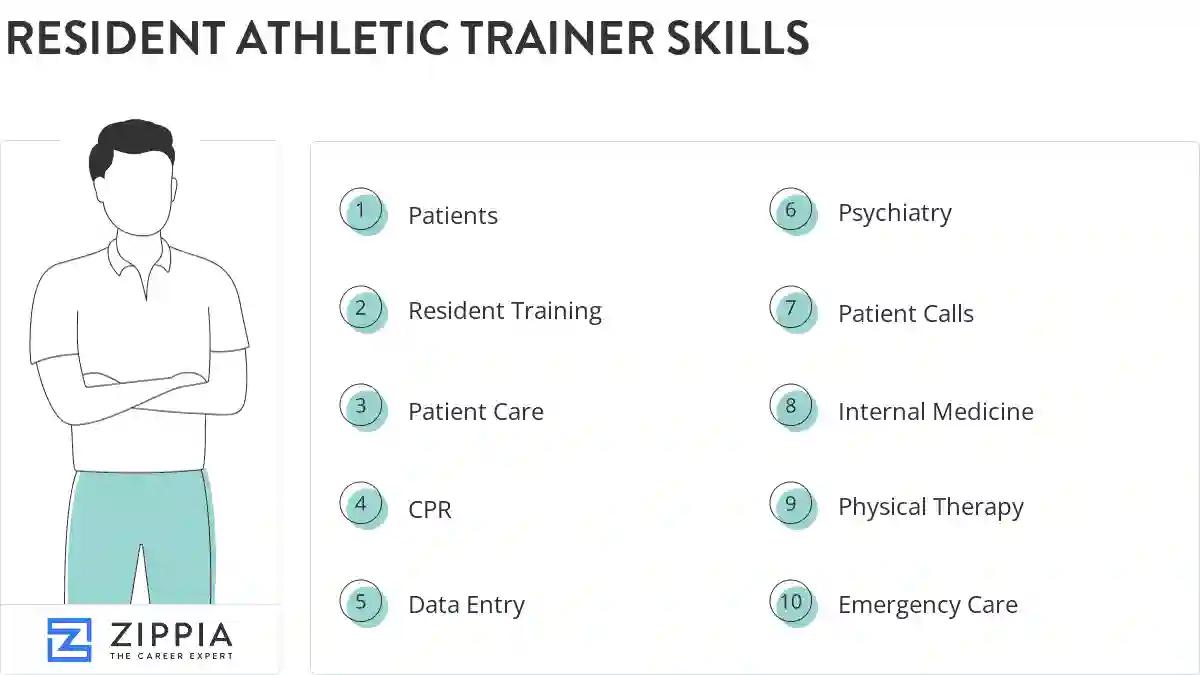
The most important skills for a resident athletic trainer resume and required skills for a resident athletic trainer to have include:
- Patients
- Resident Training
- Patient Care
- CPR
- Data Entry
- Psychiatry
- Patient Calls
- Internal Medicine
- Physical Therapy
- Emergency Care
- Surgical Procedures
- EMR
- Clinical Rotations
- Athletic Training Education
- Vital Signs
- ADL
- Mac
- Medication Administration
- IV
- Direct Care
- Developmental Disabilities
- Blood Pressure
- Product Knowledge
- Medicaid
- ICU
- Oral Hygiene
Updated January 8, 2025
