
Automatically apply for jobs with Zippia
Upload your resume to get started.
Resource analyst skills for your resume and career
15 resource analyst skills for your resume and career
1. Resource Management
Resource management is under what you call project management, wherein it is used to manage a business. This particular skill involves planning, creating, developing, implementing, and adapting certain information or data related to a project.
- Identified and analyzed business requirements for the development of resource management objectives.
- Collaborated with physicians and hospital management to develop cost efficient resource management.
2. Customer Satisfaction
- Demonstrated experience integrating work across relevant areas, developing business and services to enhance internal and external customer satisfaction and productivity.
- Partner with Federal PSO management to maximize opportunities, drive utilization, and increase customer satisfaction.
3. Financial Analysis
- Generated detailed monthly and quarterly financial analysis of results.
- Act as a key technical expert on financial analysis issues.
4. Financial Management
- Performed Resource Analyst duties that involved creating financial statements for submission to Financial Management Division for processing.
- Prepared and submitted Monthly and Quarterly Contractor Financial Management Report (533M and 533Q) to our customer (NASA).
5. Financial Reports
- Track expenditures monthly through targeted financial reports.
- Managed and tracked contractor costs in NASA 533M financial reports that were supported by service pools for technical leads.
6. National Security
- Developed, maintained and management DCOM-International Security Cooperation Contribution Database utilizing MS Access that tracks and generates reports on departmental progress.
- Field operations oversight/deployment and personnel training during multiple National Security Special Events (NSSE) and jurisdictional special events.
Choose from 10+ customizable resource analyst resume templates
Build a professional resource analyst resume in minutes. Our AI resume writing assistant will guide you through every step of the process, and you can choose from 10+ resume templates to create your resource analyst resume.7. WBS
WBS, Work Breakdown Structure, is a planning tool used in projects, programs, and even initiatives to understand the work that needs to be done to produce one or more results successfully. It is a productivity technique for developing a project schedule, resource needs, and costs that are used to break work down into smaller tasks/components to make work more accessible and manageable.
- Prepared WBS (Work Breakdown Schedule) and Sales Order for different government bureau's.
- Work with Technical POCs to establish new WBS structure using MDM and coordinate with other centers on various projects.
8. NASA
- Verified travel voucher's or authorization for a disbursement to be made, ensuring it falls within NASA guidelines.
- Prepared, audited and submitted monthly invoices to customer (NASA), including Fixed Fee invoices.
9. Data Analysis
- Performed data analysis, provided statistically relevant information, and gave recommendations to employer to achieve more effective cancer reporting rates.
- Perform clinical data analysis at designated client sites in order to identify clinical or data quality problems.
10. Cost Estimates
- Provided documentation, information and resolution to account for delays, obstacles, or changes to delivery schedule or cost estimates.
- Develop cost estimates for preclinical & clinical programs with multiple studies.
11. Data Collection
Data collection means to analyze and collect all the necessary information. It helps in carrying out research and in storing important and necessary information. The most important goal of data collection is to gather the information that is rich and accurate for statistical analysis.
- Developed, implemented and maintained database supporting comprehensive IT financial data collection from all AF major commands and agencies.
- Design, implement, and oversee advanced GIS data collection and field work.
12. Renewable Energy
- Completed analyses to determine financial impact of proposed revisions to federal and state renewable energy rules.
13. SQL
- Use relational database applications including Microsoft Access or SQL Server within a GIS application.
- Provided support for DB2 Applications in terms of the various SQL error messages
14. Cost Analysis
Cost analysis, also known as cost-benefit analysis, refers to analyzing how a company's money is used, whether this is expenses of the company itself or the cost of the current production method. This method also takes the number of products sold into consideration to determine whether the manufacturing process is benefiting or harming the company's profits.
- Supervised the monthly financial reporting including a cost analysis of productive versus administrative hours.
- Perform financial and cost analysis in support of departmental and, as applicable, citywide operations.
5 Resource Analyst resume examples
Build a professional resource analyst resume in minutes. Browse through our resume examples to identify the best way to word your resume. Then choose from 5+ resume templates to create your resource analyst resume.

What skills help Resource Analysts find jobs?
Tell us what job you are looking for, we’ll show you what skills employers want.
What skills stand out on resource analyst resumes?
Hanna Kim Ph.D.
Associate Professor, Chair, Adelphi University
I say "try to" as the reality is that having faculty in all 4 subfields is not possible for many reasons. (The 4 subfields are cultural anthropology, archeology, biological anthropology (sometimes physical anthropology), and anthropological linguistics. These subfields are mirrored in graduate school where students going for PhDs will be focused on 1 subfield.)
For undergraduates with an anthropology degree seeking employment, I can speak only from the faculty side, not the employer side. My students report these factors as relevant to their being hired (and accepted into competitive schools in museum studies, social work, law school, etc.:
Analytical skills; clear writing; ability to synthesize large amounts of reading and data into well-supported arguments and interpretations; open-mindedness toward different identities and ways of being.
A hugely important skill that anthropology graduates have is the ability to be presented with a complex situation or problem, and to be able to chart a plan on how to approach the problem, gather data and other necessary information to solve the problem, and then to come up with a solution or possible strategies. Too often, particularly in situations involving human behavior, what is needed is a stronger grasp of social and cultural factors that could impede the desired outcome. Students of anthropology know that ways of doing things, and even seeing and thinking, are profoundly influenced by categories of thought that are culturally situated. This means that problem solving has to consider a network of variables that have an impact on behavior. Anthropology students, I would argue, would embrace this complexity rather than be hesitant to acknowledge it in favor of a more expedient and, in the long run, less successful solution.
What soft skills should all resource analysts possess?
Hanna Kim Ph.D.
Associate Professor, Chair, Adelphi University
What hard/technical skills are most important for resource analysts?
Hanna Kim Ph.D.
Associate Professor, Chair, Adelphi University
What resource analyst skills would you recommend for someone trying to advance their career?
A.J. Arreguin
Professor, Our Lady of the Lake University
Students should volunteer with small/local businesses or create their brand (start a blog or become a niche social media influencer) to practice and build on their experience. Once the student/graduate does that, they should keep a weekly log with analytics to help them understand how to improve moving forward. This will be beneficial when applying for a communication/public relations job during an interview. The degree gets the student/graduate the talk, but the experience lands them the job.
What type of skills will young resource analysts need?
Lise Abrams Ph.D.
Professor of Linguistics and Cognitive Science; Coordinator of Cognitive Science, Pomona College
List of resource analyst skills to add to your resume
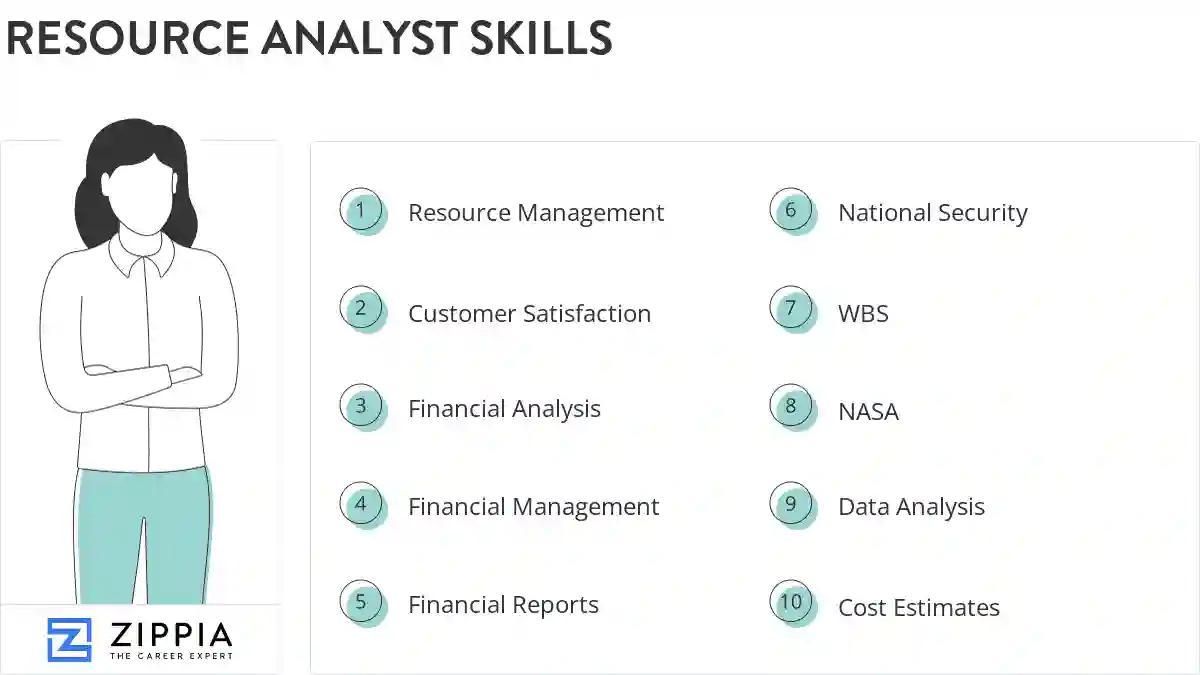
The most important skills for a resource analyst resume and required skills for a resource analyst to have include:
- Resource Management
- Customer Satisfaction
- Financial Analysis
- Financial Management
- Financial Reports
- National Security
- WBS
- NASA
- Data Analysis
- Cost Estimates
- Data Collection
- Renewable Energy
- SQL
- Cost Analysis
- SharePoint
- GIS
- Financial Data
- DOD
- Resource Utilization
- Process Improvement
- Technical Support
- Sigma
- Federal Agencies
- Access Database
- Technical Assistance
- Historical Data
- Budget Estimates
- MRP
- ERP
- CMS
- Water Quality
- Earned Value Management
- Management System
- HR
- Unix
- Subcontracts
- Troubleshoot
- Logistics
- Technical Issues
- OSD
- Windows
- Purchase Orders
- KPI
- External Clients
Updated January 8, 2025
