
Automatically apply for jobs with Zippia
Upload your resume to get started.
Resource program teacher skills for your resume and career
13 resource program teacher skills for your resume and career
1. Classroom Management
- Developed/monitored behavioral and classroom management system.
- Cultivate strong relationships with cross-functional teams to implement new classroom management strategies and curriculum development for a variety of subject areas.
2. Autism
- Planned and instructed a Resource Program for 15 students with ID, Specific Learning Disabilities, and Autism Spectrum Disorder.
- Worked with Special Education and General Education teachers to include students with Autism into their classrooms successfully.
3. English Language
- Develop lesson plans and implement instruction in English Language Arts and Mathematics.
- Instruct English Language Learners in small group setting.
4. Student Learning
- Utilized differentiated instruction to assess and evaluate student learning and providing after school tutoring, also attending professional development
- Utilized ongoing informal and formal assessment to measure effectiveness of teaching and optimize student learning, adapting instruction when needed.
6. IEP
- Planned and engaged students in lessons that focus on skills that meet specific IEP goals using a variety of reading materials.
- Completed IEP monitoring, progress reports, IEP writing, and individual assessments.
Choose from 10+ customizable resource program teacher resume templates
Build a professional resource program teacher resume in minutes. Our AI resume writing assistant will guide you through every step of the process, and you can choose from 10+ resume templates to create your resource program teacher resume.7. Public Schools
Public schools are available for everyone. They are funded and controlled by the government. With state guidance, each school board determines the curricula, finances, and jobs for schools within its borders. The government also decides on academic standards and standardised tests.
- Worked collaboratively with the public schools to develop Individualized Education Plans for students placed at our facility.
- Provide collaboration services in public schools to train staff on special education teaching procedures and behavior management.
8. ABA
ABA, an abbreviation for applied behavioral analysis, is a scientific behavior study.
- Participated in District-sponsored yearlong training and coaching of teachers in making data-driven instructional decisions based on principles of ABA.
- Worked one-on-one with children utilizing direct intensive training, natural environment teaching and ABA therapy.
9. Mathematics
- Created mathematics curriculum that aligned with Massachusetts Curriculum Frameworks then modified the curriculum to align with the Common Core Standards.
- Design and implement individualized curriculum and materials for a specially designed course in mathematics for students with mathematical disabilities.
10. Education Programs
Education program refers to a program written by the institution or ministry of education meant to determine each subject's learning progress in formal education stages.
- Monitored student's participation in regular education programs, by collaborating with regular education teachers and providing remediation material upon request.
- Developed Individualized Education Programs with specific accommodations and modifications for special education students to be successful in their least restrictive environment.
11. Professional Development
Professional development means to have the essential training certification or education with the purpose of earning and having a successful career. Every job requires a different set of skills. However, new skills may be needed in the future. Professional development, in this regard, helps people to develop and polish the skills and become efficient workers.
- Provided ongoing professional development to impact student achievement.
- Attended professional development on 6 Trait Writing.
12. Children Ages
- Created multi-classroom Curriculum for children ages 4 to 13 Assisted in creating Educational assessment used at intake.
13. Behavior Management
- Led teacher training in areas of rapport building, behavior management and engagement strategies for at-risk students.
- Structured and implemented positive behavior management/modification based programs.

What skills help Resource Program Teachers find jobs?
Tell us what job you are looking for, we’ll show you what skills employers want.
What skills stand out on resource program teacher resumes?
Dr. Peg Hughes Ph.D.
Chair, Department of Special Education. Coordinator of ECSE Programs, San Jose State University
-Educators who are fullly qualified and trained to work with students with disabilities who are also English-language learners
-Educators who are trained to work collaboratively with general educators on planning, teaching, and assessing those students with disabilities in gen-ed classrooms, i.e., co-teaching in inclusive settings
-Fluent in other languages besides English due to the diverse language backgrounds of students and families (at least in California)
-Any evidence of leadership work on the job, e.g., trainings for general educators on inclusion, diversity, families, and more
-Strong technology skills for communication with all stakeholders and for teaching students virtually
-Trained to teach using UDL approaches to address diversity of student learning styles
What soft skills should all resource program teachers possess?
Dr. Rachel Potter
Director of Applied Behavior Analysis & Autism Studies, Associate Professor of Education, Mary Baldwin University
What hard/technical skills are most important for resource program teachers?
Dr. Rachel Potter
Director of Applied Behavior Analysis & Autism Studies, Associate Professor of Education, Mary Baldwin University
What resource program teacher skills would you recommend for someone trying to advance their career?
Marcy Zipke Ph.D.
Professor, Providence College
What type of skills will young resource program teachers need?
Dr. Richard Sabousky Ph.D.
Retired Chair of Clarion's Special Education Department, Clarion University of Pennsylvania
Another skill or activity to be undertaken will be an intimate knowledge of the standards students must meet and resource materials available in their respective schools to help meet those standards. The textbook is not the curriculum or the standards but a vehicle to achieve those standards. By familiarizing the curriculum, educators will better handle those prerequisite skills needed to perform at the highest levels.
List of resource program teacher skills to add to your resume
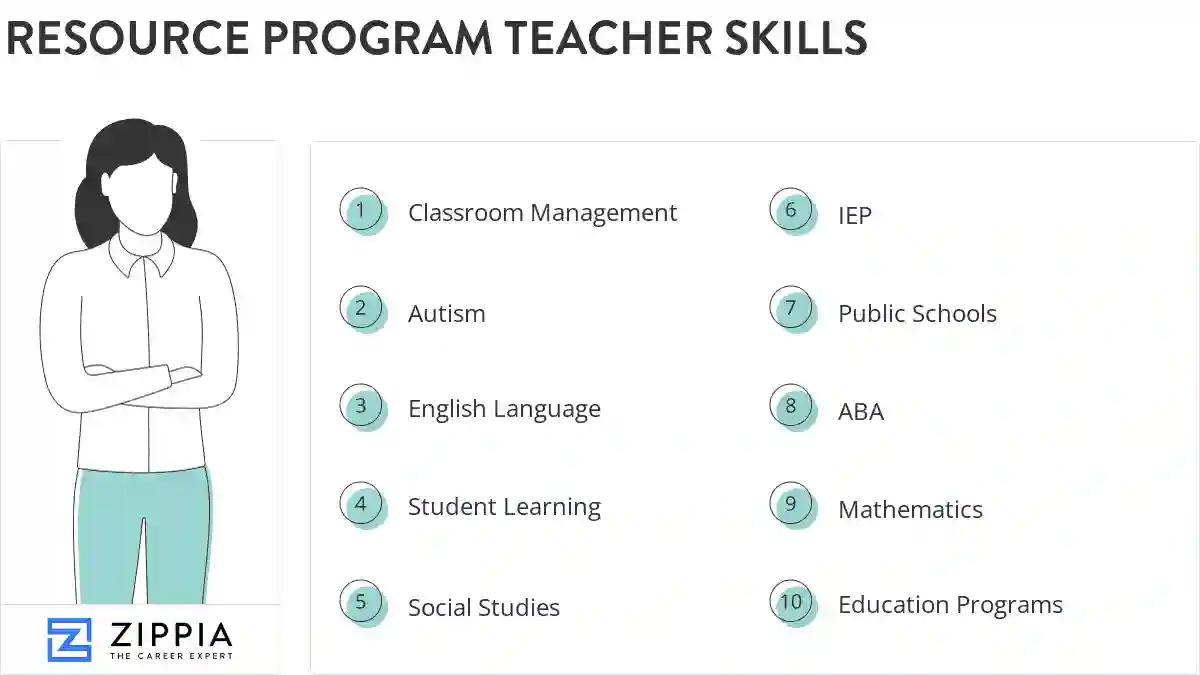
The most important skills for a resource program teacher resume and required skills for a resource program teacher to have include:
- Classroom Management
- Autism
- English Language
- Student Learning
- Social Studies
- IEP
- Public Schools
- ABA
- Mathematics
- Education Programs
- Professional Development
- Children Ages
- Behavior Management
Updated January 8, 2025

5. Social Studies
Social studies is a subject in school that teaches about society and its sciences. Sociology, political science, and economics are all examples of social studies.