
Automatically apply for jobs with Zippia
Upload your resume to get started.
Rigger helper skills for your resume and career
15 rigger helper skills for your resume and career
1. Cranes
- Signaled the operators operating equipment, cherry pickers, forklifts, load trucks, and various cranes while rigging.
- Operated heavy equipment like grad-all and boom-lift crane, on and off Naval Ships.
2. Pulleys
Pulleys are primarily designed to lift heavy items easier through a shaft, cable, and belt. It is also used to support the movement of different systems, facilitating the transport of people and things.
- Clean, lubricate, and maintain mechanisms such as cables, pulleys, or grappling devices, making repairs as necessary.
- Execute the attachment of pulleys and blocks to fixed overhead structures such as beams, and bulkheads using bolts and clamps.
3. Rig
Rigging includes designing, preparing, or setting up equipment for drilling operations. This skill is one of the main and most important activities in the oil and gas industry, whether it's for onboard operations or port operations. Rigging systems should have parts like master links, shackles, slings, and lifting bags for underwater lifting. Professionals working with rigging systems are responsible for tasks like operating platform lifts, forklifts, and overhead cranes.
- Helped operator rig up and down on well head to run tools down well.
- Rig product to crane/forklift to be lifted and moved.
4. Booms
- Operated telescoping boom industrial forklifts in process of loading and unloading structural steel and heavy, large piping and pipe spools.
- Operate powered lifts from pallet jacks to 60,000 lb capacity fork lifts in clouding hydraulic boom poles and specialized attachments.
5. Hoists
- Used hoists and jacks, hand tools, power tools, welding equipment, plumb bobs and measuring equipment.
- Prepared materials for use and used lifts and hoists to move materials; used specialized hand and power tools.
6. Fall Protection
- Hole Watch Trained, Fire Watch Trained, Aerial Lift Qualified, Fall Protection Trained.
- Fall protection trained, working at heights and on scaffolding with fall arrest system.
Choose from 10+ customizable rigger helper resume templates
Build a professional rigger helper resume in minutes. Our AI resume writing assistant will guide you through every step of the process, and you can choose from 10+ resume templates to create your rigger helper resume.7. Hand Signals
Hand signals are signs made using the hands to indicate or communicate certain instructions to anyone when audio communication won't be possible. Hand signals are used to flag down cabs, gesture at people from a distance, teach the deaf, and wave at someone. All these are in cases where voicing out the instructions won't be audible on the end of the receiver.
- Learned to make proper hand signals to maintain a safe work place.
- Performed hand signals to properly flag and move the crane.
8. Slings
- Prepare safety & rigging gadgets for our lifting jobs such as shackles, slings & other related lifting equipments.
- Rigged shafts, beams, steel plates using doggs, lifting eyes, slings, chains or chokers.
9. Hoisting
- Assist Ironworker/Structural fitters Set up hoisting equipment Grinding, cutting with torch Bolt up, connecting, alignment of steel members !
- Directed co-workers engaged in hoisting of machinery and equipment into ships.
10. PPE
Personal protective equipment is an item of protective clothing such as goggles, helmets, or other garments meant to protect the body from injury.
- Complied with all OSHA and workplace safety protocols and utilized all PPE requirements in a 6S production environment.
- Have fire extinguisher and all proper PPE in my area and on at all times.
11. Hand Tools
- Operated various hand tools, prepped for the welders.
- Adjusted, connected and disconnected wiring, piping, tubing and other parts, using hand tools and power tools.
12. Control Movement
- Control movement of heavy equipment throughout narrow openings or confined spaces, using chain falls or other equipment.
- Control movement of heavy equipment through narrow opening or confined spaces.
13. Load Weights
- Inspected and selected gear according to load weights and size, to ensure safe operations.
- Determine load weights and check them against lifting capacities to prevent overload.
14. Tack
A tack in nautical terms refers to the direction that a boat moves in order to align with the angle of the wind and to allow the boat receives the wind directly on its sails. Tack is also the word used to describe the fastening of a thing to a place. In the tailoring industry, it is used to describe the process of temporarily sewing pieces of materials.
- Performed tack welding as necessary.
- Tack weld for ship fitter using 6010 rods also using 7018 LH rods ..
15. Safety Regulations
- Inspect sporting equipment and/or examine participants to ensure compliance with event and safety regulations.
- Comply with all safety regulations and cleanliness established by company.
5 Rigger Helper resume examples
Build a professional rigger helper resume in minutes. Browse through our resume examples to identify the best way to word your resume. Then choose from 5+ resume templates to create your rigger helper resume.

What skills help Rigger Helpers find jobs?
Tell us what job you are looking for, we’ll show you what skills employers want.
List of rigger helper skills to add to your resume
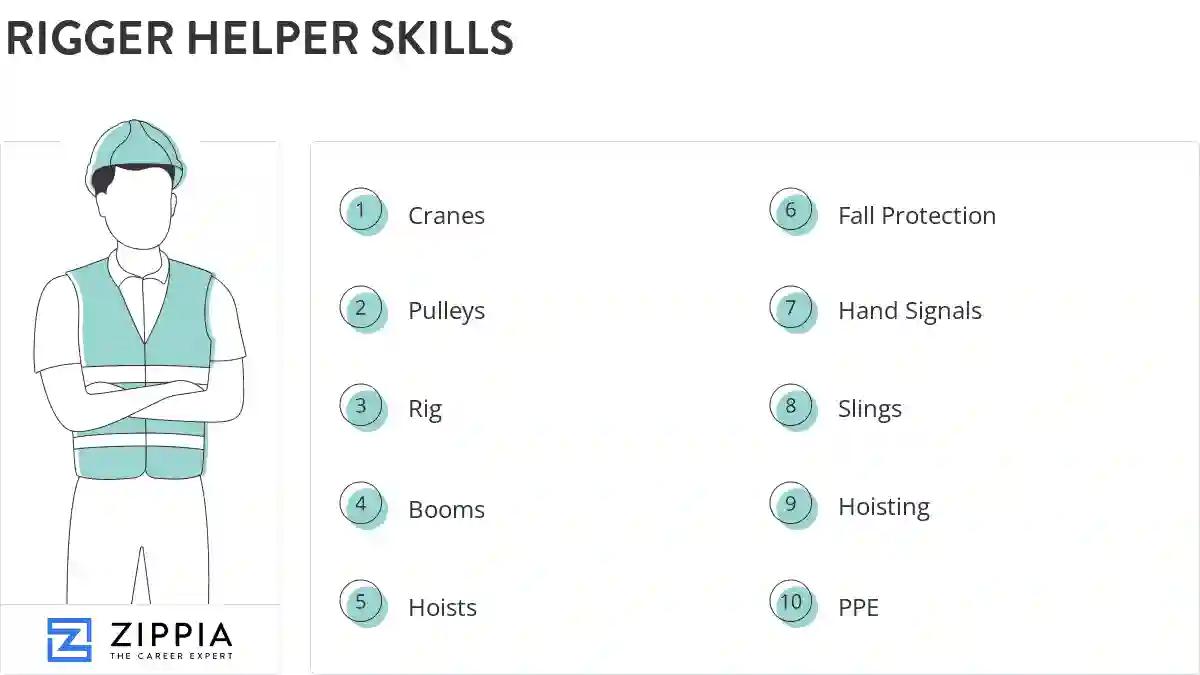
The most important skills for a rigger helper resume and required skills for a rigger helper to have include:
- Cranes
- Pulleys
- Rig
- Booms
- Hoists
- Fall Protection
- Hand Signals
- Slings
- Hoisting
- PPE
- Hand Tools
- Control Movement
- Load Weights
- Tack
- Safety Regulations
- Narrow Openings
Updated January 8, 2025
