What does a robotics systems engineer do?
A robotics engineer creates mechanical beings called robots that are used to replace human labor, especially where the safety of human labor is at stake. They are mostly used in the manufacturing, processing, and automotive industries. They build prototypes and test machines and maintain software used to control them. Their duties and responsibilities also include researching various robotic fields and the latest innovations in robotics.
Robotics systems engineer responsibilities
Here are examples of responsibilities from real robotics systems engineer resumes:
- Develop Perl scripts to automate object model and functional mapping into the application metadata and database.
- Support CNC machines and automate equipment incorporating Allen Bradley PLC's.
- Gain experience with robotic PLC programming.
- Integrate Foba laser systems with Fanuc robotics for laser marking pick and place applications.
- Analyze UNIX systems performance indicators and modify kernel configurations to enhance system operations and applications throughput.
- Establish standards, policies and procedures for all aspects of Unix server environment like administration, documentation and configuration.
- Monitor OS optimization; test, evaluate product processing and accuracy performance within environment before operational implementation are performed with SCCM.
- Develop, maintain ground test equipment.Developed and approve ground support and flight system MRB rationale.
Robotics systems engineer skills and personality traits
We calculated that 35% of Robotics Systems Engineers are proficient in C++, MATLAB, and CAD. They’re also known for soft skills such as Speaking skills, Writing skills, and Business skills.
We break down the percentage of Robotics Systems Engineers that have these skills listed on their resume here:
- C++, 35%
Used C++ language to program and develop network applications for communication between different offices and for everyday office documentation maintenance.
- MATLAB, 10%
Expedited and simplified the quotation process for solar water heating systems by accurately representing solar water heating system performance through MATLAB models
- CAD, 9%
Gained proficiency in CAD, design control, Chemical compatibility, Geometric dimensions and tolerance, Statistical analysis.
- Mechanical Systems, 6%
Worked as an electrical and mechanical systems engineer in a quality assurance engineering team that supported the CSX Transportation Locomotive Fleet.
- Design Reviews, 6%
Participated in design reviews, test programs, evaluations and performed independent analysis to insure nominal performance/cost relationship.
- Prototyping, 5%
Introduced a new change process and documentation to improve speed and efficiency of problem identification during a rapid prototyping to manufacturing.
Most robotics systems engineers use their skills in "c++," "matlab," and "cad" to do their jobs. You can find more detail on essential robotics systems engineer responsibilities here:
Math skills. While "math skills" is last on this skills list, don't underestimate its importance to robotics systems engineer responsibilities. Much of what a robotics systems engineer does relies on this skill, seeing as "mechanical engineers use the principles of calculus, statistics, and other advanced subjects in math for analysis, design, and troubleshooting in their work." Here is a resume example of how this skill is used in the everyday duties of robotics systems engineers: "perform computer math modeling for ascent trajectory design, analyses and trade studies for the space shuttle. "
The three companies that hire the most robotics systems engineers are:
- MITRE7 robotics systems engineers jobs
- Amazon2 robotics systems engineers jobs
- Booz Allen Hamilton2 robotics systems engineers jobs
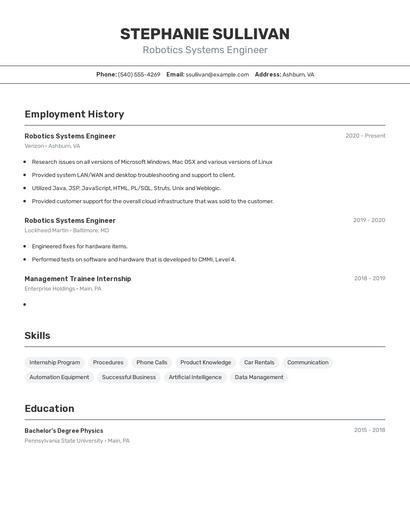
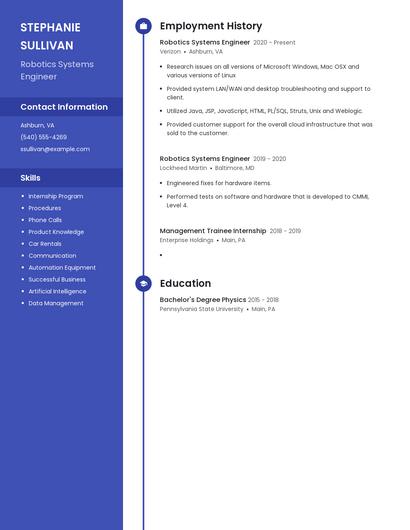
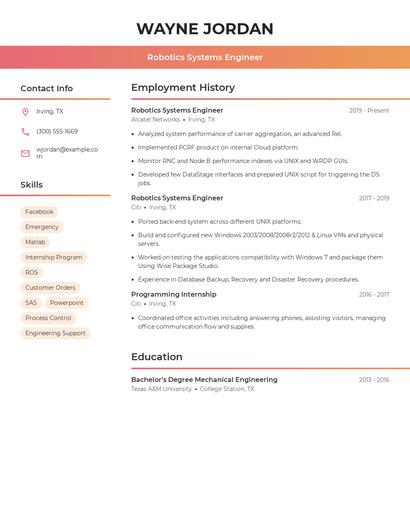
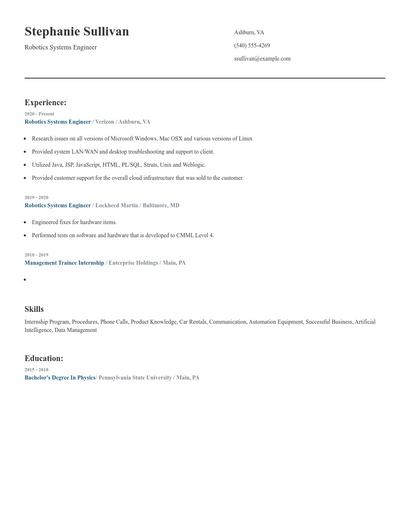
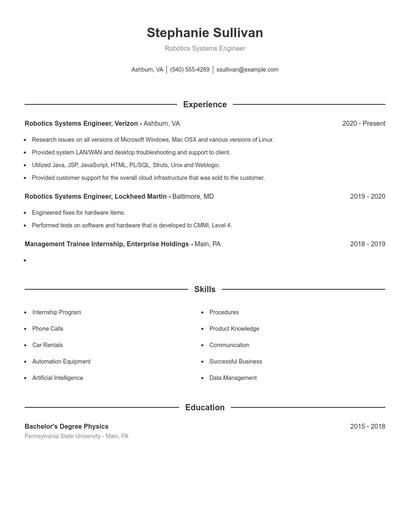
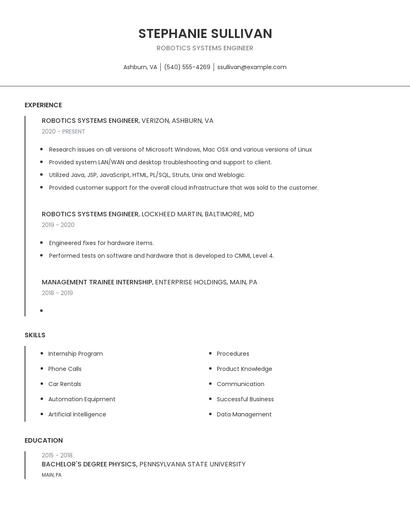
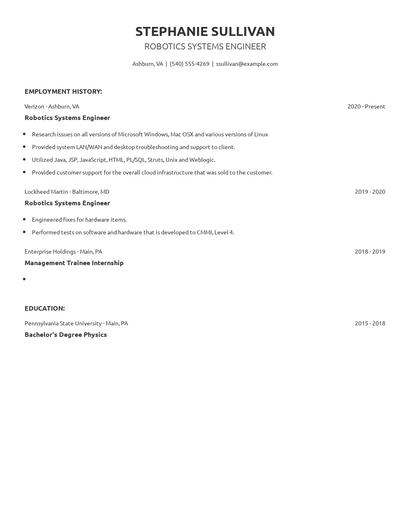
Choose from 10+ customizable robotics systems engineer resume templates
Build a professional robotics systems engineer resume in minutes. Our AI resume writing assistant will guide you through every step of the process, and you can choose from 10+ resume templates to create your robotics systems engineer resume.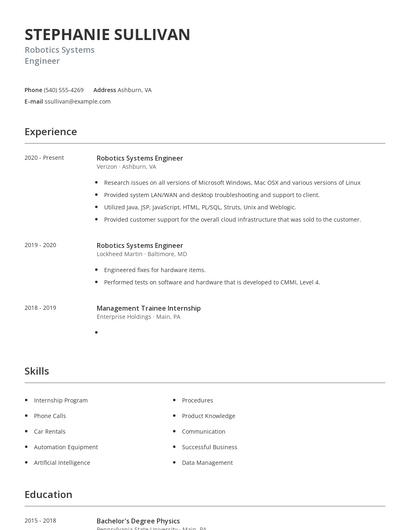
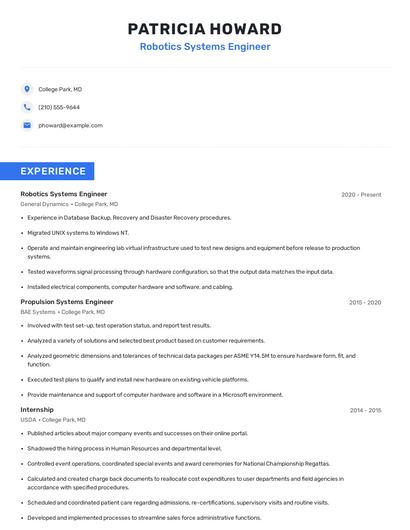
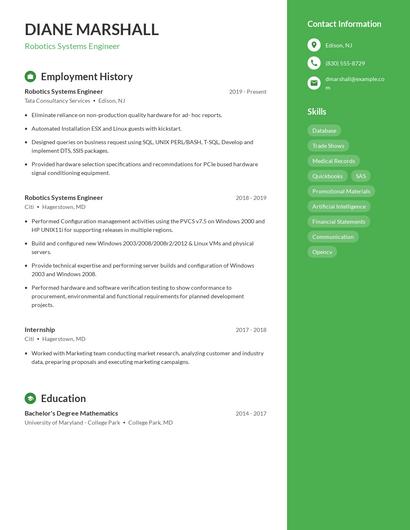
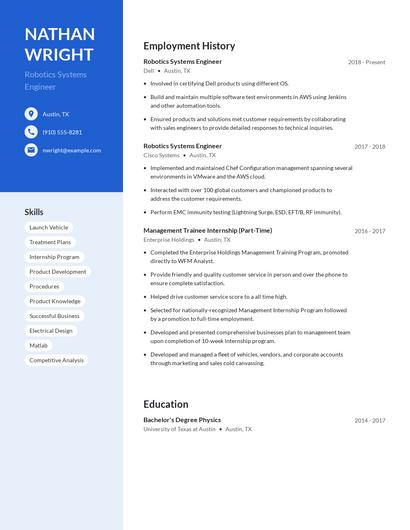
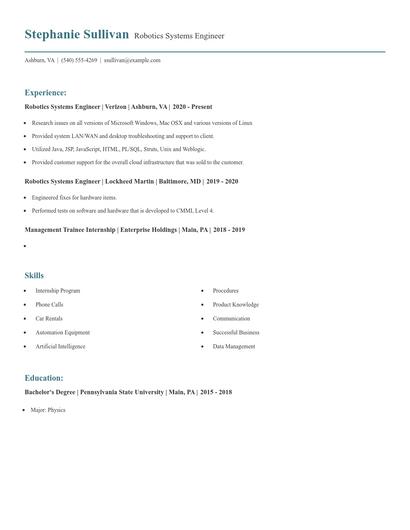
Compare different robotics systems engineers
Robotics systems engineer vs. Associate professor of automation
Engineers are highly trained professionals who determine the feasibility of various projects, usually related to the construction industry. They are considered experts in mathematics and science, two disciplines that they need to use in designing and coming up with plans for projects. They should also be well-versed in different construction or industrial materials, and they ensure that appropriate materials are used for the project. They also ensure that the projects meet the requirements of the groups that hired them. They create spaces that would both address the needs of the end-users and the industry standards. They also ensure that the projects they make would stand the test of time.
These skill sets are where the common ground ends though. The responsibilities of a robotics systems engineer are more likely to require skills like "c++," "aerospace," "matlab," and "cad." On the other hand, a job as an associate professor of automation requires skills like "sql," "automation solutions," "asset management," and "biomek." As you can see, what employees do in each career varies considerably.
On average, associate professors of automation reach lower levels of education than robotics systems engineers. Associate professors of automation are 7.6% less likely to earn a Master's Degree and 0.0% less likely to graduate with a Doctoral Degree.Robotics systems engineer vs. Engineer
A principal engineer is responsible for monitoring the overall design phase of the construction process, including coordinating with the client for progress and updates, as well as performing adjustments as needed based on clients' specifications and requirements. Principal engineers also inspect the materials and resources used to ensure that the project stays within the budget goals and set timeframe. They should have excellent communication and organizational skills, especially in preparing reports and training new staff.
In addition to the difference in salary, there are some other key differences worth noting. For example, robotics systems engineer responsibilities are more likely to require skills like "aerospace," "mechanical systems," "design reviews," and "control algorithms." Meanwhile, an engineer has duties that require skills in areas such as "python," "cloud," "c #," and "aws." These differences highlight just how different the day-to-day in each role looks.
In general, engineers achieve similar levels of education than robotics systems engineers. They're 3.2% less likely to obtain a Master's Degree while being 0.0% more likely to earn a Doctoral Degree.What technology do you think will become more important and prevalent for robotics systems engineers in the next 3-5 years?
Edoardo Sarda Ph.D.
Assistant Professor, Robotics Engineering, Lake Superior State University
Robotics systems engineer vs. Principal engineer
The required skills of the two careers differ considerably. For example, robotics systems engineers are more likely to have skills like "aerospace," "mechanical systems," "control algorithms," and "plc." But a principal engineer is more likely to have skills like "java," "architecture," "python," and "c #."
Most principal engineers achieve a higher degree level compared to robotics systems engineers. For example, they're 5.9% more likely to graduate with a Master's Degree, and 6.2% more likely to earn a Doctoral Degree.Robotics systems engineer vs. Robotics application engineer
Types of robotics systems engineer
Updated January 8, 2025
