
Automatically apply for jobs with Zippia
Upload your resume to get started.
Saddle stitch operator skills for your resume and career
11 saddle stitch operator skills for your resume and career
1. Routine Maintenance
- Permitted and provided guidance to contract maintenance during routine maintenance and scheduled turnarounds.
- Performed routine maintenance on water distribution equipment to ensure optimum performance.
2. Quality Products
A quality product satisfies the client's intended need and matches the cost the consumer paid for it.
- Followed manufacturing process procedures resulting in production of quality products that exceed customer expectations.
- Followed product specifications to complete quality products.
3. Troubleshoot
Troubleshooting is the process of analyzing and fixing any kind of problem in a system or a machine. Troubleshooting is the detailed yet quick search in the system for the main source of an issue and solving it.
- Run, maintain, troubleshoot, and operate a collator, shrink wrapping, paper cutting, and a folding machine.
- Run daily Manifest reports, generate orders via satellite, troubleshoot problems electronically and mechanically on the assembly line.
4. Inkjet
- Trained on Inkjet operation to ensure quality is maintained.
- Used trimmer, stitcher, label machine, inkjet, strapper, shrink wrapper to produces books to customer requirements.
5. Stitching
- Assisted in preparing and operating a stitching machine
- Maintained and operated Muller Martini stitching machine
6. Quality Checks
Quality checks are a component of quality control aimed at ensuring that quality requirements are met. Internally, quality checks provide assurance to managers, and externally, it provides assurance to clients, federal departments, authorities, and certifiers.
- Calibrate machinery every two hours and complete paperwork and self-quality check every hour.
- Prepared, scanned, and quality checked documents/images being converted to electronic/digital format.
Choose from 10+ customizable saddle stitch operator resume templates
Build a professional saddle stitch operator resume in minutes. Our AI resume writing assistant will guide you through every step of the process, and you can choose from 10+ resume templates to create your saddle stitch operator resume.7. Safety Procedures
Safety procedures are a set of standardized procedures, that ensures minimal to no risk to people, resources, and the work environment. A company follows the step-by-step safety procedures as it they not only keep the customers and the employees safe, but also help in avoiding legal claims.
- Assisted patrons entering and exiting rides, monitored activities to ensure adherence to safety procedures, shut-down and emergency evacuation procedures.
- Provided yard traffic control and communicated instructions to drivers to ensure all operating and safety procedures were being followed.
8. General Maintenance
General maintenance is the regular check-up and repairs of machinery, buildings, and other mechanical equipment. General maintenance is performed by repair workers who are skilled to handle the day-to-day defects produced in the machinery. General maintenance aims to make sure the items remain in the best operational conditions. Usually, a set of planned activities are performed regularly by an expert to monitor the maintenance.
- Replaced cartridges and general maintenance of copier machines.
9. RAN
RAN stands for "revenue anticipation note," which refers to a practice where an organization (often the government) borrows money to support a specific project. When these funds are then repaid, the money given to the lenders comes from the profits generated by the business originally funded.
- Performed quality control checks on all product ran on bindery machinery
- Set up machinery and ran and processed customer's orders for deluxe checks.
10. Machine Operation
- Operated and monitored equipment/line, removing or shifting materials and finished product as necessary to facilitate proper flow and machine operation.
- Fluctuate between packing and machine operation, operate high speed technologically advanced manufacturing equipment and troubleshooting and basic repair.
11. Quality Standards
Quality standards are a specific level of standards of products that are set by the companies for the customers that have to be met and maintained throughout the process until the time of delivery. Quality standards are information that includes the customer's requirements, guidelines, and characteristics for the needed final product or service.
- Performed in-process quality control inspections alerting management to deviations and made machine setting adjustments to bring production back into quality standards.
- Applied strategic planning, prioritization, and project management skills toward consistently achieving critical deadlines while maintaining high quality standards.

What skills help Saddle Stitch Operators find jobs?
Tell us what job you are looking for, we’ll show you what skills employers want.
List of saddle stitch operator skills to add to your resume
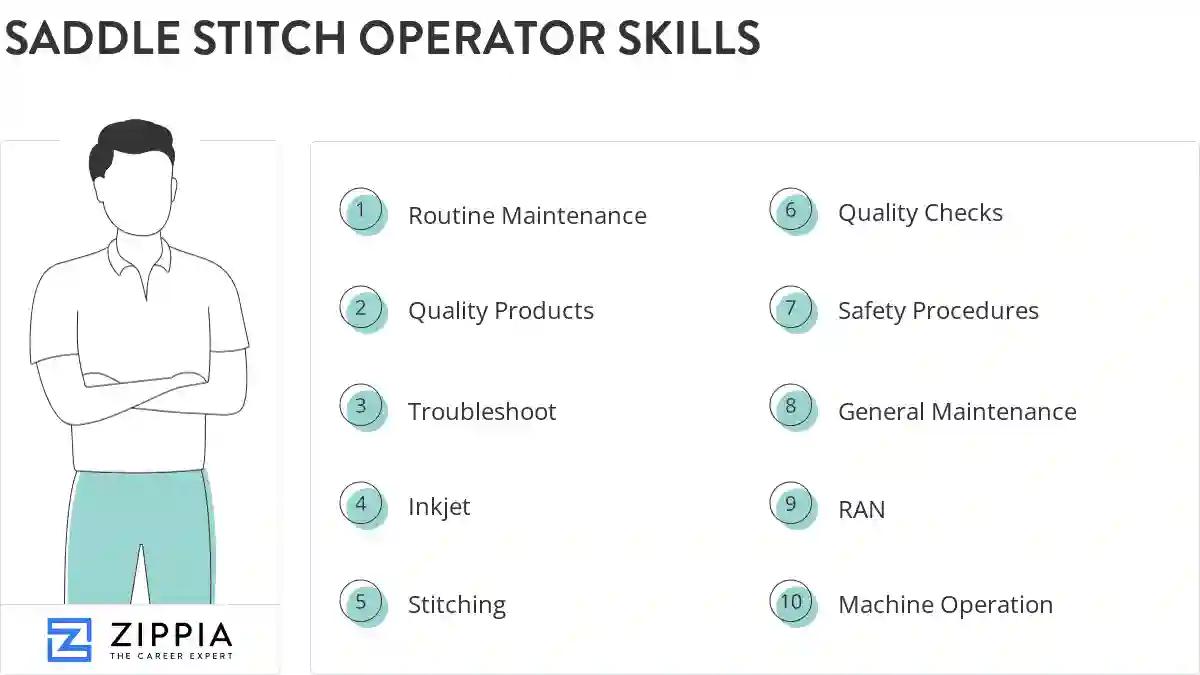
The most important skills for a saddle stitch operator resume and required skills for a saddle stitch operator to have include:
- Routine Maintenance
- Quality Products
- Troubleshoot
- Inkjet
- Stitching
- Quality Checks
- Safety Procedures
- General Maintenance
- RAN
- Machine Operation
- Quality Standards
Updated January 8, 2025
