Explore jobs
Find specific jobs
Explore careers
Explore professions
Best companies
Explore companies
Job outlook for sales program managers in the United States
Sales program manager job growth summary. After extensive research, interviews, and analysis, Zippia's data science team found that:
The projected sales program manager job growth rate is 5% from 2018-2028.
About 23,800 new jobs for sales program managers are projected over the next decade.
Sales program manager salaries have increased 12% for sales program managers in the last 5 years.
There are over 143,876 sales program managers currently employed in the United States.
There are 192,942 active sales program manager job openings in the US.
The average sales program manager salary is $103,116.
Are sales program manager jobs in demand?
Sales program manager job and salary trends over time
Sales program manager jobs over time
Sales program manager job growth rate over time
| Year | # of jobs | % of population |
|---|---|---|
| 2021 | 143,876 | 0.04% |
| 2020 | 124,610 | 0.04% |
| 2019 | 128,187 | 0.04% |
| 2018 | 120,489 | 0.04% |
| 2017 | 117,654 | 0.04% |
Average sales program manager salary over time
Sales program manager salary by year
| Year | Avg. salary | Hourly rate | % Change |
|---|---|---|---|
| 2026 | $103,116 | $49.57 | +4.5% |
| 2025 | $98,712 | $47.46 | +1.9% |
| 2024 | $96,825 | $46.55 | +2.6% |
| 2023 | $94,362 | $45.37 | +2.6% |
| 2022 | $91,946 | $44.20 | +3.6% |
Sales program manager jobs by state
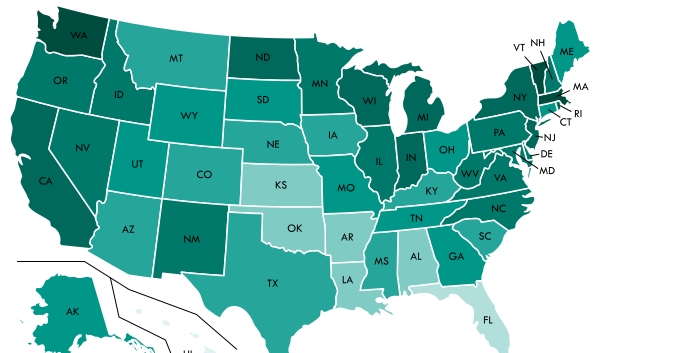
Most common states for sales program managers
| Rank | State | Population | # of jobs | Employment/ 1000ppl |
|---|---|---|---|---|
| 1 | District of Columbia | 693,972 | 783 | 113% |
| 2 | Washington | 7,405,743 | 3,442 | 46% |
| 3 | Delaware | 961,939 | 359 | 37% |
| 4 | Massachusetts | 6,859,819 | 2,453 | 36% |
| 5 | Rhode Island | 1,059,639 | 382 | 36% |
| 6 | Oregon | 4,142,776 | 1,436 | 35% |
| 7 | New Hampshire | 1,342,795 | 474 | 35% |
| 8 | Utah | 3,101,833 | 985 | 32% |
| 9 | Montana | 1,050,493 | 337 | 32% |
| 10 | Minnesota | 5,576,606 | 1,706 | 31% |
| 11 | Colorado | 5,607,154 | 1,691 | 30% |
| 12 | Connecticut | 3,588,184 | 1,069 | 30% |
| 13 | Virginia | 8,470,020 | 2,446 | 29% |
| 14 | Wyoming | 579,315 | 170 | 29% |
| 15 | North Dakota | 755,393 | 213 | 28% |
| 16 | Illinois | 12,802,023 | 3,484 | 27% |
| 17 | Idaho | 1,716,943 | 462 | 27% |
| 18 | Nebraska | 1,920,076 | 494 | 26% |
| 19 | New Jersey | 9,005,644 | 2,223 | 25% |
| 20 | Maryland | 6,052,177 | 1,520 | 25% |
Most common cities for sales program managers
| Rank | City | # of jobs | Employment/ 1000ppl | Avg. salary |
|---|---|---|---|---|
| 1 | Frankfort | 3 | 11% | $83,278 |
| 2 | Juneau | 3 | 9% | $90,943 |
| 3 | Annapolis | 3 | 8% | $99,576 |
| 4 | Dover | 3 | 8% | $99,608 |
| 5 | Cupertino | 3 | 5% | $117,177 |
| 6 | Lansing | 3 | 3% | $109,254 |
| 7 | Atlanta | 8 | 2% | $90,546 |
| 8 | Ann Arbor | 3 | 2% | $109,510 |
| 9 | Hartford | 3 | 2% | $93,975 |
| 10 | Little Rock | 3 | 2% | $76,091 |
| 11 | Baton Rouge | 3 | 1% | $78,485 |
| 12 | Des Moines | 3 | 1% | $81,080 |
| 13 | Montgomery | 3 | 1% | $73,593 |
| 14 | Sacramento | 3 | 1% | $119,675 |
| 15 | Charlotte | 4 | 0% | $99,047 |
| 16 | Boston | 3 | 0% | $112,408 |
| 17 | Indianapolis | 3 | 0% | $106,566 |
| 18 | Phoenix | 3 | 0% | $85,628 |
Sales Program Manager job outlook: Expert opinions
Our panel of sales program manager experts
University of Alaska Fairbanks
Texas Christian University
Texas Christian University

University of Maryland

Baylor University
Clarion University of Pennsylvania

State University of New York (SUNY) at Geneseo
University of Tennessee

Swarthmore College

Auburn University at Montgomery

The Touro College
Western Carolina University
Auburn University at Montgomery

Maryville University

Davenport University

Azusa Pacific University

Sacred Heart University
Christopher Newport University

Centenary College of Louisiana

University of Arkansas at Little Rock
What Sales Program Manager skills would you recommend for someone trying to advance their career?
Jaunelle Celaire: Never stop learning! This may consist of going back to school, earning new certifications in your field of study, attending conferences and seminars, and making sure that your time management is always at its finest level of excellence.
What will help Sales Program Managers increase their earning potential?
Jaunelle Celaire: 2. Leadership - the world needs more of these; the ability to lead, craft and grow. Digital literacy - this world is definitely turning digital and virtual is the new trend. Emotional intelligence - there is a vast number of personalities in our world today; individuals grow and it is our job to stay emotionally connected, so we can operate more effectively.
Ken Corbit Ph.D.
Assistant Professor of Professional Practice in MarketingTexas Christian University
Specialized Sales, Merchandising And Marketing Operations
What general advice would you give to a Sales Program Manager?
Ken Corbit Ph.D.: Strategic
Company Selection:
Focus on joining companies with robust sales training programs, emphasizing consultative selling. Look for organizations that invest in your development, providing live calling experiences, quota-driven sales processes, and exposure to tools like Salesforce.
Tech
Proficiency and Sales Tools Mastery:
Familiarize yourself with cutting-edge sales technologies, including CRM tools like Salesforce. Your proficiency in these tools will not only streamline your sales processes but also position you as a tech-savvy professional in the competitive sales landscape.
Hands-On
Experience:
Actively engage in live calling, take ownership of sales funnels, and work with senior hiring authorities during your training. This hands-on experience will not only build your confidence but also prepare you for the challenges of consultative selling.
Research
and Decision-Making Skills:
Develop strong research skills to evaluate companies based on fit, growth opportunities, compensation structures, and overall potential. This informed decision-making approach will set you apart and empower you to navigate the sales landscape strategically.
Mentorship
and Networking:
Seek mentorship both within and outside your organization. Building relationships with mentors who invest in your sales skills and knowledge will provide valuable insights. Additionally, actively participate in online forums to connect with practical sales
knowledge and best practices.
What Sales Program Manager skills would you recommend for someone trying to advance their career?
Ken Corbit Ph.D.: AI-Integrated Consultative Selling: Recognize the evolving role of AI in sales. Embrace AI tools that enhance your pre-call preparation, role-playing, agenda setting, and call talk track development. Stay ahead by incorporating AI into your sales strategies to deliver personalized and efficient client engagements.
What will help Sales Program Managers increase their earning potential?
Ken Corbit Ph.D.: Holistic
Knowledge Mastery:
Become an expert in your industry, staying abreast of market trends, and thoroughly understanding the products/services you sell. This comprehensive knowledge will empower you to provide exceptional value, resulting in higher sales success and increased client
retention.
Strategic
Question-Based Selling:
Master the art of question-based selling. Use insightful questions to uncover client needs, address pain points, and tailor your approach. This strategic skill will not only boost initial sales but also contribute to secondary sales and long-term client satisfaction.
Compensation
Structure Expertise:
Understand your organization's compensation structure thoroughly. This includes baseline compensation, commission and bonus plans, and additional benefits. This knowledge allows you to set realistic targets, maximize your earnings, and take full advantage
of uncapped commission structures.
Consistent
Target Achievement:
Consistently meet or exceed targets and quotas to demonstrate your value. This not only enhances your immediate success but also positions you for continuous earning potential, especially in roles with uncapped commissions.
Negotiation
and Value Recognition:
Develop negotiation skills to ensure you are compensated appropriately. Recognize your worth and, when appropriate, discuss compensation adjustments or additional benefits with your employer. A proactive approach to recognizing and articulating your value
contributes to your overall salary potential.
In a rapidly evolving sales landscape, continuous learning, tech adaptability, and proactive career management are fundamental for achieving sustained success in consultative sales.
Dr. Brandon Chicotsky
Assistant Professor of Professional Practice in Marketing at the TCU Neeley School of BusinessTexas Christian University
Specialized Sales, Merchandising And Marketing Operations
What skills will help Sales Program Managers earn the most?
Dr. Brandon Chicotsky: Research about the client and strategic questions (with active listening) to understand a client's needs and opportunities will help a sales professional determine if there is value alignment, which leads to more efficient and remunerative outcomes.
Roland Rust Ph.D.
Distinguished University Professor, David Bruce Smith Chair in Marketing, Executive Director, Center for Excellence in Service, Ph.D., Business Administration, University of North Carolina at Chapel Hill MarketingUniversity of Maryland
Robert H. Smith School of Business
What skills stand out on Sales Program Manager resumes?
Roland Rust Ph.D.: One might think that a stellar sales record would be most important, but that would be most relevant only if the individual has prior sales manager experience. If promoting a salesperson to sales manager, the thing that may be missing is administrative and managerial skills. In addition, we are in a technological revolution, driven by AI, which means that prior knowledge and experience with AI-related analysis would also definitely stand out (although probably hard to find).
Andrea Dixon Ph.D.
Executive Director, Center for Professional Selling, Frank and Floy Smith Holloway Endowed Professorship in Marketing, President, University Sales Center Alliance 2019-2021Baylor University
Hankamer School of Business
What skills stand out on Sales Program Manager resumes?
Andrea Dixon Ph.D.: Like salespeople, sales managers must focus their resumes on tangible, objective performance results that are achieved by their teams.
Growth in revenue or quota attainment for the overall team are examples of the types of objective performance results that matter.
High-performing sales managers also highlight long-term performance indicators, which includes both long-term revenue growth by the unit
AND investment metrics that signal the sales manager is building company results for the long run. For example, a high-performance sales manager focuses on building and maintaining a high-performing unit. Such a manager looks to move low performers to other roles where they can be successful.
Another investment metric that a sales manager can signal is the percent of their unit promoted to managerial roles in the organization.
What soft skills should all Sales Program Managers possess?
Andrea Dixon Ph.D.: Since sales professionals have a lot of information available to them today via customer relationship management (CRM) systems, the sales manager's "supervisory" role is less important (especially for experienced sellers). Consequently, the sales manager needs to be more of a coach and enabler of high performance. Having confidence balanced with humility allows the sales manager to engage more effectively with their salespeople.
One of the critical soft skills for sales managers going forward will be the ability to connect members of the sales team to others in the organization - in other words, the sales manager of the future needs to have strong skills in network building for others. Sellers have access to data which helps them build success.
They also need access to the right people to turn to when they need specific expertise or assistance.
What hard/technical skills are most important for Sales Program Managers?
Andrea Dixon Ph.D.: One of the growing technical skill requirements for sales managers is in the area of data analytics. Our performance and customer systems provide a myriad of data, and the role of the sales manager is to be a sense-maker of that mound of data. What are the implications for changes in strategy or behavior evident in last quarter's activity? How can the sales manager help a specific seller "see" where the data suggest new approaches?
What skills will help Sales Program Managers earn the most?
Andrea Dixon Ph.D.: People who can recognize patterns (in data, in people), build connections with and across others, create a focus on high-performance behaviors, and lead with a confident humility are those who will win today and in the future business environment.
What are the biggest trends we'll see in the Sales Program Manager job market given the pandemic?
Dr. Miguel Olivas-Luján Ph.D.: As the economy "reopens" (thanks to appeased fears of contagion driven by vaccination, herd immunity, people worn out by the lockdowns, warmer weather, etc.), we should see workforce adjustments across industries and occupations. Already in March, unemployment was returning to 6% (from a high of 14.8% in April 2020, but after a low of 3.5 in February 2020; https://data.bls.gov/timeseries/LNS14000000). Barring unexpected resistance in the virus variants or other influences, the summer and fall months should give us better job market numbers, but this recovery seems to be benefitting some population segments more than others. The unemployed rate for teenagers was at 13%, followed by Blacks (9.6%), Hispanics (7.9%), Asians (6%), adult men (5.8%), and adult women (5.7%; more detail is available at https://www.bls.gov/news.release/empsit.nr0.htm).
Dr. Ian Alam
Professor of MarketingState University of New York (SUNY) at Geneseo
School Of Business
Will there be an enduring impact of the coronavirus pandemic on Sales Program Managers?
Dr. Ian Alam: Companies hire graduates based on the perception of business growth or future growth in customer acquisitions. Currently the perception is that pandemic will die down in the near future. Yet the reality is somewhat different. The COVID cases are going up everywhere in the country and abroad. Therefore, the recent uptick we saw in hiring will fade away very soon. As a result, I expect an enduring negative effect on the graduate employments prospects. However, if our current vaccination program leads to herd immunity, i.e. at least 70% of the population is vaccinated by the end of summer, then the economy will open up further. This will encourage the employers to start the hiring again.
Scott Gilpatric
Professor and Department HeadUniversity of Tennessee
Department of Economics, Haslam College of Business
What will help Sales Program Managers increase their earning potential?
Scott Gilpatric: The easy answer is being really proficient with handling data, including being comfortable with learning to code in whatever manner might be needed. There's no question those skills are likely to open doors. But in a very different way, one thing that really matters is being able to talk comfortably about ideas and developments in economics, business, or policy areas, signaling a strong base of knowledge. Towards that end, reading deeply, not just the headlines but long-form analysis in places like The Economist and other high-quality publications can be really beneficial.
What's a good job out of college for Sales Program Managers?
Stephen O'Connell: Work that uses your skills and builds new ones. There is a premium on your own flexibility over the couple of years, with a lot of job-market volatility due to uncertain structural impacts of the pandemic.
Brett Lehman Ph.D.
ProfessorAuburn University at Montgomery
Department of Sociology, Anthropology, and Social Work
What's a good job out of college for Sales Program Managers?
Brett Lehman Ph.D.: There is a business side and a human side to this answer. On the business side, I hope graduates are provided benefits like health insurance, a gainful salary, and opportunities for advancement. The way to hit a home-run is to get a job where those needs are taken care of and you still get to use your skills for something you feel is important. Most sociology students get into the subject because they care about the human side, want to help people, and see opportunity for creating positive social change. You'll get motivated sociology graduates when you show them a path towards achievement on the human side; then when we there's less worry about the business side, some impressive results could follow!
What certifications/licenses/courses can have the biggest impact for Sales Program Managers?
Jodi Smolen: I think this depends on the industry. Finance students give themselves an advantage by taking the Securities Industry Essential (SIE) exam during college. The exam does not require employer sponsorship and it is good for 4 years. If students want to become a securities trader, investment banker, or financial advisor, the SIE exam is a necessary step before they take the Series 6 and 7 exams after graduation. It shows a prospective employer that the student is serious about a career in the financial services industry.
In addition, finance students should hone their advanced Excel skills. Whether they do this in college, or on their own time, knowing Pivot Tables and VLOOKUP will set them apart from other candidates.
Computer science students should know that Python is in strong demand. If they know the basics of this language, they will have more job opportunities in different industries. Similarly, many data science jobs require Python, SQL or R programming languages. Candidates who pick up programming languages easily can learn on the job, but it is always more desirable to walk into the job knowing the language they want to use.
Will there be an enduring impact of the coronavirus pandemic on Sales Program Managers?
Angela Sebby Ph.D.: While jobs may be slower to return to the capacity pre-Covid, the industry and tourism employment will rebound as people still want to travel and explore diverse foods, cultures, and experiences. However, the enduring impact will be the rapid onset of technology that allowed for limited contact with employees and others has become the new norm. Although human interaction is an important aspect of service in the tourism industry, employers have found that they can reduce the number of personal interactions but still deliver an acceptable level of quality service. What would have taken years to adopt, COVID created an amplified adoption.
What soft skills should all Sales Program Managers possess?
TeWhan Hahn Ph.D.: Writing skills including email writing, being able to work in teams, and knowing the workplace etiquettes.
Meaghan Goodman Ph.D.
Program Director & Assistant ProfessorMaryville University
Speech-Language Pathology
What's a day at work look like for a Sales Program Manager?
Meaghan Goodman Ph.D.: A bachelor's in communication sciences and disorders can prepare you for three different tracks. First, it can prepare you to become a licensed Speech-Language Pathology Assistant (SLPA). This is someone who works under a fully credential speech-language pathologist. Often times, they carryout intervention plans developed by a fully credentialed speech-language pathologist. If graduate school is on your horizon, a bachelor's degree in communication sciences and disorders will prepare you for acceptance into a Speech-Language Pathology program, or an Audiology program. If you are not accepted into a graduate program right away, working as a speech-language pathology assistant (SLPA) is a great way to get experience in the field!
What soft skills should all Sales Program Managers possess?
Todd Terry: Graduates as they prepare to enter the workforce should pay particular attention to their ability to communicate with coworkers. This communication could happen through face-to-face interactions, remote meetings with the aid of technology for example, meeting by computer software, written communication through instant messaging, or emails. Also, part of communicating is being a good listener.
Graduates should have good critical thinking skills. They will need to be adaptive and able to analyze data to make good informed decisions.
In today's work environment, working on teams is a regular function. Therefore, employers are looking for the candidate who can professionally interact with other team members, have a positive attitude and a good work ethic.
What's a good job out of college for Sales Program Managers?
Bala Musa Ph.D.: A good job out of college is one that allows you to apply creative and critical thinking skills. Future work environments will require employees to innovate and adapt. Any job that helps you cultivate, sharpen and apply those skills will serve you and your organization well. It will prepare you to adapt in the face of change and future disruptions.
Will there be an enduring impact of the coronavirus pandemic on Sales Program Managers?
Keith Hassell: One thing the pandemic has taught us all, college students and employers, is to be flexible and adaptable. During the spring 2020 semester - students' "routines" were thrown out the window, and they were forced to switch from in-person to remote learning. Although this was a learning curve for those on and off campus, it taught students a valuable lesson: adaptability.
With the transition to remote work for many employers, they, too, had to adjust their workflows, especially with regards to recruiting for internships and post-graduate opportunities. Some employers did have to postpone or cancel internships, but some also saw it as an opportunity to think outside the box, coming up with new innovative ways to virtually host opportunities, and to recruit. The ways in which companies can now recruit, virtually across new geographic areas, is a direct result of the pandemic, one we anticipate to last far beyond.
What technical skills for a Sales Program Manager stand out to employers?
Keith Hassell: Employers are increasingly looking for applied skillsets and additional certifications to set a candidate apart. Sacred Heart University has recently launched a remote work certification, which houses three modules - focusing on the remote worker, the remote team and the remote leader, providing the tools and resources to comfortably leverage and utilize virtual platforms at various organizations. Additional specialized training, certifications and more are great selling tools pending on the specific area of interest. Certifications are common in areas such as project management, sales, IT/network/software, Google application and more. The candidate needs to think, "What can I do that is beyond my coursework to show I am passionate about my field? How do I make myself stand out?" Certifications is an attainable way to do this.
In addition, soft skills continue to be equally important in today's job market. NACE (the National Association of Colleges and Employers) identified seven core competencies that employers seek from entry level candidates which include critical thinking/problem solving, oral/written communication, teamwork/collaboration, digital technology, leadership, professionalism/work ethic, career management and global/intercultural fluency.
Todd Lee Goen
Instructor & Internship DirectorChristopher Newport University
Department of Communication
What technical skills for a Sales Program Manager stand out to employers?
Todd Lee Goen: Technical skills are often industry and/or position specific. Applicants should highlight any technical skills related to the position advertisement and those that add value to the position/organization. Most importantly, requirements for technical skills change with time and technological advances. This means employers value workers capable of adapting to change and continually improving and acquiring new technical skills. Thus, it's usually more important to demonstrate you are capable of learning and developing technical skills than it is to have a specific skill set upon hire (although this is not true for some positions/industries).
That said, technical skills related to online presentations, virtual meetings, virtual networking, remote working and the like are hot commodities right now. While most organizations were in the process of adopting many of these technologies and ways of doing business pre-pandemic, the pandemic accelerated the process. Organizations are making it work, but they often don't know best practices or the most efficient means of working in the largely virtual, pandemic environment. Post-pandemic, many of the remote/virtual changes the pandemic brought will stay in some form. Technical skills that support this type of workplace will make applicants stand out to many employers because they need/want to do virtual/remote business better.
What's a good job out of college for Sales Program Managers?
Todd Lee Goen: Pandemic or no pandemic, the best job out of college is one that sets you on the path to achieve your ultimate career goal(s). Reflect on where you want to be in five or ten years or even twenty-five years. Then consider positions that will set you on the path to achieve that goal. Very few people land their dream job upon graduation - dream jobs are typically those we're not qualified to do without some additional work experience and training. A good job is one that will help you achieve your goal(s) - just don't frame it that way in the interview.
Good jobs pay a livable salary for the location, offer benefits (health insurance and retirement at minimum), and provide professional development opportunities (these can take a variety of forms). Too often, college grads overlook professional development. If an employer isn't willing to invest in you, there's no guarantee you will succeed in the job. Good employers understand they need qualified employees who continually develop their skills and abilities, and good employers will make sure employees have the resources they need to succeed.
Dr. Barbara Davis
William J. Atkins DeanCentenary College of Louisiana
Frost School of Business
Will there be an enduring impact of the coronavirus pandemic on Sales Program Managers?
Dr. Barbara Davis: Graduates will be forever changed by the coronavirus pandemic. This major event during their academic careers is so far reaching and will impact the rest of their lives. This event will forever be remembered and utilized in all future decisions they make.
What experience really stands out on Sales Program Manager resumes?
Dr. Barbara Davis: Graduates participating in internships related to their areas of interest. Internships spanning more than one semester at the same firm stand out as well.
What are the biggest trends we'll see in the Sales Program Manager job market given the pandemic?
Dr. Timothy Edwards: I think more journalists and media professionals will work remotely. The pandemic has proven that the technology is sufficient enough to facilitate this change, and this trend will help save costs for media outlets.
What skills stand out on Sales Program Manager resumes?
Dr. Timothy Edwards: Writing and research skills. Analytical and critical thinking skills. Technical skills such as web design, graphic design, audio and video production skills. Employers are interested in potential employees knowledge, intelligence and skills.