
Automatically apply for jobs with Zippia
Upload your resume to get started.
Sas programmer skills for your resume and career

15 sas programmer skills for your resume and career
1. Macro
- Developed Utility Macros and extensively used existing macros for Validation, Analysis, Report generation and Integration of Data.
- Introduced Time-Dependent Processing to focus only on those interested transactions with Macro variables and IF statement.
2. Data Analysis
- Required to make recommendations based upon data analysis and provide analytic consultation to other business areas, leadership or external customers.
- Performed different Hypothesis, significance testing, categorical data analysis, and regression-based modeling techniques (both linear and logistic).
3. SAS Macros
- Created, implemented and maintained SAS macro library for production of statistical tables/figures/listings; Developed data editing checks in SAS.
- Developed and extensively used existing SAS macros for Validation, Analysis and Report generation.
4. Statistical Analysis
- Developed macros for report generation using SAS/Macros as per the statisticians' requirements and programs for statistical analysis and data displays.
- Perform business profile and segmentation analysis and conduct statistical analysis using T-test, Chi-square Test, variance analysis and multivariate analysis.
5. SAS/SQL
- Create safety and efficacy TLF-derived analysis reports by using SAS/BASE, SAS/STAT, SAS/SQL, SAS/GRAPH, SAS/MACRO;.
- Recorded frequent transactions along with the customer information required in finding out the risk of transaction using SAS/SQL.
6. SAS Procedures
- Developed loss prediction model using Enterprise miner modeling solutions and SAS procedures.
- Developed programs for extensive statistical analysis of data using SAS procedures.
Choose from 10+ customizable sas programmer resume templates
Build a professional sas programmer resume in minutes. Our AI resume writing assistant will guide you through every step of the process, and you can choose from 10+ resume templates to create your sas programmer resume.7. Unix
UNIX is a computer operating system that was first created in the 1960s and has been constantly updated since then. The operating system refers to the set of programs that enable a machine to function. It is a multi-user, multi-tasking device that works on computers, laptops, and servers. UNIX systems also have a graphical user interface (GUI), similar to Microsoft Windows, that makes it simple to use.
- Used SAS9.2 to manipulate smaller pools of data as well as UNIX to extract and manipulate data stored in Oracle tables.
- Provided departmental support for a Unix (Linux) environment, including training, mentoring, and investigation of user problems.
8. SAS Programs
- Developed SAS programs to generate data summaries, data listings and safety analysis which are required for monitoring regulatory purposes.
- Develop SAS programs/methodologies for fair estimation of Full-Quarter Earnings and Point-in-Time Earnings of individuals.
9. Base SAS
- Created programming of data listings, Summary tables, Categorical tables and figures using Base SAS, Macros and SAS graph.
- Experience with developing ETL Processes using Base SAS Data Step processing code (writing ETL code in SAS).
10. CDISC
- Performed program documentation on all programs, files and variables for accurate historical record and for future reference by using CDISC.
- Established domain models according to SDTM specs and also created new domains that are CDISC compliant and Implemented CDISC SDTM Standards.
11. SDTM
- Created CRT's (Case Report Tabulations) and listing reports using Study Data Tabulation Model (SDTM) Model.
- Involved in mapping of clinical trial data into CDISC (SDTM) format, converted raw data to SDTM Domains.
12. HTML
- Participated in writing custom safety and efficacy reports that direct SAS output to RTF and HTML files using SAS ODS facility.
- Generated high quality reports and presentations into different formats, such as HTML, RTF and PDF through employing SAS ODS.
13. SAS Data
- Utilized various SAS data procedures to accomplish customer segmentation and marketing campaign for financial services clients.
- Worked with external vendors in order to develop or monitor the content and structure of SAS data sets, when necessary.
14. Adam
ADAM software assists leading companies by rendering smart and convenient digital management solutions. This software has proved to be of great importance for retailers and Enterprises working on large scales. The ADAM software offers impeccable features to its users, such as designing and structuring media and delivering it among the team members and advanced systems to help users manage their group tasks very efficiently.
- Generated ADAM specifications under the guidance of project statistician.
- Created Adam Data sets and generated TLF (Table, Listing, Figure).
15. QC
Quality control is a set of instructions or procedures to ensure a manufactured product or a service is up to the highest quality standards. This set of quality control criteria are either defined by the clients or the company itself.
- Developed analysis data set specifications, developed programs and performed QC.
- Perform statistical analyses and QC statistical output.
5 SAS Programmer resume examples
Build a professional sas programmer resume in minutes. Browse through our resume examples to identify the best way to word your resume. Then choose from 5+ resume templates to create your sas programmer resume.

What skills help SAS Programmers find jobs?
Tell us what job you are looking for, we’ll show you what skills employers want.
What sas programmer skills would you recommend for someone trying to advance their career?
Dr. Robert P. Eyler
Professor, Sonoma State University
List of sas programmer skills to add to your resume
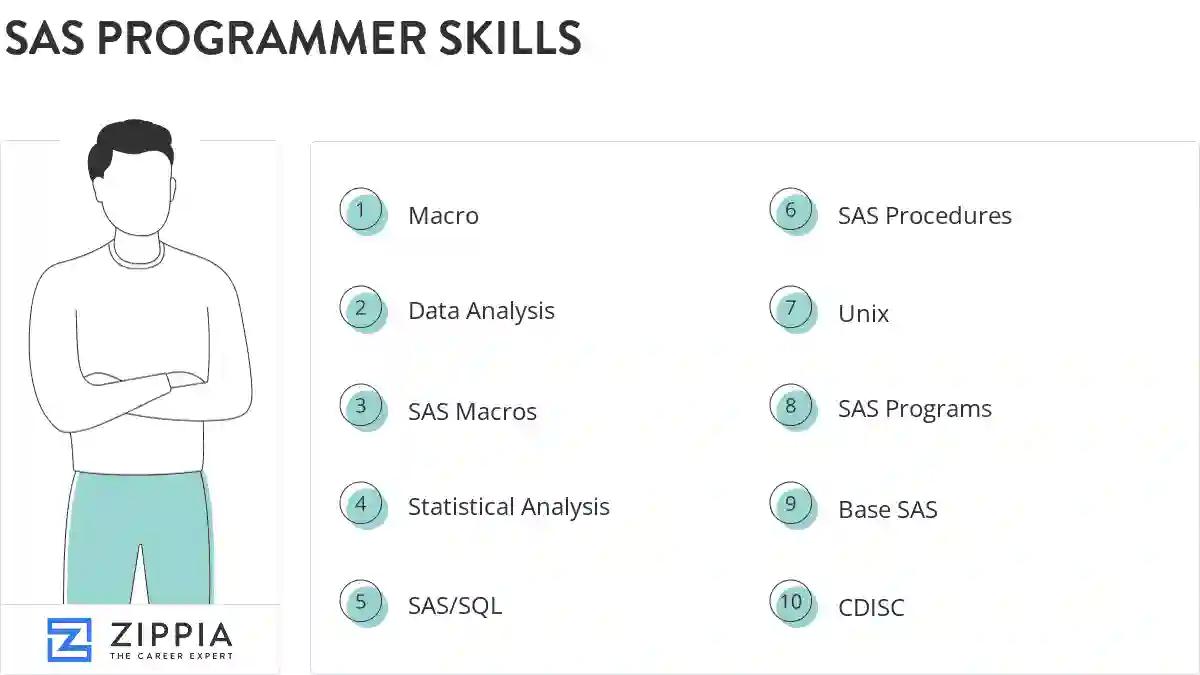
The most important skills for a sas programmer resume and required skills for a sas programmer to have include:
- Macro
- Data Analysis
- SAS Macros
- Statistical Analysis
- SAS/SQL
- SAS Procedures
- Unix
- SAS Programs
- Base SAS
- CDISC
- SDTM
- HTML
- SAS Data
- Adam
- QC
- Summary Tables
- Proc SQL
- Ms-Excel
- SAS/GRAPH
- Sas Graph
- ETL
- Efficacy
- Windows XP
- Ad-Hoc Reports
- FDA
- Extraction
- Data Manipulation
- SQL Server
- Data Validation
- Sas Enterprise
- Teradata
- Data Warehouse
- DB2
- RTF
- CSV
- Clinical Trial Data
- Generate Reports
- III
- Pharmaceutical Industry
- SAS/STAT
- ISE
- SAS/ODS
- Mainframe
- Java
- Extract Data
- Descriptive Statistics
- Regression
- Proc Freq
Updated January 8, 2025
