Explore jobs
Find specific jobs
Explore careers
Explore professions
Best companies
Explore companies
Job outlook for sas programmers in the United States
Are sas programmer jobs in demand?
Sas programmer job and salary trends over time
Sas programmer jobs over time
Sas programmer job growth rate over time
| Year | # of jobs | % of population |
|---|---|---|
| 2021 | 2,903 | 0.00% |
| 2020 | 6,401 | 0.00% |
| 2019 | 6,293 | 0.00% |
| 2018 | 16,650 | 0.01% |
| 2017 | 17,894 | 0.01% |
Average sas programmer salary over time
Sas programmer salary by year
| Year | Avg. salary | Hourly rate | % Change |
|---|---|---|---|
| 2026 | $79,182 | $38.07 | +3.4% |
| 2025 | $76,573 | $36.81 | +2.3% |
| 2024 | $74,840 | $35.98 | +2.5% |
| 2023 | $73,028 | $35.11 | +3.0% |
| 2022 | $70,897 | $34.09 | +0.4% |
Sas programmer jobs by state
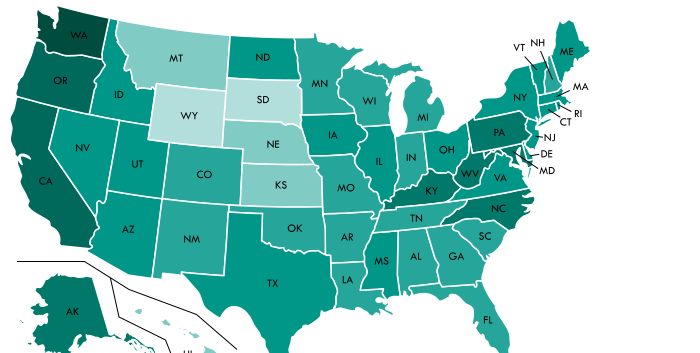
Most common states for sas programmers
| Rank | State | Population | # of jobs | Employment/ 1000ppl |
|---|---|---|---|---|
| 1 | District of Columbia | 693,972 | 599 | 86% |
| 2 | Delaware | 961,939 | 300 | 31% |
| 3 | Virginia | 8,470,020 | 2,545 | 30% |
| 4 | Maryland | 6,052,177 | 1,804 | 30% |
| 5 | Rhode Island | 1,059,639 | 314 | 30% |
| 6 | Vermont | 623,657 | 177 | 28% |
| 7 | Massachusetts | 6,859,819 | 1,575 | 23% |
| 8 | Oregon | 4,142,776 | 938 | 23% |
| 9 | Utah | 3,101,833 | 672 | 22% |
| 10 | New Hampshire | 1,342,795 | 296 | 22% |
| 11 | Montana | 1,050,493 | 218 | 21% |
| 12 | Washington | 7,405,743 | 1,516 | 20% |
| 13 | North Dakota | 755,393 | 151 | 20% |
| 14 | New Jersey | 9,005,644 | 1,699 | 19% |
| 15 | Nebraska | 1,920,076 | 352 | 18% |
| 16 | Minnesota | 5,576,606 | 971 | 17% |
| 17 | Wyoming | 579,315 | 98 | 17% |
| 18 | North Carolina | 10,273,419 | 1,596 | 16% |
| 19 | Idaho | 1,716,943 | 283 | 16% |
| 20 | Alaska | 739,795 | 115 | 16% |
Most common cities for sas programmers
| Rank | City | # of jobs | Employment/ 1000ppl | Avg. salary |
|---|---|---|---|---|
| 1 | South Plainfield | 8 | 33% | $79,400 |
| 2 | Elk Grove Village | 4 | 12% | $78,606 |
| 3 | Bethesda | 6 | 10% | $82,765 |
| 4 | Newark | 3 | 9% | $77,946 |
| 5 | North Chicago | 2 | 7% | $78,813 |
| 6 | Kennesaw | 2 | 6% | $73,502 |
| 7 | Pasadena | 4 | 3% | $87,136 |
| 8 | Durham | 5 | 2% | $83,231 |
| 9 | Columbia | 3 | 2% | $71,962 |
| 10 | Boston | 4 | 1% | $80,959 |
| 11 | Atlanta | 3 | 1% | $73,513 |
| 12 | Arlington | 2 | 1% | $82,533 |
| 13 | Chicago | 4 | 0% | $78,645 |
| 14 | New York | 3 | 0% | $78,118 |
| 15 | Washington | 3 | 0% | $88,775 |
| 16 | Baltimore | 2 | 0% | $82,900 |
| 17 | Charlotte | 2 | 0% | $81,483 |
| 18 | Jacksonville | 2 | 0% | $73,364 |
| 19 | Oakland | 2 | 0% | $94,742 |
SAS Programmer job outlook: Expert opinions
Our panel of sas programmer experts
Portland State University
San Francisco State University
Kettering University
The University of Tennessee - Martin
Butler University

Sonoma State University

University of Akron
What will help SAS Programmers increase their earning potential?
Wu-chang Feng: I believe so. With the advent of generative AI, it is now much easier to go from idea to implementation. We can now build things closer to the limits of our imagination.
What SAS Programmer skills would you recommend for someone trying to advance their career?
Luella Fu: I think Statisticians enjoy the quantitative reasoning aspect of their jobs, whether it’s designing the data collection, visualizing data, or creating insights from it. It’s also a pretty stable job with good pay. What Statisticians probably don’t like is the amount of time they spend in front of a computer to do their data analyses. It can create eye strain. Also, data cleaning can be full of unexpected challenges that take much longer to solve than one expects.
What general advice would you give to a SAS Programmer?
Dr. Jim Huggins: Computer science is a problem-solving discipline. Computer scientists help people solve problems. Typically, those problems deal with data; someone has a large set of data and needs to answer questions about that data, or process it in some way. Computer scientists write programs that run on computers to help their clients answer those questions and perform those processing tasks. On a given day, a computer scientist might do any or all of the following tasks, working alone or in teams: - Meet with clients to understand their problems and how a computing system might help them solve their problems. - Design computing systems to meet client needs. - Build computing systems to meet design specifications. - Test computing systems in order to find errors in their construction and fix those errors. - Repair computing systems that are not functioning properly. - Instruct users how to use the computing systems the computer scientist has designed for them. - Brainstorm new ideas for computing systems that would meet the needs of new customers.
What will help SAS Programmers increase their earning potential?
Dr. Jim Huggins: Computer scientists enjoy the opportunity to be creative every day. Every computing system being designed is different from the last one or the next one; creativity is required to solve new problems every day. Computer scientists enjoy the opportunity to solve problems. There is a great feeling of accomplishment when a team finishes developing a computing system or helps a client solve their problems by using a computing system they designed. Computer scientists are innovative. By definition, they create systems that never existed beforehand. People enjoy knowing that they're creating the future of our world. Each benefit of being a computer scientist can also be a challenge. Working with people, both to determine the requirements for a system that's never existed, and to build that system, can be subject to the same interpersonal conflicts of any discipline. Problem-solving can be frustrating if the solution is not immediately apparent. Building computing systems requires technical skills that can take time to learn and to master.
What SAS Programmer skills would you recommend for someone trying to advance their career?
David Gerberry Ph.D.: Keep in mind one of the greatest virtues of your background is that the critical thinking and problem-solving skills developed in studying mathematics are a unique asset in just about any career. While it is stressful for students to see that very few job postings will say "mathematician," the flexibility to pivot and succeed in many different careers is a major strength.
Dr. Rachel Tatarski Ph.D.
Assistant Professor of PracticeThe University of Tennessee - Martin
Sports, Kinesiology, And Physical Education/Fitness
What will help SAS Programmers increase their earning potential?
Dr. Rachel Tatarski Ph.D.: Look for additional badges, credentials, certifications, and/or licensures that can set you apart from the crowd. For example, a physical therapist with a sports medicine residency will be more competitive than someone without when applying to sports-focused physical therapy positions. LinkedIn Learning and Coursera are also great ways to develop new skills or become even better at ones you already have.
Dr. Lee Farquhar
Associate ProfessorButler University
Radio, Television, And Digital Communication
What SAS Programmer skills would you recommend for someone trying to advance their career?
Dr. Lee Farquhar: Storytelling is still at the heart of the industry. Start with good reporting and writing. From there, broaden your technical skills so that your stories can connect with audiences in a variety of platforms. A certain fluidity is necessary for the modern and future reporter, crossing from one medium to another seamlessly. The reporter must be resolute in their reporting and nimble in their delivery to the audience.
What are the biggest trends we'll see in the SAS Programmer job market given the pandemic?
Dr. Robert P. Eyler: We will see more jobs out there for data science and analysis across multiple subfields (AI programming, digital marketing, process automation, information/cyber security). Many of these trends were already in motion pre-pandemic and are now hastensed due to the dynamic marketplace online and on our phones. We will also see risk management specialists hired as businesses come back to work slowly but surely.
What SAS Programmer skills would you recommend for someone trying to advance their career?
Dr. Robert P. Eyler: Learning to code is a good initial skill, especially if the student sees themselves in a field where databases and the internet of things (IoT) is an important piece of any job they take. Shoring up their skills with Excel if needed is a good way to spend that time too; taking a class on a subject like cybersecurity that is not graded but may help undertsand the strategic landscape of frontier technology businesses may be a good thing to do.
What technology do you think will become more important and prevalent for SAS Programmers in the next 3-5 years?
Dr. Mark Fridline Ph.D.: I recommend all my students expose themselves to as many technologies as possible. Many statistical software programs are available for students to learn. There are many free statistical software packages available that can quickly be discovered. Data management skills will always be prevalent in the statistical field. Learning these technological skills will open many job opportunities.