
Automatically apply for jobs with Zippia
Upload your resume to get started.
Science editor skills for your resume and career
10 science editor skills for your resume and career
1. SEO
- Utilize content management systems and SEO metadata to provide quality finished VOD products to both domestic and international customers.
- Developed SEO strategies to increase profitability and managed social media to spread brand awareness and bolster readership.
2. Chemistry
Chemistry is the branch of science that tells us about the composition, properties, and structure of elements and compounds. The processes these elements undergo and how they undergo change all come under the branch of chemistry.
- Managed revision and publication of flagship textbook titles in Physics, Chemistry and Biology.
- Edited Modern Chemistry student and teacher editions for Houghton-Mifflin/Harcourt, grades 9-12, National and Virginia Standards.
3. Proofread
Proofreading simply carefully checking your text for possible errors like typographical errors or mistakes in grammar, style, and spelling before it can be published or shared. This is generally known as the very last stage of any writing process when you need to fix minor spelling and punctuation mistakes, typos, formatting issues,
and inconsistencies.
- Prepared art/map/photo specifications and proofread final pages.
- Proofread and edit research manuscripts, press releases, and other scientific documents for publication in either UK or US English
4. House Style
- Ensured that all materials adhered to house style and University communications guidelines.
- Maintained data accuracy and in-house style within company databases.
5. Writing Articles
- Demonstrate self-motivation and commitment to achieving objectives by actively interviewing special guest, writing articles and research.
- Maintained publication's up-to-the-minute-news reputation by scheduling, assigning, editing and writing articles.
6. Mathematics
- Edited mathematics and science content for state-specific preparatory curriculum distributed nation-wide.
Choose from 10+ customizable science editor resume templates
Build a professional science editor resume in minutes. Our AI resume writing assistant will guide you through every step of the process, and you can choose from 10+ resume templates to create your science editor resume.7. Press Releases
- Improved client communications by correcting grammatical, formatting and distribution inconsistencies in client press releases, media advisories and earnings announcements.
- Edited and formatted press releases and corporate financial statements for regional, national and international wire distribution.
8. Editorial Changes
- Proofread colleagues' editorial changes, increasing quality and facilitating production.
9. Copyedit
Copyedit is the process of checking written materials before publishing, aiming to identify any discrepancies, mistakes, and other technical errors. Copyediting also involves correcting materials, revising them as necessary to produce high-quality content.
- Read and copyedit manuscripts for publication
- Contribute hundreds of personally-created articles and visual support to appropriate sites, proofread and copyedit for all local editors.
10. State Standards
State Standards refer to the educational standards within each state. These standards are set by the Department of Education of each state and outline what students must learn within each grade and subject. The teachers' training and standardized testing is also based on what the standards outline.
- Determined whether to reuse, modify, or replace existing material Checked lesson modules for fit with state standards.
- Edited Pearson Education's K-6 enVisionMATH program, Common Core State Standards.

What skills help Science Editors find jobs?
Tell us what job you are looking for, we’ll show you what skills employers want.
What type of skills will young science editors need?
Dr. Christina Fisanick
Associate Professor of English, California University of Pennsylvania
List of science editor skills to add to your resume
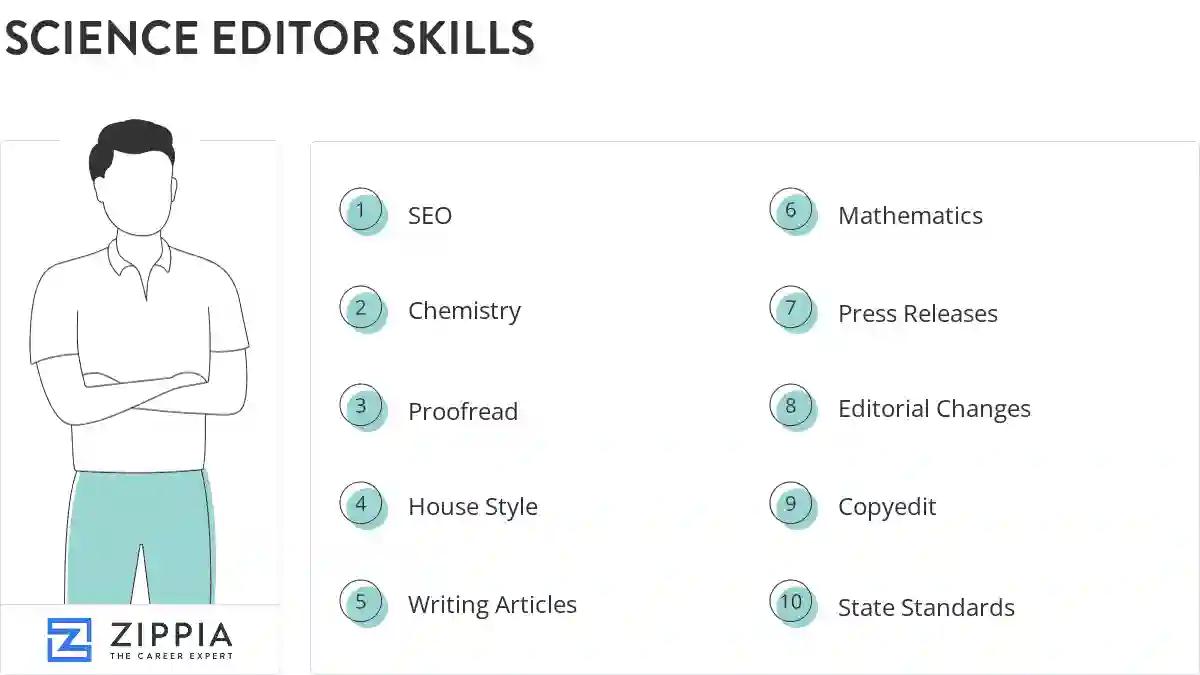
The most important skills for a science editor resume and required skills for a science editor to have include:
- SEO
- Chemistry
- Proofread
- House Style
- Writing Articles
- Mathematics
- Press Releases
- Editorial Changes
- Copyedit
- State Standards
Updated January 8, 2025
