
Automatically apply for jobs with Zippia
Upload your resume to get started.
Scientific programmer skills for your resume and career
15 scientific programmer skills for your resume and career
1. Python
Python is a widely-known programming language. It is an object-oriented and all-purpose, coding language that can be used for software development as well as web development.
- Designed and implemented novel clustering algorithms in C++ and Python for company's flagship chemical data analysis software.
- Applied Python, Unix Shell Script as daily tool for data collection, calculation and automation.
2. Visualization
- Designed and wrote C++, parallel VTK-based visualization application for studying tera-scale data.
- Designed visualization of inter modules communica- tions to display latency on anti jamming response.
3. Linux
Linux is a Unix-like operating system. Just like Windows, Mac OS, and IOS, Linux is an operating system used by millions across the globe. Android itself is powered by the Linux operating system. Linux manages all the hardware resources that are associated with your computer. The software is famous because of the protection it grants from viruses, malware, and crashes. The Linux operating system is entirely free and is an open-source software meaning it can be altered by those equipped with the knowledge to code.
- Help users in utilizing software packages installed on JCSDA Linux computing systems.
- Researched, designed and implemented 2D Tomography engine in C++ on the Linux platform under the Promax geophysical software system.
4. Software Development
Software development is the mechanism by which programmers create computer programs. The Software Development Life Cycle (SDLC) is a framework for developing applications that follow technological needs and consumer requirements. It consists of many stages. The SDLC establishes an international standard that software developers can use to enhance and create their programs. It provides a well-defined framework for software developers to pursue in the production, maintenance, and design of premium quality software. The aim of the software development process is to create high-quality software on time and within budget.
- Helped develop an Automated Software Development System that increased efficiency of the software development teams.
- Involved in complete software development life cycle including requirements, analysis, testing, and maintenance.
5. Java
Java is a widely-known programming language that was invented in 1995 and is owned by Oracle. It is a server-side language that was created to let app developers "write once, run anywhere". It is easy and simple to learn and use and is powerful, fast, and secure. This object-oriented programming language lets the code be reused that automatically lowers the development cost. Java is specially used for android apps, web and application servers, games, database connections, etc. This programming language is closely related to C++ making it easier for the users to switch between the two.
- Designed and implemented a user-friendly graphical Java application for editing response/susceptibility matrices stored in XML format.
- Implemented complex potential theory and source dissolution equations in Java.
6. C
- Designed/developed modules in C for parsing Link-11/16 radio messages on Singapore's Missile Corvette Boats.
- Developed and tested the application programs - all applications were written in C and FORTRAN.
7. C++
C++ is a general-purpose programming language that is used to create high-performing applications. It was invented as an extension to the C language. C++ lets the programmer have a high level of domination over memory and system resources. C++ is an object-oriented language that helps you implement real-time issues based on different data functions
- Analyzed application and debugged C++ code to identify problems and recommend solutions.
- Modified existing customer software written in C++ to provided feature enhancements.
8. Data Analysis
- Coded Logistic Regression Models for data analysis.
- Performed data analysis and statistics research
9. Database
A database is a collection of data and information which makes it easy to view, access, and manage. Databases save a lot of time and can store huge amounts of data. Databases make sorting data easier and stores it in certain fields which narrows the searching criteria. A database usually contains tables, graphs, and columns to display data.
- Performed system analysis, testing, and documentation of database process enhancements.
- Included a proprietary in-house relational database system.
10. JavaScript
- Designed and developed JavaScript and HTML code for scientific data file retrieval and download for the C/NOFS web site.
- Increased proficiencies in ESRI javascript API, Javascript and Jquery.
11. Fortran
Fortran is a programming language used for numeric and scientific computing. The general-purpose language was originally developed by IBM for scientific and engineering applications.
- Developed a FORTRAN code for generating convection ASCII text bulletins and verified that my bulletins are correct.
- Explored implementing CUDA GPU parallelism in a hybrid WENO-spectral hydrodynamic code written in FORTRAN.
12. Data Processing
Data processing refers to the manipulation and collection of data to generate meaningful information by a computer. It may include the transfer of raw data to a machine-legible form, managing the flow of data through the CPU or any memory to an output device, and conversion of output. Any utilization of computers to perform specific functions on data can be incorporated under data processing.
- Investigated data processing using CUDA for parallel processing.
- Performed data processing, managing and bioinformatics analysis.
13. SQL
- Managed developers and collaborated with developers in the Richardson, TX office to maintain and support CAD data using SQL RDBMS.
- Led development effort to port a dynamic website from PHP/MySQL to Microsoft .NET and MS SQL.
14. Unix
UNIX is a computer operating system that was first created in the 1960s and has been constantly updated since then. The operating system refers to the set of programs that enable a machine to function. It is a multi-user, multi-tasking device that works on computers, laptops, and servers. UNIX systems also have a graphical user interface (GUI), similar to Microsoft Windows, that makes it simple to use.
- Designed systolic architecture for the digital signal processing model and implemented it in the Unix environment.
- Provided S/W support on SUN workstation using Ada, OOD and UNIX.
15. Perl
A Practical Extraction and Report Language, or simply PERL, is a programming language used for a script intended for syntax. You can see this when a particular web programmer or a junior developer creates a script for servers. It is used to manipulate text and utilize tasks such as web development, programming, and system administration.
- Developed public web pages using HTML and Perl.
- Help script some of the in-house tools created using Perl & Bash.

What skills help Scientific Programmers find jobs?
Tell us what job you are looking for, we’ll show you what skills employers want.
What soft skills should all scientific programmers possess?
Jennifer Cramer
Associate Professor and Chair, University of Kentucky
What skills stand out on scientific programmer resumes?
Jennifer Cramer
Associate Professor and Chair, University of Kentucky
What scientific programmer skills would you recommend for someone trying to advance their career?
Nikyra Capson
Assistant Professor, Idaho State University
What type of skills will young scientific programmers need?
Aniket Bera
Assistant Research Professor, University of Maryland
List of scientific programmer skills to add to your resume
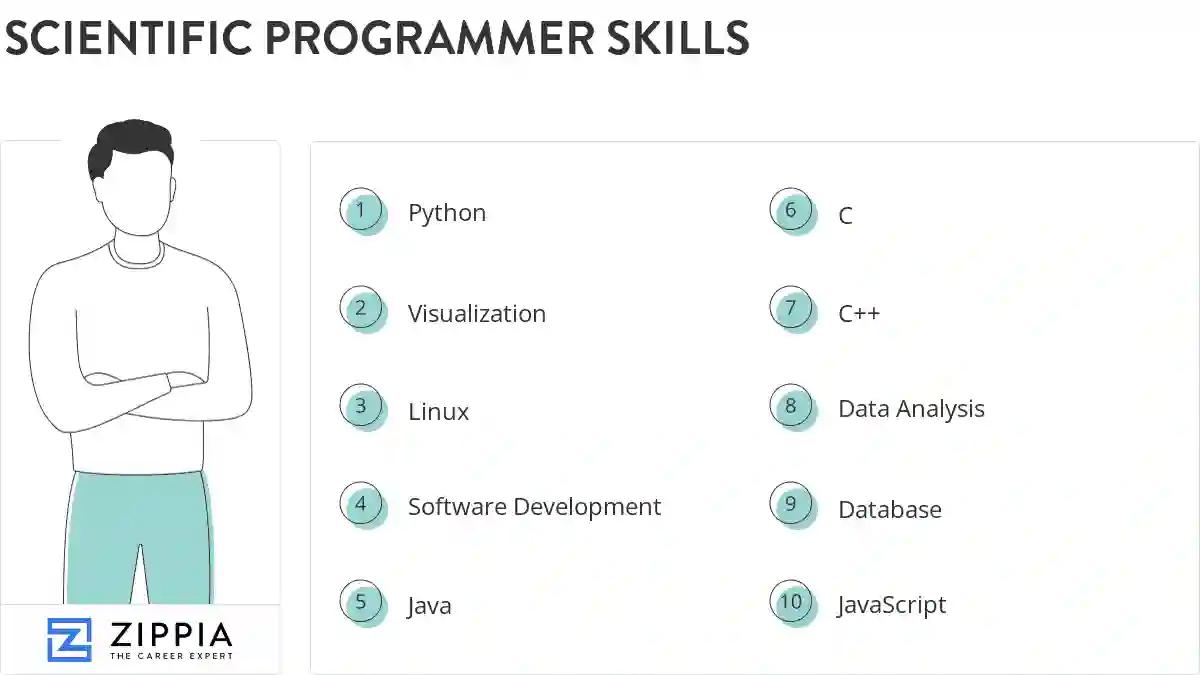
The most important skills for a scientific programmer resume and required skills for a scientific programmer to have include:
- Python
- Visualization
- Linux
- Software Development
- Java
- C
- C++
- Data Analysis
- Database
- JavaScript
- Fortran
- Data Processing
- SQL
- Unix
- Perl
- Regression
- Statistical Analysis
- PHP
- GIS
- NASA
- R
- User Interface
- Satellite Data
- XML
- HTML
- Clinical Trials
- FDA
- Test Procedures
- Windows
- Debugging
- Apache Tomcat
- Software Tools
- Supercomputers
- API
- GUI
- Aperture
- Control Systems
Updated January 8, 2025
