
Automatically apply for jobs with Zippia
Upload your resume to get started.
Second floor operator skills for your resume and career
15 second floor operator skills for your resume and career
1. Safety Rules
Principles or regulations that ensure the protection of people, objects, or the environment are called safety rules. These rules can be governing actions, devices, or procedures that help in minimizing the risks of loss, injury, or damage.
- Performed quality inspection Followed quality procedures and safety rules Made corrective actions Used forklift to transport finished product.
- Enforced safety rules and policies and provided assistance wherever needed.
2. Safety Procedures
Safety procedures are a set of standardized procedures, that ensures minimal to no risk to people, resources, and the work environment. A company follows the step-by-step safety procedures as it they not only keep the customers and the employees safe, but also help in avoiding legal claims.
- Performed safety checks to insure all safety procedures and policies were followed.
- Created or enhanced new and existing safety procedures to improve quality and safe operating practices in the manufacturing facility.
3. Machine Operators
Machine operators, also known as machinists, refer to workers responsible for various machines with specific functions. Their duties include setting up equipment, loading materials, and operating machinery. The machine operators also monitor and optimize their operations for efficiency.
- Assisted machine operators on the paper machine and general work around the mill as needed.
- Operate machinery used in the production process, or assist machine operators.
4. Safety Standards
- Filled proper materials while abiding by all safety standards.
- Operated mixing machine using company specifications and adhering to Food and Drug administration policies for sanitation and OHSA safety standards.
5. Production Schedules
The project plan of a film or a documentary that highlights how a production budget will be spent over a given period until its completion is called a production schedule. The scheduling process starts with writing and analyzing the script, which is then broken down to determine and allocate the budget for each scene. The production schedule also includes several elements of the film including; cast actors, special effects, wardrobe, special equipment, stunts, extras, silent bits, production equipment, and many others.
- Monitored and maintained accurate inventory by studying production schedule to determine material requirements, movements and deliveries.
- Planned and supplied material requirements by studying production schedule; scheduling deliveries to production area.
6. Control Room
A control room, also known as an operations center, is a room that serves as central control and monitoring station for security, building, and other types of systems of a large facility or physical area. Control rooms act as the central nervous system of a facility and require a reliable and efficient communication system to effectively handle emergencies, as well as critical incidents and decisions.
- Monitored pressure and temperature levels in the power plant control room.Paid close and accurate attention to operation details.
- Experience as control room operator, process operator and utilities operator.
Choose from 10+ customizable second floor operator resume templates
Build a professional second floor operator resume in minutes. Our AI resume writing assistant will guide you through every step of the process, and you can choose from 10+ resume templates to create your second floor operator resume.7. Production Equipment
Production equipment in limited terms is used to define any type of machinery or equipment used in the production of a video or film. Basic production equipment includes a camera, tripod, lighting kit, camera light, short term microphone, light reflector, boom pole, shock mount, audio cables, wireless microphone, headphones, portable digital audio recorder, camera lenses, extra batteries, external hard drive, and DSLR shoulder mount rig.
- Assembled, disassembled and sanitize the production operating equipment, monitor production equipment and weight product and complete all necessary documentation.
- Performed basic troubleshooting and minor repairs to ensure production equipment ran efficiently and finished product as necessary to facilitate proper flow
8. CNC
CNC stands for Computer Numerical Control. It is a subtractive manufacturing technique that usually uses computerized controls and machine tools to strip layers of material from a stock piece.
- Operated CNC lathes and millers.
- Operate CNC and other machines to make quality parts Inspect products for defects Final assemble and package to be sent to shipping
9. Customer Orders
- Verify weights on all packages for customer orders.
- Reviewed master production schedule and work orders, established priorities for specific customer orders and revised according to work order specifications.
10. Customer Specifications
A Customer Specification is a document that describes the general requirement of an expected service from a contractor. It outlines the key requirements of the customer. Customer specifications should be written in simple and general language so that the contractor clearly understands the expectations of the customer. It is also known as a User Specification.
- Operated Drais Flushers with supplied recipes to produce quality ink in accordance with customer specifications.
- Located and prepared orders for shipping according to customer specifications and regulations, maintained delivery data accurate and up to date.
11. Press Machine
- Operated punch press machinery also a certified forklift operator I also have material handling experience and shipping and receiving
- Performed troubleshooting and basic maintenance of stamp press machinery.
12. Computer System
- Pulled and filled prepared shipping orders using on-board computer system and scanners and prepared shipping documentation and labels.
- Inventory Cycle Counter - Responsibilities included counting inventory for inventory control and inputting inventory into the computer system.
13. Safety Regulations
- Assist contractors as needed and enforcement of safety regulations.
- Up keeping the job safety regulations PIC Group prides itself on.
14. Press Operation
- Assisted chief operator during press operation by performing color matching, supervising consumption quantities and monitoring print quality.
- Press operation - Production assembly line - Quality assurance
15. Leadership
- Exhibited leadership skills by managing co-worker assignments while simultaneously monitoring the skate floor
- Strengthened leadership skills during this time, as I was responsible for training and directing 3 Utility persons u nder me.
5 Second Floor Operator resume examples
Build a professional second floor operator resume in minutes. Browse through our resume examples to identify the best way to word your resume. Then choose from 5+ resume templates to create your second floor operator resume.

What skills help Second Floor Operators find jobs?
Tell us what job you are looking for, we’ll show you what skills employers want.
List of second floor operator skills to add to your resume
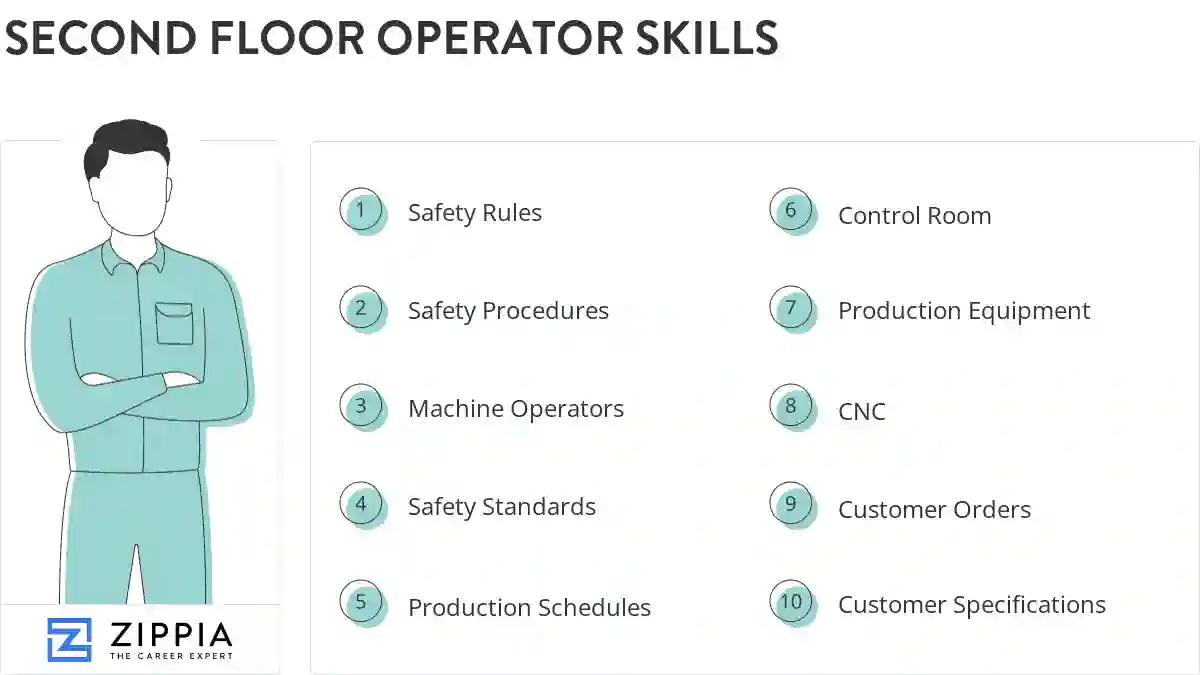
The most important skills for a second floor operator resume and required skills for a second floor operator to have include:
- Safety Rules
- Safety Procedures
- Machine Operators
- Safety Standards
- Production Schedules
- Control Room
- Production Equipment
- CNC
- Customer Orders
- Customer Specifications
- Press Machine
- Computer System
- Safety Regulations
- Press Operation
- Leadership
Updated January 8, 2025
