
Automatically apply for jobs with Zippia
Upload your resume to get started.
Security installation technician skills for your resume and career
15 security installation technician skills for your resume and career
1. Ladders
- Perform elevated work safely utilizing extension ladders and scissor lift equipment.
- Satellite TV installers must have good eyesight and hand dexterity, be able to climb ladders, and carry heavy equipment.
2. Troubleshoot
Troubleshooting is the process of analyzing and fixing any kind of problem in a system or a machine. Troubleshooting is the detailed yet quick search in the system for the main source of an issue and solving it.
- Service troubleshoot and install many different manufactures systems.
- install, troubleshoot, program and test fire alarm systems.
3. Equipment Installation
- Trained new employment on equipment installation and service.
- Provide customers with cost estimates for equipment installation.
4. Hand Tools
- Attached, fastened, and disconnected cables and lines to loaded and materials, using hand tools.
- Used hand tools i.e power drill, fishing wire, sawzall.
5. Security Installation
- Advanced through promotions from mobile and home audio/video/security installation tech to installation supervisor and floor manager.
6. Customer Service
Customer service is the process of offering assistance to all the current and potential customers -- answering questions, fixing problems, and providing excellent service. The main goal of customer service is to build a strong relationship with the customers so that they keep coming back for more business.
- Provided customer service during consultation meetings ensuring clients received all necessary surveillance equipment to satisfy their security needs.
- Provide excellent customer service and explained operation of systems.
Choose from 10+ customizable security installation technician resume templates
Build a professional security installation technician resume in minutes. Our AI resume writing assistant will guide you through every step of the process, and you can choose from 10+ resume templates to create your security installation technician resume.7. Plan Installations
- Plan installations by evaluating location, locating access and laying-out equipment and wiring plan.
- Plan installations by evaluating location and laying out wiring plan.
8. Control Systems
- Develop and design access control systems with security monitoring.
- Serviced/Installed access control systems in Federal Government sites.
9. Repair Security Systems
- Install and repair security systems for residential and commercial property
- Install or repair security systems, alarm devices, or related equipment, following blueprints of electrical layouts and building plans.
10. Control Panels
A control panel is a flat, enclosed unit, often the vertical part of a system in which the control or monitoring instruments are displayed and accessible to users. Control panels are typically closed-circuit boards with connections to all peripheral devices in their area. They can be found in factories to monitor and control machines or production lines and in places like nuclear power plants, ships, airplanes, and mainframe computers.
- Mount and fasten control panels, door and window contacts, sensors, or video cameras.
- Mounted control panels, wiring, and video cameras by following safety regulations.
11. Strong Customer Service
- Demonstrate strong customer service skills while representing the company during installations.
- Contributed to repeat and referral business by using strong customer service and problem solving skills.
12. Security Industry
- Install and terminate low voltage products and equipment used in the security industry.
- Attend voluntary classes to gain general knowledge of security industry.
13. Test Equipment
Test equipment is a mechanical tool or a device which is used create signals and gather response from an electronic device under test. It helps in detecting any faults in the device and it also proves the proper operation of the electronic device.
- Skilled veteran in using test equipment such as digital voltmeter, oscilloscopes wave form monitors, vectorscopes and spectrum analyzers.
- Diagnose faults or malfunctions to determine required repairs, using engine diagnostic equipment such as computerized test equipment and calibration devices.
14. Service Calls
- Maintain accurate inventory of equipment for installations and service calls.
- Provided follow-up and service calls as requested by customers.
15. Video Cameras
- Mounted and fastened access control panels, door and window contacts, sensors, or video cameras.
- Install and configure video cameras, microwave sensors, receivers, transmitters and audio/video systems.
5 Security Installation Technician resume examples
Build a professional security installation technician resume in minutes. Browse through our resume examples to identify the best way to word your resume. Then choose from 5+ resume templates to create your security installation technician resume.

What skills help Security Installation Technicians find jobs?
Tell us what job you are looking for, we’ll show you what skills employers want.
List of security installation technician skills to add to your resume
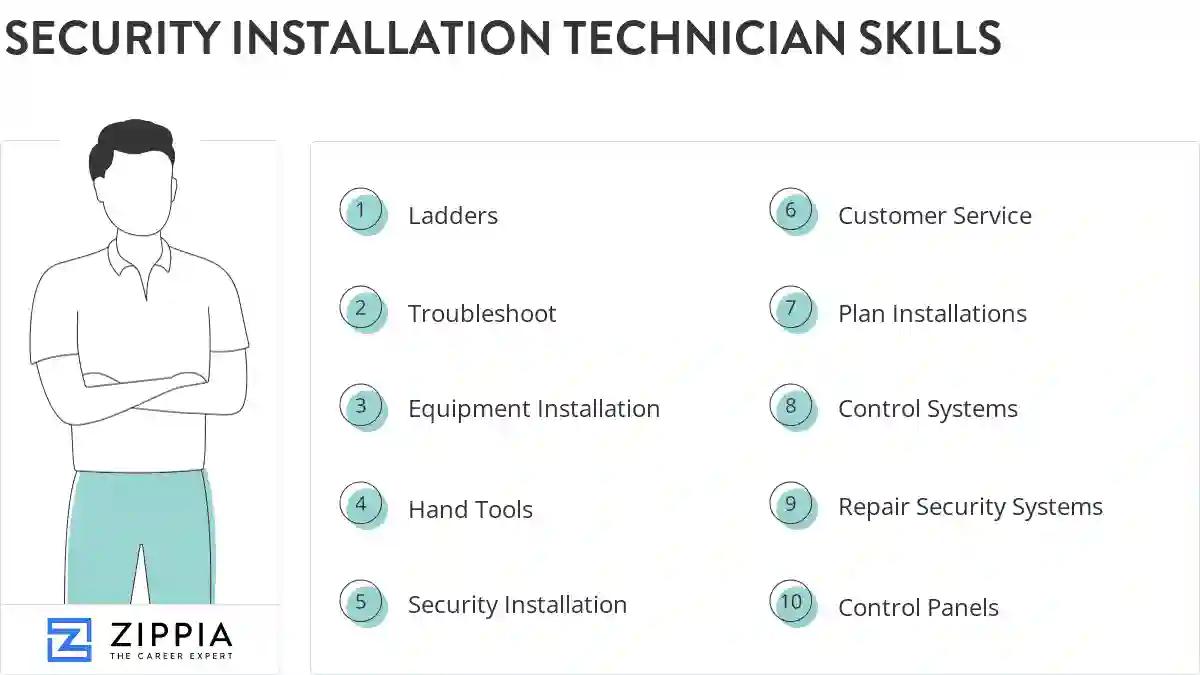
The most important skills for a security installation technician resume and required skills for a security installation technician to have include:
- Ladders
- Troubleshoot
- Equipment Installation
- Hand Tools
- Security Installation
- Customer Service
- Plan Installations
- Control Systems
- Repair Security Systems
- Control Panels
- Strong Customer Service
- Security Industry
- Test Equipment
- Service Calls
- Video Cameras
- Security Equipment
- Alarm Devices
- Cctv Cameras
- Installation Procedures
- Intercom Systems
- Camera Systems
- Switches
- Honeywell
- Electronic Security Systems
- DOD
- CAT5
- Alarm Panels
- CAT6
- Door Contacts
- Fire Alarm Systems
- System Specifications
- Laying-Out Equipment
- False Alarms
- Security Cameras
- DSC
- Structured Cabling
- Electrical Layouts
- Installation Sites
- ADT
- Card Readers
- Loose Connections
- RAN
- Security Devices
Updated January 8, 2025
