Explore jobs
Find specific jobs
Explore careers
Explore professions
Best companies
Explore companies
Job outlook for security operations managers in the United States
Security operations manager job growth summary. After extensive research, interviews, and analysis, Zippia's data science team found that:
The projected security operations manager job growth rate is 6% from 2018-2028.
About 189,200 new jobs for security operations managers are projected over the next decade.
Security operations manager salaries have increased 4% for security operations managers in the last 5 years.
There are over 10,503 security operations managers currently employed in the United States.
There are 274,437 active security operations manager job openings in the US.
The average security operations manager salary is $59,395.
Are security operations manager jobs in demand?
Security operations manager job and salary trends over time
Security operations manager jobs over time
Security operations manager job growth rate over time
| Year | # of jobs | % of population |
|---|---|---|
| 2021 | 10,503 | 0.00% |
| 2020 | 44,623 | 0.01% |
| 2019 | 46,518 | 0.01% |
| 2018 | 9,549 | 0.00% |
| 2017 | 8,911 | 0.00% |
Average security operations manager salary over time
Security operations manager salary by year
| Year | Avg. salary | Hourly rate | % Change |
|---|---|---|---|
| 2026 | $59,395 | $28.56 | +2.8% |
| 2025 | $57,751 | $27.76 | --0.1% |
| 2024 | $57,837 | $27.81 | +0.5% |
| 2023 | $57,539 | $27.66 | +1.1% |
| 2022 | $56,908 | $27.36 | +1.6% |
Security operations manager jobs by state
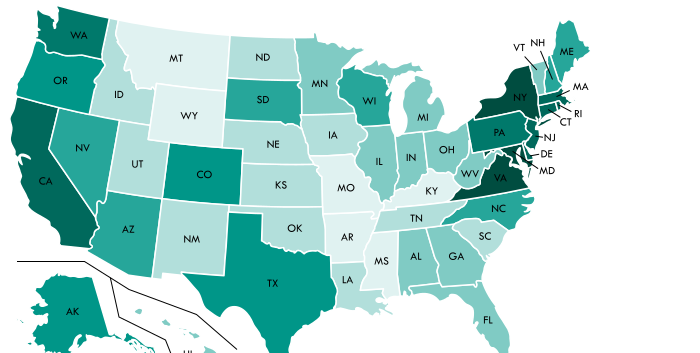
Most common states for security operations managers
| Rank | State | Population | # of jobs | Employment/ 1000ppl |
|---|---|---|---|---|
| 1 | District of Columbia | 693,972 | 368 | 53% |
| 2 | New Hampshire | 1,342,795 | 592 | 44% |
| 3 | Minnesota | 5,576,606 | 2,380 | 43% |
| 4 | North Dakota | 755,393 | 304 | 40% |
| 5 | Delaware | 961,939 | 363 | 38% |
| 6 | Alaska | 739,795 | 271 | 37% |
| 7 | Montana | 1,050,493 | 375 | 36% |
| 8 | North Carolina | 10,273,419 | 3,561 | 35% |
| 9 | Washington | 7,405,743 | 2,617 | 35% |
| 10 | Iowa | 3,145,711 | 1,097 | 35% |
| 11 | Nebraska | 1,920,076 | 666 | 35% |
| 12 | Rhode Island | 1,059,639 | 370 | 35% |
| 13 | Pennsylvania | 12,805,537 | 4,403 | 34% |
| 14 | Georgia | 10,429,379 | 3,447 | 33% |
| 15 | Indiana | 6,666,818 | 2,198 | 33% |
| 16 | South Dakota | 869,666 | 284 | 33% |
| 17 | Wyoming | 579,315 | 193 | 33% |
| 18 | Kansas | 2,913,123 | 906 | 31% |
| 19 | Maine | 1,335,907 | 397 | 30% |
| 20 | Wisconsin | 5,795,483 | 1,686 | 29% |
Most common cities for security operations managers
| Rank | City | # of jobs | Employment/ 1000ppl | Avg. salary |
|---|---|---|---|---|
| 1 | Pensacola | 3 | 6% | $51,087 |
| 2 | Diamond Bar | 2 | 4% | $79,732 |
| 3 | Atlanta | 5 | 1% | $50,475 |
| 4 | Baltimore | 4 | 1% | $86,465 |
| 5 | Detroit | 4 | 1% | $56,965 |
| 6 | Arlington | 3 | 1% | $94,950 |
| 7 | Kansas City | 3 | 1% | $42,795 |
| 8 | Miami | 3 | 1% | $52,229 |
| 9 | Tampa | 3 | 1% | $51,525 |
| 10 | Los Angeles | 7 | 0% | $80,412 |
| 11 | New York | 7 | 0% | $86,691 |
| 12 | Chicago | 6 | 0% | $52,735 |
| 13 | Phoenix | 4 | 0% | $63,847 |
| 14 | Boston | 3 | 0% | $82,807 |
| 15 | Jacksonville | 3 | 0% | $49,559 |
| 16 | San Diego | 3 | 0% | $75,646 |
| 17 | San Francisco | 3 | 0% | $85,370 |
| 18 | Washington | 3 | 0% | $90,777 |
| 19 | Denver | 2 | 0% | $69,022 |
Security Operations Manager job outlook: Expert opinions
Our panel of security operations manager experts
Susquehanna University
University of Alaska Fairbanks

Manhattan College

Sacred Heart University

Pepperdine University, Seaver College

Sam Houston State University

The City College of New York
Belmont University

Goldey-Beacom College

Sonoma State University

Centenary College of Louisiana

University of Arkansas at Little Rock
Lauren Smith
Lecturer of Management & MarketingSusquehanna University
Business Administration, Management And Operations
What general advice would you give to a Security Operations Manager?
Lauren Smith: Lauren Smith advises graduates to actively engage in a dual pursuit of entrepreneurship and traditional corporate roles, emphasizing the importance of gaining diverse experiences.
What Security Operations Manager skills would you recommend for someone trying to advance their career?
Jaunelle Celaire: Never stop learning! This may consist of going back to school, earning new certifications in your field of study, attending conferences and seminars, and making sure that your time management is always at its finest level of excellence.
What technical skills for a Security Operations Manager stand out to employers?
Dr. John Leylegian Ph.D.: I think almost any graduate will finish school with the same skill set in terms of technical knowledge. What can stand out is an ability to code and use various professional-grade software packages - the actual programming languages and software packages are secondary. If you can code in VBA, moving to Matlab or Python is not a big deal - it's just a matter of syntax. If you can use one CFD code or one FEA code, others will be much easier to learn. The foundation will be attractive to employers. Of course, the non-technical skills are SO important as well, most notably communication (speaking and writing).
What technical skills for a Security Operations Manager stand out to employers?
Keith Hassell: Employers are increasingly looking for applied skillsets and additional certifications to set a candidate apart. Sacred Heart University has recently launched a remote work certification, which houses three modules - focusing on the remote worker, the remote team and the remote leader, providing the tools and resources to comfortably leverage and utilize virtual platforms at various organizations. Additional specialized training, certifications and more are great selling tools pending on the specific area of interest. Certifications are common in areas such as project management, sales, IT/network/software, Google application and more. The candidate needs to think, "What can I do that is beyond my coursework to show I am passionate about my field? How do I make myself stand out?" Certifications is an attainable way to do this.
In addition, soft skills continue to be equally important in today's job market. NACE (the National Association of Colleges and Employers) identified seven core competencies that employers seek from entry level candidates which include critical thinking/problem solving, oral/written communication, teamwork/collaboration, digital technology, leadership, professionalism/work ethic, career management and global/intercultural fluency.
Will there be an enduring impact of the coronavirus pandemic on Security Operations Managers?
Steven Bauer: The coronavirus has accelerated the transformation to a digital world, and this effect will continue after the pandemic is behind us. Graduates will need to be able to navigate a hybrid business environment, with in-person and virtual meetings, interactions and platforms. There will also be increased opportunities to be entrepreneurial and innovative in the digital area. In addition, graduates will have to become more skilled at navigating a global environment since greater digitization will draw countries closer to each other.
Carliss Miller Ph.D.
Assistant Professor of ManagementSam Houston State University
Department of Management & Marketing
What are the biggest trends we'll see in the Security Operations Manager job market given the pandemic?
Carliss Miller Ph.D.: Flexible working arrangements were considered a perk or benefit, but given the pandemic more and more jobs will be designed with flexible work arrangements in mind. We will continue to see trends in the labor market with a push towards personal services (e.g. virtual assistants, professional organizers) and professional services. There will also continue to be a demand for knowledge work. More and more, employers are looking to hire applicants that can provide concrete evidence of being "Day 1" ready.
Employers will focus more on identifying prospects with certain "soft skills" which were a nice-to-have pre-pandemic, but are now critical for organizational survival. These skills include: critical thinking, agility, ability to adapt to change, resilience, virtual team effectiveness, crisis management, emotional intelligence, empathy, and inclusive leadership. Additionally, data analysis and interpretation is a highly sought after skill even for jobs that historically did not require analytical ability.
What type of skills will young Security Operations Managers need?
Prabal Kumar De Ph.D.: I think the necessary skills remain the same. One modification that would stay is greater virtual engagement. Therefore, newly essential skills such as acing a virtual interview, making a mark during a Zoom meeting, or managing or being a valuable part of a remote working group would be useful long after the immediate threats from the COVID-19 crisis be gone.
Nina Woodard
Senior Career Development SpecialistBelmont University
Office of Career & Professional Development
What are the biggest trends we'll see in the Security Operations Manager job market given the pandemic?
Nina Woodard: The pandemic hasn't impacted all areas of the entertainment industry in the same way. Anything related to live events and touring has been placed on an extended pause, which has been very difficult for graduates hoping to work in those fields. On an encouraging note, consumers will always find a way back to live experiences, so that segment of the industry will absolutely recover; the timing is just still a bit unknown. Other areas such as record or publishing companies have held steady. And, digital marketing and content creation companies are as busy, if not busier, than they've ever been as artists seek alternative ways to stay connected to their fans. Technology has intersected with entertainment in exciting, creative ways that will continue even as some of the more traditional avenues become available again. For many companies, ideas that started as pivots are now vibrant components of their long-term strategies.
The way we work may have also permanently changed. Companies have realized that remote working is a truly viable option for most businesses. While maintaining company culture, and the social nature of an entertainment-based organization, may still require some level of in-person interaction, it seems likely that many organizations may continue with remote/hybrid office models.
What Security Operations Manager skills would you recommend for someone trying to advance their career?
Nina Woodard: For entertainment, digital marketing and content creation skills are critical. Even if a role isn't specifically connected to digital marketing, social media is almost always involved in most entry-level roles. We strongly encourage students and recent graduates to learn basic graphic design platforms, video editing and audio editing. Learning how to maximize impact on social media platforms such as YouTube, Instagram or TikTok is also a worthy investment of time. There's a wide range of self-paced training resources online, many available for free or at reduced costs for students.
What general advice would you give to a Security Operations Manager?
Nina Woodard: Any job search strategy comes down to a combination of education, experience and relationships. Many students and graduates have mistakenly believed that that gaining experience or networking isn't an option during this season, but that's simply not the case. We encourage our job seekers to build their strategy and then identify ways to translate certain elements into the virtual realm. Most companies are now offering remote internships, which allows students to explore options without physical limitations. We've also found industry professionals to be extremely accessible and willing to connect with students/recent grads for a quick Zoom chat or phone call. Anyone working in entertainment is there because someone helped them along the way. Most people are genuinely eager to repay that favor by investing in others just beginning the professional journey.
Will there be an enduring impact of the coronavirus pandemic on Security Operations Managers?
Dr. Nicole Evans: The full impact of the coronavirus pandemic is not yet known. Some industries have been hit harder than others. For example, demand for courier and logistic services has increased during the pandemic. On the other hand, sales in the hospitality industry have declined. On a positive note, young graduates are very adaptable and are just beginning their careers. They are very flexible and have numerous career options, so the impact will probably not be enduring and long term for them.
Craig Nathanson Ph.D.
Adjunct LecturerSonoma State University
School of Business & Economics
What experience really stands out on Security Operations Manager resumes?
Craig Nathanson Ph.D.: Most important on resumes to only show accomplishments you are proud of and reflect measurable success and completion of past work. These accomplishments should be a snapshot of what we have done and can do in the future. The most important two lines of a resume are in the objectives, to list what the person is seeking. These two lines give the reader a quick view of what the person wants.
Now is a great time to start the new year to build a portable work portfolio to represent an alignment of what a person is excited about and enjoys in their work.
What type of skills will young Security Operations Managers need?
Craig Nathanson Ph.D.: I see the essential human skills gaining importance to build a new post-covid work life. These include creativity, leading and working in teams, writing, speaking, being self-aware, and lowering bias and networking; career branding as critical areas for graduates to focus on now.
Dr. Barbara Davis
William J. Atkins DeanCentenary College of Louisiana
Frost School of Business
What experience really stands out on Security Operations Manager resumes?
Dr. Barbara Davis: Graduates participating in internships related to their areas of interest. Internships spanning more than one semester at the same firm stand out as well.
What skills stand out on Security Operations Manager resumes?
Dr. Timothy Edwards: Writing and research skills. Analytical and critical thinking skills. Technical skills such as web design, graphic design, audio and video production skills. Employers are interested in potential employees knowledge, intelligence and skills.