
Automatically apply for jobs with Zippia
Upload your resume to get started.
Security systems administrator skills for your resume and career
15 security systems administrator skills for your resume and career
1. Security Systems
A security system refers to any device that can perform security operations such as surveillance, access control, alarm, or intrusion control in a facility or area through a system of components and multifunctional devices designed to protect people and the property against a variety of hazards including crime, arson, accidents, espionage, sabotage, subversion, and attack. A security system also detects several other threats, including smoke, carbon monoxide poisoning, and water damage.
- Experience developing and implementing policies and procedures for customer service center operations supporting ID card operations and technical security systems.
- Ordered security systems and monitored installation, assessed system malfunctions, and provided remediation.
2. Troubleshoot
Troubleshooting is the process of analyzing and fixing any kind of problem in a system or a machine. Troubleshooting is the detailed yet quick search in the system for the main source of an issue and solving it.
- Communicated with all departments within the company to troubleshoot external and internal customer service issues and provide innovative solutions.
- Administer, maintain and troubleshoot Active Directory related issues including replication.
3. Linux
Linux is a Unix-like operating system. Just like Windows, Mac OS, and IOS, Linux is an operating system used by millions across the globe. Android itself is powered by the Linux operating system. Linux manages all the hardware resources that are associated with your computer. The software is famous because of the protection it grants from viruses, malware, and crashes. The Linux operating system is entirely free and is an open-source software meaning it can be altered by those equipped with the knowledge to code.
- Install new and rebuild existing RCVS application servers on the Red Hat Linux platform.
- Worked in Linux and Bash programming for system administration of our in-house server.
4. DOD
Definition of Done (DoD) is a set of deliverables that are needed to devise software. These deliverables are valuable to the system and can be exemplified by writing code, coding comments, unit testing, integration testing, design documents, release notes, and so on.
- Provide DOD approved vulnerability scanning and automated remediation using Retina and Hercules.
- Designed and implemented security architecture for 150 DOD controlled computer systems.
5. Database
A database is a collection of data and information which makes it easy to view, access, and manage. Databases save a lot of time and can store huge amounts of data. Databases make sorting data easier and stores it in certain fields which narrows the searching criteria. A database usually contains tables, graphs, and columns to display data.
- Maintained secure accurate up-to-date database of software and hardware inventory and made recommendations for upgrades to contractors.
- Updated the inventory asset database with accurate records to enable better production decision making.
6. Windows Server
- Administer Windows servers ensuring system performance, reliability, availability and integrity.
- Secured and administered Windows Server and Windows XP/Vista environment within the brigade.
Choose from 10+ customizable security systems administrator resume templates
Build a professional security systems administrator resume in minutes. Our AI resume writing assistant will guide you through every step of the process, and you can choose from 10+ resume templates to create your security systems administrator resume.7. IDS
An IDS (intrusion detection system) stands for a software application or device that monitors a network to identify policy violations or malicious activities.
- Provided Administration support on Lotus Notes 7 Domino Server setup users Notes IDs for users.
- Installed and disabled User IDs, reset passwords, and updated access.
8. Network Security
- Perform IT security-related tasks reviewing web server audit logs for intrusion attempts and utilize network security tools to identify potential weaknesses.
- Administrated McAfee Network Security Manager: reviewed alerts, identified and recorded security breaches, followed set procedures for escalation.
9. VMware
- Created environments for production, testing and development using VMware.3
- Install and manage VMware server on Dell PowerEdge servers to test web applications on Windows 2000 OS.
10. Computer System
- Administer Active Directory duties through group policy, security policy, domains, users, and computer systems.
- Contributed towards the development of computer systems and storage system architectures for research and end user needs.
11. OS
In technical terms, OS stands for "Operating System". It is a software that is used to run programs on the computer. An operating system acts as a link between the user and the hardware components. Windows, macOS, iOS, Linux are examples of an operating system.
- Managed automated security and functional OS and application patches.
- Assist students, faculty and staff with hardware, software, and OS problems.
12. Security Policies
- Provide guidance and clarification regarding organizational security policies & protocols, helping evangelize security awareness throughout all internal customer interactions.
- Identified potential risk, monitored activity, secured network environments, and enforced security policies and procedures.
13. DNS
Domain Name Systems, or DNS for short, is the internet's system for converting readable language, i.e., google.com, to machine language, i.e, 192.168. For a simple analogy, some call it the phonebook of the internet. Any website has its own IP address, for example, 192.168.160. Understandably this is hard to remember. So what a DNS does is link the domain name, google.com, with its IP address, 192.168.160.
- Administered Radius servers, mail servers, DNS servers, real audio/video servers, accounting server and news server.
- Maintained Active Directory environment with Server 2008 R2, including group policy administration, DHCP, and DNS configuration.
14. SCCM
- Design, deploy, and provide operational support for 2012 SCCM environment - including migration from previous 2007 environment.
- Developed process to manually push patches with software developed by fellow administrator when SCCM went down.
15. Incident Response
Incident response is defined as the process by which a company or organization handles a cyber attack or a data breach. Along with dealing with the initial attack, this also deals with the possible consequences of the breach. The goal of incident response is to limit the damage caused by the attack.
- Execute Incident Response measures to efficiently identify, categorize, contain, and eradicate security incidents.
- Supervised tests and data recovery processes in coordination with incident response team.
5 Security Systems Administrator resume examples
Build a professional security systems administrator resume in minutes. Browse through our resume examples to identify the best way to word your resume. Then choose from 5+ resume templates to create your security systems administrator resume.

What skills help Security Systems Administrators find jobs?
Tell us what job you are looking for, we’ll show you what skills employers want.
What skills stand out on security systems administrator resumes?
Austin McCoy
Director of Javelina Engineering Student Success Center, Texas A&M University - Kingsville
-Internship/co-op experience -Research experience
-Good leadership skills and involvement on campus and in the community and activities where the individual works as part of a team.
-Well written resume can tell a lot about the technical writing skill; a resume needs to be clean and comfortable to read; recruiters can find what they are looking for easily.
-Less is sometimes more because students sometimes will put more information on a resume than is pertinent to the position applying for.
What soft skills should all security systems administrators possess?
David Garaventa
Director, Computer Information Systems and Cybersecurity Programs, Assistant Professor, CIS, Albertus Magnus College
This is not to say that technical skills don't matter, because they do, especially in the IT field. But suppose an employee brings a strong set of soft skills to an IT team (e.g., collaboration, communication, critical thinking, etc.). In that case, they probably also can learn more technical skills as part of their job function. I once had a colleague say to me that when she is hiring, she has found that technical skill is all over the place...but it's the soft skills that are harder to find. Lastly, having the ability - and a desire - to be continually learning is essential. Technology is not static, and businesses are not static, so thinking critically in different settings across various technology platforms is very important. The tools your department uses today may not be the tools they are using tomorrow, so being fluid, adaptable, and constantly learning is the name of the game.
What hard/technical skills are most important for security systems administrators?
David Garaventa
Director, Computer Information Systems and Cybersecurity Programs, Assistant Professor, CIS, Albertus Magnus College
Going deeper into the subject, technical skills around project management, cloud infrastructure, security, and end-user support bridge across all industries. Having knowledge and skills in these areas will serve IT professionals well, no matter what field or industry they end up in. Again, it is challenging to recommend specific technical skills because the field of IT is so broad.
What security systems administrator skills would you recommend for someone trying to advance their career?
Dr. Ariful Azad Ph.D.
Director of Graduate Studies for the Dept. of Intelligent Systems Engineering, Assistant Professor of Intelligent Systems Engineering, Indiana University Bloomington
What type of skills will young security systems administrators need?
Vince Bowen
Executive Director, Department Chair Energy Systems Technology & Education Center (ESTEC), Idaho State University
List of security systems administrator skills to add to your resume
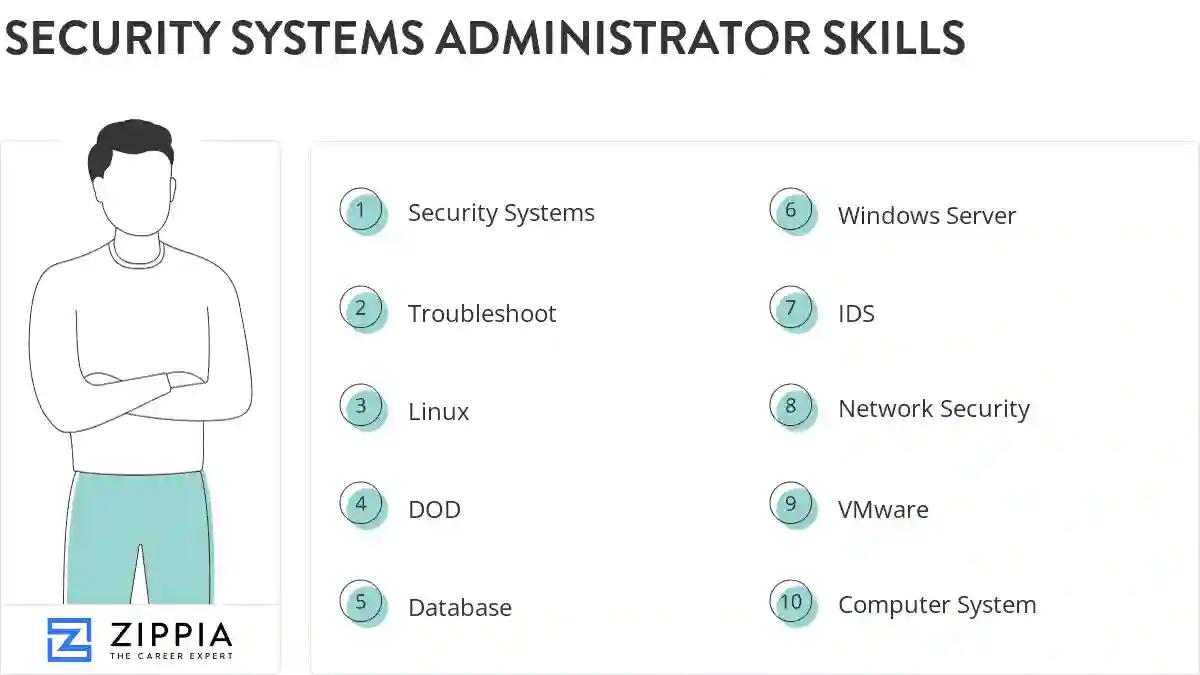
The most important skills for a security systems administrator resume and required skills for a security systems administrator to have include:
- Security Systems
- Troubleshoot
- Linux
- DOD
- Database
- Windows Server
- IDS
- Network Security
- VMware
- Computer System
- OS
- Security Policies
- DNS
- SCCM
- Incident Response
- Unix
- Intrusion Detection
- Switches
- Tcp Ip
- Management System
- Nessus
- Security Incidents
- Technical Support
- LAN
- TCP/IP
- User Accounts
- DHCP
- Lenel
- Workstations
- Physical Security
- SAN
- SQL Server
- Data Loss Prevention
- HBSS
- Disaster Recovery
- System Performance
- Virtualization
- VPN
- Provisioning
- PKI
- Encryption
- McAfee
- PC
- GPO
- CCTV
- Red Hat
- National Security
- Security Administration
- SharePoint
Updated January 8, 2025
