
Automatically apply for jobs with Zippia
Upload your resume to get started.
Senior associate scientist skills for your resume and career
15 senior associate scientist skills for your resume and career
1. Data Analysis
- Worked simultaneously on multiple projects, performed data analysis and generated detailed reports.
- Conducted statistical data analysis and defined new assay parameter.
2. Chemistry
Chemistry is the branch of science that tells us about the composition, properties, and structure of elements and compounds. The processes these elements undergo and how they undergo change all come under the branch of chemistry.
- Provided medicinal chemistry support in the therapeutic areas of diabetes (insulin secretion and insulin sensitivity) and oncology.
- Implement the use of personal computers with electronic data collection/analysis for product development in the Chemistry Department.
3. Cell Culture
- Collaborate with Bios Pilot Plants to develop technical transfer protocols of cell culture media/buffers used for Cell Banking campaigns.
- Trained over 5 laboratory personnel in cell culture, RNA isolation from cells, and RT-PCR.
4. CRISPR
- Created ion channel protein knockout T cell line by using CRISPR technology.
- Use CRISPR technology to create target knockout cell line.
5. Flow Cytometry
Flow cytometry (FC) is a procedure used to recognize and gauge the physical and compound attributes of a populace of cells or particles. In this cycle, an example containing cells or particles is suspended in a liquid and infused into the stream cytometer instrument. Stream cytometry is a research center technique used to recognize, distinguish, and check explicit cells. This technique can likewise distinguish specific parts inside cells. This data depends on actual attributes and additionally markers called antigens on the phone surface or inside cells that are special to that phone type.
- Tested meningococcal strains by flow cytometry for surface expression of factor H binding protein.
- Used tri-color flow cytometry to assay pluripotency.
6. Oncology
Oncology is defined as the facet of medicine that deals with cancer. Oncology also deals with the prevention and diagnosis of these diseases. A medical professional who has studied the discipline of oncology is referred to as an ‘oncologist'. An oncologist can further specialize in their discipline and become a medical oncologist, surgical oncologist, or radiation oncologist.
- Designed, synthesized, purified, and characterized small molecule drug candidates for evaluation against oncology and antibacterial targets.
- Coordinated and effectively communicated with members of the Oncology Therapeutic Area to facilitate progress of programs.
Choose from 10+ customizable senior associate scientist resume templates
Build a professional senior associate scientist resume in minutes. Our AI resume writing assistant will guide you through every step of the process, and you can choose from 10+ resume templates to create your senior associate scientist resume.7. Molecular Biology
- Performed molecular biology techniques including western blot and Elisa.
- Played a key role in managing the all aspect of molecular biology and tissue culture work in the lab.
8. Cell-Based Assays
- Experienced in proficiently executing cell-based assays using FLIPR.
- Develop in vitro cell-based assays for assessing therapeutics for cardiometabolic disease.
9. Extraction
- Presented results using Microsoft Excel, Word and other proprietary data extraction programs
- Experienced in a variety of sample preparation techniques and extraction methods such as LLE, SLE and SPE.
10. Elisa
An enzyme-linked immunosorbent assay or ELISA is an examination or test to measure and detect a person's specific antigen, antibodies, and protein. This type of test will identify if the sample component is infected with a relative disease or condition such as HIV infection, anemia, Zika Virus, and Lyme disease with just a single experiment.
- Performed experiments for bridging of new lots of key/critical reagents such as detector antibodies for use in ELISA.
- Implemented a whole blood/serum/plasma based PK ELISA to address discrepancies in mouse PK data.
11. GMP
GMP stands for Good Manufacturing Practice. It is a system that ensures that all products like food, beverages, and medicinal drugs that are produced comply with the quality standards. It helps in minimizing the risks and hazards that cannot be eliminated after the testing of final products.
- Support upstream large-scale GMP manufacturing as development liaison.
- Assisted in the review and approval of GMP documents such as SOP's and associated forms and initiate revisions.
12. Assay Development
Assay development is a process in molecular biology to test or measure the activity of a drug or biochemical substance in an organic sample or organism and to screen putative compounds to determine the interaction and/or modification of the target. The aim is to standardize the assay and to be able to use it repeatedly and reproducibly.
- Target identification and validation assay development for osteoporosis and other therapeutic areas.
- Trained new interns/staff, and wrote up assay development outcome reports as well as respective protocols.
13. Drug Discovery
Drug Discovery, in the scientific fields of medicine and pharmacology, refers to the exploration and discovery of new and effective medicinal substances and compounds, most usually through years of dedicated research and a large number of studies, conducted tests, and revisions.
- Performed early research and development for cardiovascular and metabolic disease drug discovery.
- Drug Discovery - Supervised project group and led target validation, compound screening and characterization efforts in new drug discovery projects.
14. RNA
A Ribonucleic acid (RNA) has a vital role in determining the biological macromolecule commonly found in all bodily cells. It is the synthesis of protein, carriers message instruction from the Deoxyribonucleic acid or DNA. RNA is a kind of single-stranded cell that has different forms. It allows the molecule to go back and forth to its original condition.
- Cultured primary (rat) and stem cell-derived neurons and extracted RNA.
- Optimized procedures to extract RNA from bone taken from surgical procedures.
15. Technical Reports
Technical reports are a type of document that is used to indicate either the progress, result, or process of scientific research or the state of problems occurring within such research. A technical report may also showcase the report's overall conclusion and may also include recommendations. This kind of report does not require a peer review and isn't published officially but distributed within the organizations where it was formed.
- Documented development and research efforts in technical reports.
- Composed and presented technical reports, project summaries, and product transfer documents containing quantitative analysis of complex data sets.
5 Senior Associate Scientist resume examples
Build a professional senior associate scientist resume in minutes. Browse through our resume examples to identify the best way to word your resume. Then choose from 5+ resume templates to create your senior associate scientist resume.

What skills help Senior Associate Scientists find jobs?
Tell us what job you are looking for, we’ll show you what skills employers want.
What soft skills should all senior associate scientists possess?
Alexandra (Sasha) Ormond Ph.D.
Associate Professor of Chemistry, Director of Dual Degree Engineering, Meredith College
What skills stand out on senior associate scientist resumes?
Alexandra (Sasha) Ormond Ph.D.
Associate Professor of Chemistry, Director of Dual Degree Engineering, Meredith College
What hard/technical skills are most important for senior associate scientists?
Alexandra (Sasha) Ormond Ph.D.
Associate Professor of Chemistry, Director of Dual Degree Engineering, Meredith College
What senior associate scientist skills would you recommend for someone trying to advance their career?
Nicole Browning Ph.D.
Associate Professor of Biology, Biology Coordinator, Brenau University
What type of skills will young senior associate scientists need?
Dr. Douglas Capone Ph.D.
Professor, University of Southern California
What technical skills for a senior associate scientist stand out to employers?
Dr. Joey Neilsen
Assistant Professor, Villanova University
List of senior associate scientist skills to add to your resume
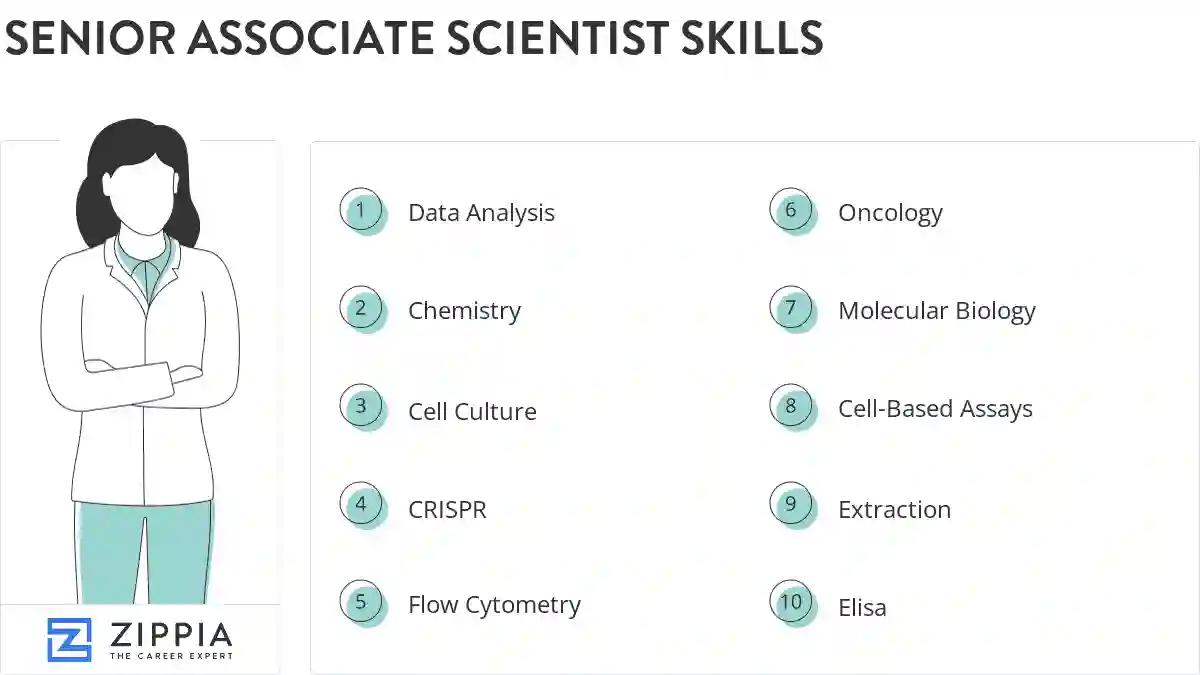
The most important skills for a senior associate scientist resume and required skills for a senior associate scientist to have include:
- Data Analysis
- Chemistry
- Cell Culture
- CRISPR
- Flow Cytometry
- Oncology
- Molecular Biology
- Cell-Based Assays
- Extraction
- Elisa
- GMP
- Assay Development
- Drug Discovery
- RNA
- Technical Reports
- Graphpad Prism
- Experimental Design
- QC
- Western Blotting
- Laboratory Equipment
- HPLC
- Cell Lines
- Animal Handling
- Clinical Trials
- GLP
- Lims
- Blot
- Technical Support
- Experimental Data
- Visualization
- DNA
- Pharmaceutical Industry
- Early Development
- Next-Generation Sequencing
- Drug Candidates
- UV
- Drug Products
- IND
- Harvest
- R
- Biomarkers
- FACS
- RT-PCR
- Profiling
- Analytical Method Development
- FDA
- NMR
- SDS-PAGE
- IV
- API
Updated January 8, 2025
