
Automatically apply for jobs with Zippia
Upload your resume to get started.
Senior deployment engineer skills for your resume and career
15 senior deployment engineer skills for your resume and career
1. Azure
- Implemented high availability with Azure Classic and Azure Resource Manager deployment models.
- Developed an Azure based high performance compute environment to support the massive computational requirements of client congressional redistricting Azure application.
2. Cloud
Cloud is a server that is accessed over the internet. There are different programs and software that also run on these servers. These clouds can be accessed from anywhere in the world as they are not present in your computer storage, but have their online servers. Cloud consists of data centers all across the world.
- Supported Object Storage environments which delivered distributed and decentralized Cloud Storage, Secure Backup, Disaster Recovery and Storage-as-a-Service solutions.
- Implemented automation and integration for cloud and system infrastructure solutions using Puppet and Chef.
3. Java
Java is a widely-known programming language that was invented in 1995 and is owned by Oracle. It is a server-side language that was created to let app developers "write once, run anywhere". It is easy and simple to learn and use and is powerful, fast, and secure. This object-oriented programming language lets the code be reused that automatically lowers the development cost. Java is specially used for android apps, web and application servers, games, database connections, etc. This programming language is closely related to C++ making it easier for the users to switch between the two.
- Transformed usability designs into actionable development specifications and test plans for UI fundamentals, Java widgets and operator-specific cell phone applications.
- Deployed Java/J2EE applications to Application servers in an Agile continuous integration environment and also automated the whole process.
4. Linux
Linux is a Unix-like operating system. Just like Windows, Mac OS, and IOS, Linux is an operating system used by millions across the globe. Android itself is powered by the Linux operating system. Linux manages all the hardware resources that are associated with your computer. The software is famous because of the protection it grants from viruses, malware, and crashes. The Linux operating system is entirely free and is an open-source software meaning it can be altered by those equipped with the knowledge to code.
- Supported the workflows for HPUX's Ignite, AIX's NIM, Solaris' Wan boot and Linux's VMWare.
- Installed and configured WebLogic and Apache Tomcat application servers running on Red Hat Enterprise Linux in a clustered/non-clustered environment.
5. Bash
The Bourne- Again Shell, or simply BASH, is commonly known as a default command interpreter of Linux and GNU systems.
- Developed automation and deployment utilities using Ruby and Bash.
- Automated major deployment tasks using bash scripts and programming procedures before Puppet infrastructure hitting on Live.
6. Jenkins
Jenkins is an open source automation server that is free to use. It aids continuous deployment and execution by automating the aspects of product creation related to building, analyzing, and deploying. It is a system based on the server that runs in servlet containers like Apache Tomcat. Jenkins is a Java-based fully accessible automation platform with plugins designed for Continuous Integration.
- Configured backup strategies and installing required plugins in Jenkins.
- Set up and configured Jenkins as build server for enterprise projects and installed required plugins in Jenkins.
7. IP
An IP - Internet Protocol is a unique number assigned to all devices connected to information technology, such as printers, routers, modems, etc. Each device or domain that connects to the Internet is assigned an IP address, and as packets are directed to the IP address attached to them, the data goes where it is needed. IP addresses are the identifier used to send information between devices on a network. They contain location information and make devices accessible for communication.
- Formed the only and main deployment department for the Intellectual Property (IP).
- Performed in depth site surveys which included current configuration of switches IP addressing etc.
8. Open Source
- Lead all maintenance and updating of hardware and software of the standalone open source collection system.
- Experience installation of hardware and software of the standalone open source collection system.
9. Provisioning
- Reviewed power provisioning & identified required materials for installs.
- Support customers of company engineered broadband software/hardware, including CMTS, CM, and provisioning software.
10. Maven
Apache Maven or, as it is more commonly and simply known, Maven is a software dedicated to the automation of the creation of other softwares and tools, primarily intended for projects which make use of the Java language.
- Migrated existing Maven 2.x projects to Maven 3.0.3 and improving exiting gradle project scripts.
- Used maven SOAP UI based automated testing for post deployment verifications.
11. DNS
Domain Name Systems, or DNS for short, is the internet's system for converting readable language, i.e., google.com, to machine language, i.e, 192.168. For a simple analogy, some call it the phonebook of the internet. Any website has its own IP address, for example, 192.168.160. Understandably this is hard to remember. So what a DNS does is link the domain name, google.com, with its IP address, 192.168.160.
- Performed enterprise analysis and remote-hands service for SaaS hosted applications, IPv6, DNS and DC infrastructure.
- Maintained DHCP, DNS and Wins servers for corporate and field users.
12. Debugging
- Managed and created containers using Docker and responsible for debugging and provisioning docker environment.
- Coordinated environmental testing of system electronics and debugging of any and all arising anomalies.
13. Virtualization
- Configured BIOS for virtualization to support RAID configurations.
- Worked with Infrastructure teams as well as Storage and Virtualization team to troubleshoot and resolve issues that arose.
14. Tomcat
- Worked on creation of Puppet manifest files to install tomcat instances and to manage configuration files for multiple applications.
- Experienced in trouble shooting, configuring and deploying enterprise applications in BEA Web Logic and Tomcat as well.
15. Switches
- Install and configure Windows servers, workstations, laptops, and switches at DHS-ICE as Regional Field Lead.
- Configured & tested Cisco 3560 & 6500 switches.

What skills help Senior Deployment Engineers find jobs?
Tell us what job you are looking for, we’ll show you what skills employers want.
What senior deployment engineer skills would you recommend for someone trying to advance their career?
Dr. Galen Duree
Head of the Department of Physics and Optical Engineering and Professor, Rose-Hulman Institute of Technology
General reading about technologies or reading available articles about subjects the graduate is interested in will help generate questions they can ask potential graduate schools. This time would also be a chance to improve areas where the graduate may feel weak while an undergraduate. Many online resources can help them brush up on week background topics. Do not worry about transfer credits because that is usually not helpful in graduate school, but improve knowledge and experience in areas where the graduate feels weak. If the graduate has identified a graduate school and program to study in, the graduate school might have some recommendations about what to review. All of this will help improve success in graduate school.
If the next step is a job with a company or lab, taking courses to improve communication will help. Many technically competent or even technically brilliant people struggle with effective communication. Techniques about writing reports, making oral presentations, or communicating technical information will help improve success. The gap year also provides time to investigate technologies that the graduate wants to be involved in and the companies or labs in those areas.
Once the graduate has identified areas of interest and companies or labs that the graduate might want to work for, they can be contacted to either answer questions or point the graduate in a direction for further investigation.
In either case, a gap year can provide a chance to refine the graduate's choice for the next steps and help them prepare other skills overlooked during the undergraduate years.
What type of skills will young senior deployment engineers need?
John Ring
Director Engineering Outreach, Elon University
List of senior deployment engineer skills to add to your resume
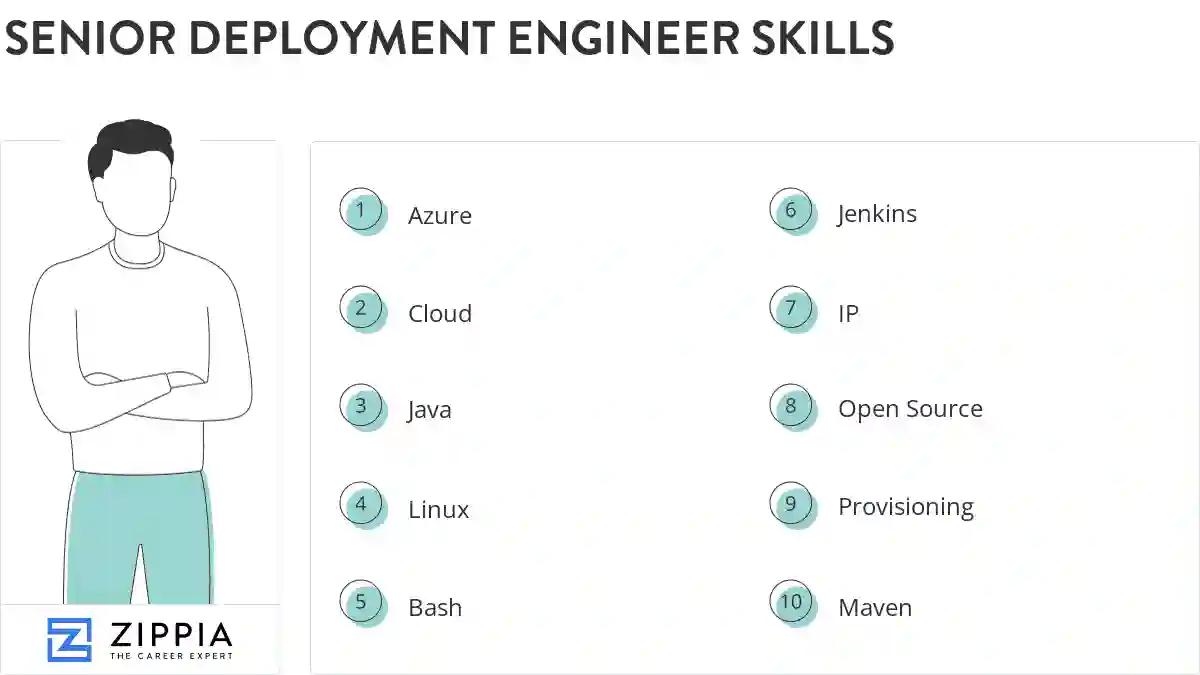
The most important skills for a senior deployment engineer resume and required skills for a senior deployment engineer to have include:
- Azure
- Cloud
- Java
- Linux
- Bash
- Jenkins
- IP
- Open Source
- Provisioning
- Maven
- DNS
- Debugging
- Virtualization
- Tomcat
- Switches
- Artifactory
- SLA
- Windows Server
- ANT
- SCCM
- Windows XP
- Workstations
- RF
- Site Surveys
- Troubleshoot
- SME
- Deployment Process
- QA
- Broadband
- Production Environment
- Network Design
- SharePoint
Updated January 8, 2025
