
Automatically apply for jobs with Zippia
Upload your resume to get started.
Senior instrumentation and control engineer skills for your resume and career
15 senior instrumentation and control engineer skills for your resume and career
1. PLC
- Performed configuration of the Gould-Modicon 984 PLC for the project, and completed the PLC check out.
- Developed low end control system based on Allen-Bradley SLC-500 PLC and Panel View Operator Interface.
2. SCADA
- Demonstrated to SHELL client and Implementation of all Signals in SCADA for Delta System at IFAT along with EMERSON and ABB.
- Developed control philosophy and SCADA architecture for seamless integration of ABB-Bailey Symphony DCS systems at the ends of pipeline.
3. HMI
A human-machine interface is a dashboard or user interface that connects an operator to a device, system, or machine.
- Developed HMI graphics that were implemented by GE.
- Advanced HMI development and programming incorporating ActiveX controls.
4. Control Systems
- Specified, designed, installed and modified process control systems in direct support of commercial manufacturing operations.
- Programmed and configured Honeywell TDC-3000 Distributed Control Systems and various Programmable Logic Controllers.
5. DCS
A DSC, Distributed Control System, is a specially computerized design control system that autonomously coordinates several subsystems located around the entire manufacturing plant or industrial process through a high-speed communication network where top-down coordination and control are utmost for efficiency.
- Developed control strategy, software, and protocols for the validation and commissioning of new DCS system and equipment upgrades.
- Loop drawings, Instrument Network diagrams.DCS check and made trouble shooting of existing faults, SOE, alarms.
6. C Design
- Prepared technical reports related to specific design issues.
- Mentored drafters, Junior I/C Designers and Level III and below engineers.
Choose from 10+ customizable senior instrumentation and control engineer resume templates
Build a professional senior instrumentation and control engineer resume in minutes. Our AI resume writing assistant will guide you through every step of the process, and you can choose from 10+ resume templates to create your senior instrumentation and control engineer resume.7. Engineering Design
Engineering design is defined as the method that engineers use to recognize and solve problems. It is an extensive and flexible approach to problem-solving and provides the necessary information needed regarding every step of the process. An engineering design is a collaborative effort of the team to identify problems underlying a process and find out ways to solve them.
- Provide engineering design and specifications to support procurement and construction activities for projects.
- Perform engineering design evaluations and develop a range of options and recommendations.
8. Architecture
- Develop, review and approve loop wiring diagrams, specialty wiring details, hard wired trip system and network architecture overview.
- Designed system architecture, hardware, and software for $5M monitoring and indication system.
9. Process Control
Process control is a method pertaining to continuous production processes that uses the aid of ICS (Industrial Control Systems) for production. This method enables production to be done with a level of consistency and safety in an economically friendly manner that is impossible to achieve solely through manual control.
- Managed refinery instrumentation and process control system projects.
- Specify, review and approve process control and monitoring instrumentation utilizing the InTools Smart Plant application.
10. Oil Gas
- Project Manager: Oil Gas Measurement System.
11. Factory Acceptance
- Developed, lead and executed Factory Acceptance Tests, IQ, Software IOQ and OQ activities.
- Conducted factory acceptance tests and training on customer's site
12. Cost Estimates
- Collaborate with engineers and sales teams on proposal preparations by providing material take-offs and cost estimates.
- Developed project scope, provided input to project cost estimates and schedules.
13. API
- Involve in FEED for Natural Gas Production of Chevron Project under the requirements of API 14C.
- Maintained required safety training and compliance; specifically from IEC, API, ASTM and NACE.
14. SPI
SPI stands for "serial peripheral interface," which is a communication interface that transfers data between two electronic devices. This allows data to be transferred in both directions between the devices simultaneously, known as "full duplex mode." This mode differs from a "parallel" interface, which requires more complex and longer wiring.
- Assigned to provide tagging system at SPI hard/soft tags based on PID's.
- Supported engineering team for Smart Plant Instrumentation (SPI) to create and update instrument data base and specification sheets.
15. Instrumentation Design
- Perform and lead the performance of electrical and instrumentation design for environmental system projects.
- Worked on all aspects of detailed electrical and instrumentation design.
5 Senior Instrumentation And Control Engineer resume examples
Build a professional senior instrumentation and control engineer resume in minutes. Browse through our resume examples to identify the best way to word your resume. Then choose from 5+ resume templates to create your senior instrumentation and control engineer resume.

What skills help Senior Instrumentation And Control Engineers find jobs?
Tell us what job you are looking for, we’ll show you what skills employers want.
What skills stand out on senior instrumentation and control engineer resumes?
Florian Solzbacher
Department Chair, Professor, Elect & Computer Engineering, University of Utah
Supplemental skills, such as Entrepreneurial or business training, can enhance and differentiate a student's resume. This shows that an engineer is not solely focused on the core technical engineering skills but does have an understanding of the driving forces and their interaction in a real-world business setting, that are not only part of the design requirements for a product (e.g., design to cost), but also often drive the selection of technical solution paths, after all, every development and product has to make business sense. Imagine two young engineers proposing a solution to their manager for a new product: one maybe even over-exceeds the technical requirements, but the development and/or manufacturing and servicing effort and cost is significantly higher than a colleagues solution that may only just about reach the requirements, or maybe even compromise on some specifications, but that is far cheaper to develop, make and service and that may allow entering a far larger market- chances are very high that the business may decide to go for the "inferior" solution from a technical point of view, that is, however, the better product. This supplemental skill set is a significant competitive advantage to have as an engineer.
What senior instrumentation and control engineer skills would you recommend for someone trying to advance their career?
Andre Knoesen Ph.D.
Professor, Electrical and Computer Engineering, University of California, Davis
What type of skills will young senior instrumentation and control engineers need?
Maria Jacob
Professor, University of Central Florida
List of senior instrumentation and control engineer skills to add to your resume
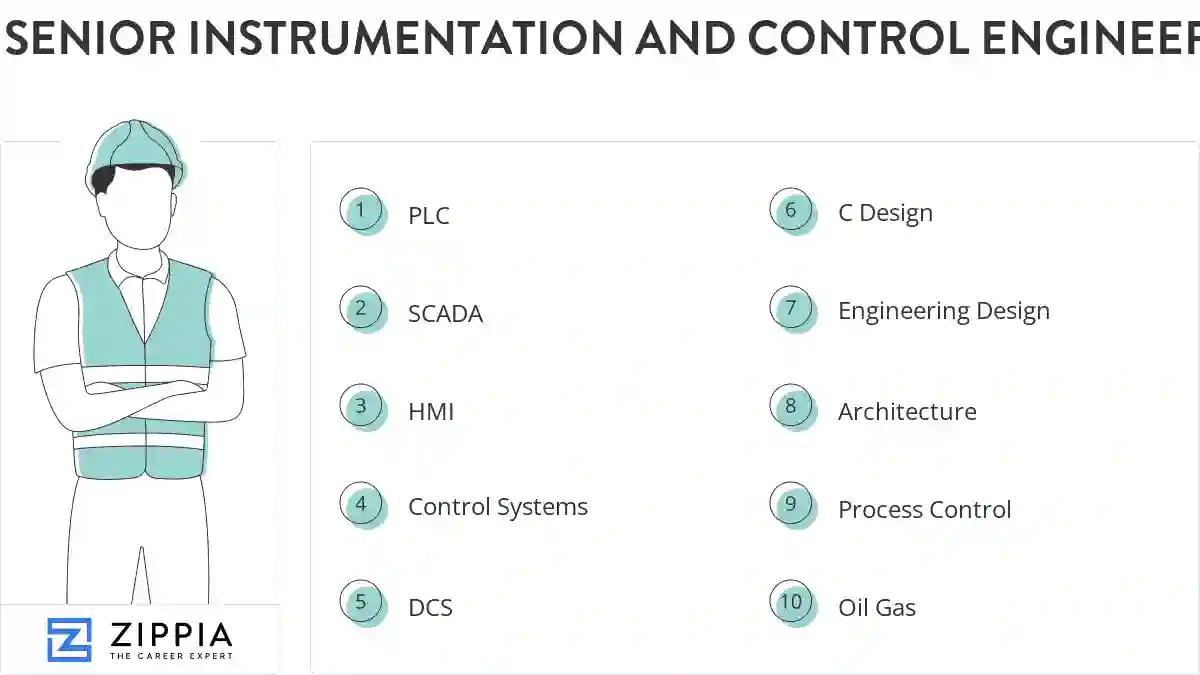
The most important skills for a senior instrumentation and control engineer resume and required skills for a senior instrumentation and control engineer to have include:
- PLC
- SCADA
- HMI
- Control Systems
- DCS
- C Design
- Engineering Design
- Architecture
- Process Control
- Oil Gas
- Factory Acceptance
- Cost Estimates
- API
- SPI
- Instrumentation Design
- Calculation
- Logic Diagrams
- SIS
- IEC
- Vendor Drawings
- C Engineering
- HAZOP
- Control Narratives
- SIL
- Control Valves
- EPC
- I/O List
- PID
- Switches
- NEC
- Safety Analysis
- Instrument Data Sheets
- InTools
- Delta
- MCC
- Continuous Emissions
- Allen-Bradley Plc
- Ethernet
- VFD
- Control Philosophy
- Transmitters
- Control Equipment
- Nuclear Power
- Retrofit
- Analyzers
- Instrument Specifications
Updated January 8, 2025
